The feeling
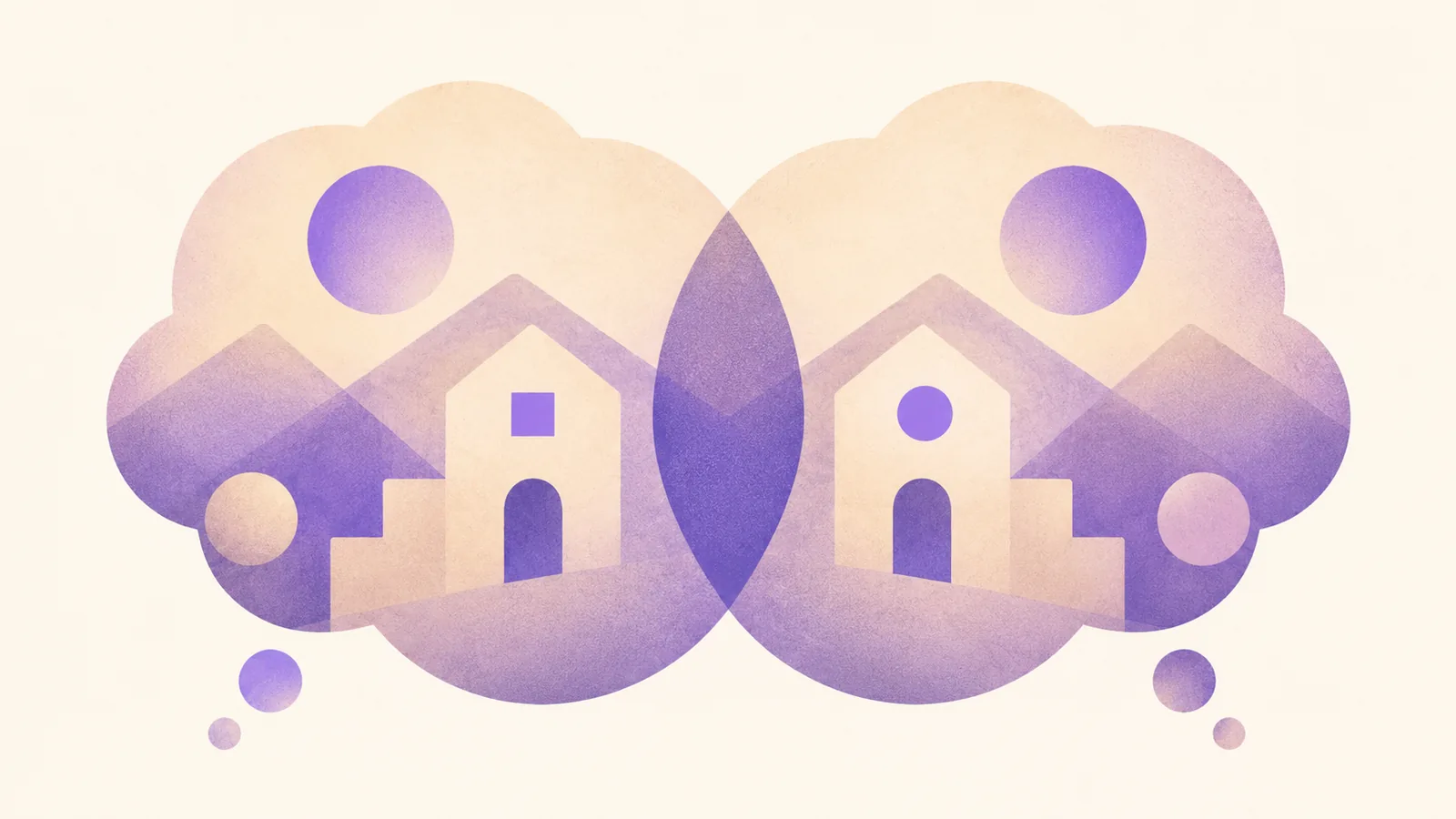
Déjà vu is French for "already seen." It is the sense that a brand new moment has happened before, paired with the certainty that it has not. That combination is what makes it so strange: the familiarity is there, and you know it has no basis.
You walk into a friend's new apartment, a restaurant in a city you are visiting for the first time, or a classroom on the first day, and for a few seconds everything feels like a replay.
Read also: The Mandela Effect: why so many people remember it wrong and Why we don't remember our first years of life.
Who gets it and when
The most cited review on the subject, published in 2003 by psychologist Alan S. Brown in Psychological Bulletin, pulled together more than a century of research. The main findings:
- about 60% of people report having had déjà vu, and other estimates in the same review reach two thirds;
- it becomes less frequent with age;
- it shows up more often with stress and fatigue;
- it is reported more by people with more education and higher income, and by people who travel more;
- places and scenes are the most common trigger.
Source: Brown, A review of the déjà vu experience, Psychological Bulletin, 2003.
Four families of explanation
In the same review, Brown sorted the scientific explanations into four groups:
- Dual processing. Two mental processes that normally run together, like perceiving and recognizing, fall out of sync for an instant.
- Neurological. A brief hiccup in transmission between neurons or a tiny electrical discharge in the brain.
- Memory. Something in the scene really is familiar, but you cannot recall where from, and the familiarity spreads to the whole moment.
- Attention. You glimpse a scene without paying attention, then see it again a split second later with full attention. The second look feels like a repeat.
The look-alike scene experiment
Psychologist Anne Cleary, at Colorado State University, tested the memory explanation in the lab. The idea, known as the gestalt familiarity hypothesis, is that a new place can share the layout of a place you have forgotten: furniture, doors and objects arranged the same way. Your brain recognizes the arrangement but cannot retrieve the memory, and the result is the sense of having been there before.
In later work, Cleary and Alexander Claxton looked at the feeling, common during déjà vu, of knowing what will happen next. Participants reported that feeling, but it did not come with better predictions. The authors called it an illusion of prediction.
When it is just a quirk and when to get it checked
For the vast majority of people, déjà vu is fleeting, lasts a few seconds and signals nothing wrong. The medical literature does note, however, that déjà vu experiences can be a sign of some forms of temporal lobe epilepsy.
Context is what usually sets the cases apart. Episodes that are very frequent, longer than usual, or come with other symptoms, such as an odd rising feeling in the stomach, altered awareness or repetitive movements, are worth bringing up with a doctor.
If you like the tricks memory plays, read about the Mandela Effect and why we don't remember our first years of life.
Source: Illman et al., Déjà experiences in temporal lobe epilepsy, Epilepsy Research and Treatment, 2012.
Sources
- Brown AS. A review of the déjà vu experience. Psychological Bulletin, 2003. https://doi.org/10.1037/0033-2909.129.3.394
- Cleary AM. Recognition memory, familiarity, and déjà vu experiences. Current Directions in Psychological Science, 2008. https://doi.org/10.1111/j.1467-8721.2008.00605.x
- Cleary AM, Claxton AB. Déjà vu: an illusion of prediction. Psychological Science, 2018. https://doi.org/10.1177/0956797617743018
- Illman NA et al. Déjà experiences in temporal lobe epilepsy. Epilepsy Research and Treatment, 2012. https://doi.org/10.1155/2012/539567
Frequently asked questions
Is déjà vu common?
Yes. Alan Brown's review estimates that roughly 60% to two thirds of people have had it.
Can déjà vu predict the future?
No. Cleary and Claxton found that the feeling of knowing what comes next did not come with more accurate predictions.
When should I see a doctor?
When episodes are very frequent, long, or come with other symptoms such as altered awareness or repetitive movements.