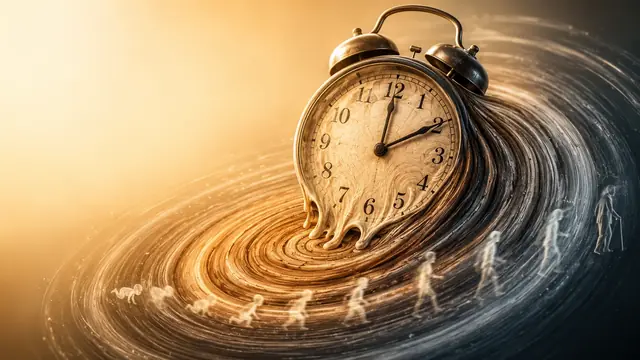
Childhood amnesia
Almost nobody remembers events from before age 3 or 4. Scientists call it childhood amnesia. The strange part is that babies and toddlers learn and remember a lot at the time; the forgetting comes later.
Read also: The Mandela Effect: why so many people remember it wrong and Why déjà vu happens, according to science.
The study that tracked the forgetting
Patricia Bauer and Marina Larkina, at Emory University, recorded 3-year-olds talking with their mothers about recent events, then asked about those events again years later. At ages 5 to 7, the children still remembered much of what happened. By 8 and 9, recall dropped sharply. For the authors, the forgetting of the earliest years happens during childhood itself.
Source: Bauer and Larkina, The onset of childhood amnesia in childhood, Memory, 2014.
The role of the hippocampus
The hippocampus is the brain region essential for storing memories of events. In early life it produces new neurons at a very high rate. A study in Science, in mice, linked that intense production to forgetting: new neurons may rewire circuits and make older memories harder to reach. It was done in animals, and it is not yet known whether the same mechanism explains childhood amnesia in people.
Babies do record memories
In 2025, researchers at Yale University ran functional MRI scans on awake babies from 4 months to 2 years old while they looked at pictures. When the hippocampus was more active on first seeing an image, the baby tended to look longer at it when it appeared again, a sign of recognition. The effect was clearer after about age 1. The finding suggests the problem may be retrieving those memories later, not storing them.
Source: Yates et al., Hippocampal encoding of memories in human infants, Science, 2025.
What about "memories" from when you were a baby?
Very early memories are often rebuilt from photos, home videos and family stories. Talking with children about the past seems to help them form longer-lasting memories. See also the Mandela Effect and false memories.
Sources
- Bauer PJ, Larkina M. The onset of childhood amnesia in childhood. Memory, 2014. https://doi.org/10.1080/09658211.2013.854806
- Akers KG et al. Hippocampal Neurogenesis Regulates Forgetting During Adulthood and Infancy. Science, 2014. https://doi.org/10.1126/science.1248903
- Yates TS et al. Hippocampal encoding of memories in human infants. Science, 2025. https://doi.org/10.1126/science.adt7570
Frequently asked questions
At what age do our first memories start?
Most adults remember little before age 3 or 4, although babies learn and recognize things much earlier.
Do babies form memories?
A 2025 Yale study suggests they do: the hippocampus of babies around 1 year old was already involved in recording what they saw.
Are my earliest memories real?
Some may be, but very early memories are often rebuilt from photos and family stories.
Why do we forget our early childhood?
Leading explanations involve the developing hippocampus and language, and the difficulty of retrieving memories stored before age 3 or 4.