Dreaming that you are incorporating: what it usually indicates
Dream interpretation is not prediction and not diagnosis. This article separates what sleep research observes from what popular interpretation associates with the theme, always saying which is which.
Dreaming that you are incorporating a spirit or an orixá (one of the deities of Candomblé and Umbanda, Afro-Brazilian religions) is not proof of mediumship, is not a punishment and does not mean that something bad has taken hold of you. The dream tends to appear after contact with Umbanda or Candomblé, in phases of curiosity about your own faith, or in periods when you feel "taken over" by something: a strong emotion, work, other people's demands.
One distinction matters. Possession is the name that Christian and popular views usually give to something bad that invades a person against their will. Incorporação (incorporation), for Umbanda and Candomblé, is a ritual religious practice: it happens during a gira (Umbanda ceremony) or a festival, with preparation, under the guidance of the leader of the house, and it is seen as an encounter, not an attack.
Read also: Dreaming about macumba or Umbanda and Dreaming about Zé Pilintra.
How Umbanda and Candomblé understand incorporation
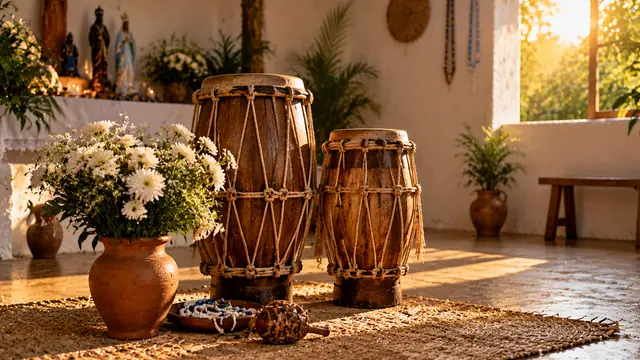
In Umbanda, the medium is sometimes called the cavalo ("horse") or aparelho ("instrument"): it is through the medium that the spirits, called entidades, manifest themselves during the gira to dance, give advice and offer passes (blessings through the laying on of hands). Among them are caboclos (spirits of Indigenous Brazilians), pretos-velhos (spirits of wise elders of African descent), exus, pombas-giras and malandros (streetwise rogue spirits) such as Zé Pilintra.
With the orixás, the custom changes. In many Umbanda houses, orixás such as Iemanjá (linked to the sea) and Xangô are worshipped in other ways, and some people speak of irradiação (radiation) instead of incorporation. In Candomblé, the orixá manifests in initiates during the rite, dances with its emblems and is greeted by the community. In the myths collected by Reginaldo Prandi in Mitologia dos orixás, Xangô is the king linked to thunder and justice, and Iemanjá is the mother linked to the waters. These descriptions belong to belief, not to science.
Source: Prandi, Mitologia dos orixás.
What sleep science observes
The continuity hypothesis, tested by Michael Schredl and Friedrich Hofmann in 2003, explains the simplest part: someone who went to a gira, watched a video or heard a relative describe how they incorporate carries those images into the night. Outside sounds get in too: William Dement and Edward Wolpert showed in 1958 that external stimuli applied during sleep sometimes show up in the plot of the dream. A drum at a street party can become an atabaque.
The feeling of your body moving on its own has to do with the stage of the most vivid dreams, REM sleep. In their review of the biology of REM sleep, John Peever and Patrick Fuller describe how the mechanisms of this stage interfere with sensory and motor functions. Beyond what the review summarizes, a common explanation is that the brain lives the movement from the inside while the body stays still, which can give the impression of being carried along.
In a psychological reading, incorporating can speak of losing control, or of the opposite: the wish to be, for a moment, someone looser or stronger.
Sources: Schredl and Hofmann, Continuity between waking activities and dream activities, Consciousness and Cognition, 2003; Dement and Wolpert, Journal of Experimental Psychology, 1958; Peever and Fuller, The biology of REM sleep, Current Biology, 2017.
See also: Dreaming about a child and Dreaming about a mãe de santo or pai de santo.
Who you incorporated and what it usually goes with
| Scene | What usually goes with it |
|---|---|
| Incorporating Zé Pilintra | A wish for lightness and the ability to wriggle out of things, or guilt for having bent the rules on something |
| Incorporating Iemanjá | A need to care or to be cared for, emotions overflowing |
| Incorporating Xangô | A thirst for justice, a situation in which you need to take a stand |
| Incorporating outside the terreiro, on the street or at work | Fear of losing control in public, an emotion that slipped out |
| Resisting incorporation | Conflict between your family's faith and your own, a wish to keep hold of the reins |
| Seeing another person incorporated speaking to you | Seeking advice, a memory of a gira, trust in someone older |
Each figure has its own reading in dreaming about Iemanjá, dreaming about Xangô, dreaming about a caboclo and dreaming about a pomba-gira.
When the dream calls for attention
Most of the time, the dream passes. See a doctor if you talk loudly, thrash, kick or fall out of bed while you dream: strong movements during REM sleep can be a sign of a sleep disorder, and the same review by Peever and Fuller lists REM sleep behavior disorder among the problems linked to this stage. If you start to fear going to sleep, see how to have fewer nightmares.
If, while awake, you feel that something is controlling your thoughts or you hear voices, see a mental health professional, without having to give up your faith. If you are in intense distress, in the US you can call or text 988 (Suicide & Crisis Lifeline).
Sources: Peever and Fuller, The biology of REM sleep, Current Biology, 2017; Morgenthaler and colleagues, Journal of Clinical Sleep Medicine, 2018.
Incorporation in dreams: Freud, Jung and beliefs
In Freud's psychoanalysis. Freud wrote that, in his experience, "every dream deals with the dreamer himself". When you appear in a dream, another person may be hidden behind you, through identification. Incorporating is the most literal version of this: you become the figure. The Freudian question would be which of its qualities you are borrowing.
In Jung's psychology. Jung saw the gods of myth as expressions of images shared by all of humanity. In a Jungian key, giving a body to Xangô or Iemanjá in a dream may mean making room for an inner force, justice or care, that your routine does not let appear. It is a psychological reading, which does not replace the religious one.
In symbols and faith. In A Dictionary of Symbols, Chevalier and Gheerbrant treat ritual dance as a language of connection with the sacred in many cultures. Experiences of being "taken" exist in several religions: in Pentecostal churches, believers speak of being filled with the Holy Spirit, as in the account of Pentecost (Acts 2). Some churches read Afro-Brazilian incorporation as possession; practitioners see it as an encounter.
Bringing both readings together. Science explains the body that seems to move on its own and the images stored from the gira. Faith asks what force you are meeting.
Sources: Freud, Die Traumdeutung, 1900; Jung (ed.), Man and His Symbols; Chevalier and Gheerbrant, A Dictionary of Symbols.
Incorporation in dream books
O Livro dos Sonhos, a Brazilian dream book by L. P. Baçan, has no entry for incorporation, medium or gira. The closest entries are for elements of the scene: dance, which speaks of changes in life and satisfaction in love, and drum, which speaks of prosperity in life and intrigue in love. It is tradition, not prediction.
Freud preferred another path: instead of a fixed code, he noticed that the same fragment of a dream can hide different meanings for different people and in different contexts.
Sources: L. P. Baçan, O Livro dos Sonhos, 2014; Freud, Die Traumdeutung, 1900.
What folk belief says about this dream
Among umbandistas (followers of Umbanda), dreaming that you are incorporating is often read as mediumship emerging and as an invitation to talk with the leader of a house, without hurry. Incorporating a specific spirit would speak of affinity and protection; resisting, of fear of taking up a path. In some Christian churches, the same dream is seen as a spiritual warning and a call to prayer. These are beliefs of the traditions, not predictions. See what dream meanings look like according to science and culture.
Sources
- Prandi R. Mitologia dos orixás (Mythology of the Orishas). São Paulo: Companhia das Letras, 2001. https://www.companhiadasletras.com.br/livro/9788535900644/mitologia-dos-orixas
- Schredl M, Hofmann F. Continuity between waking activities and dream activities. Consciousness and Cognition, 2003. https://doi.org/10.1016/S1053-8100(02)00072-7
- Dement W, Wolpert EA. The relation of eye movements, body motility, and external stimuli to dream content. Journal of Experimental Psychology, 1958. https://doi.org/10.1037/h0040031
- Peever J, Fuller PM. The Biology of REM Sleep. Current Biology, 2017; 27: R1237-R1248. https://doi.org/10.1016/j.cub.2017.10.026
- Morgenthaler TI et al. Position Paper for the Treatment of Nightmare Disorder in Adults: An American Academy of Sleep Medicine Position Paper. Journal of Clinical Sleep Medicine, 2018. https://doi.org/10.5664/jcsm.7178
- Freud S. The Interpretation of Dreams (Die Traumdeutung), 1900. Project Gutenberg. https://www.gutenberg.org/ebooks/66048
- Jung CG (ed.). Man and His Symbols, 1964. Portuguese edition consulted: O homem e seus símbolos, Nova Fronteira/HarperCollins Brasil. https://www.skoob.com.br/book/8435
- Chevalier J, Gheerbrant A. A Dictionary of Symbols (Dictionnaire des symboles). Portuguese edition consulted: Dicionário de símbolos, José Olympio/Record. https://www.record.com.br/products/dicionario-de-simbolos
- Baçan LP. O Livro dos Sonhos (Brazilian dream book). Self-published, 2014.
Frequently asked questions
Does dreaming that I am incorporating mean I am a medium?
Not necessarily. For research, the dream reflects images and emotions from the day. In Umbanda, mediumship is assessed over time, by spending time with a house, and not because of a single dream.
What is the difference between incorporation and possession?
Possession is the term used in Christian and popular views for something bad that invades a person. Incorporation is a ritual practice of Umbanda and Candomblé, done with preparation and seen by believers as an encounter.
What does it mean to dream that I incorporated Zé Pilintra?
It usually goes with a wish for lightness, for solving things through conversation or for letting loose. In folk belief, it speaks of protection and open paths. It is a reading from tradition, not a prediction.
Why was my body moving on its own in the dream?
During REM sleep, the brain can live the movement while the body stays still. If you really do move a lot or hurt yourself while sleeping, see a doctor.
What is the spiritual meaning of dreaming that you are incorporating?
For many umbandistas, it is a sign of mediumship and protection; for some churches, a warning. It is a faith reading, without proof, and it varies from one tradition to another.