Dreaming about a caboclo: the direct answer
Dream interpretation is not prediction and not diagnosis. This article separates what sleep research observes from what popular interpretation associates with the theme, always saying which is which.
Dreaming about a caboclo is not a sign of a spiritual obligation, of illness or that something is going to happen. In umbanda, a Brazilian religion that blends African, Indigenous, Catholic and Spiritist elements, caboclos are entities that, according to the religion's belief, are spirits of Indigenous Brazilians, linked to the forest, to herbs, to healing and to straightforward advice. They are not orixás, the deities of the Afro-Brazilian religions, although many houses link them to the line of Oxóssi, the hunter orixá. The dream tends to show up in phases of searching for firmness or guidance, or of longing for nature.
A reminder is worthwhile: the umbanda caboclo is a religious figure, not a portrait of Indigenous peoples, who have their own languages, cultures and religions. In everyday Brazilian Portuguese, "caboclo" also names a person of mixed Indigenous and white ancestry, or a man from the countryside. If the scene had a terreiro, an Afro-Brazilian house of worship, read dreaming about macumba or umbanda.
Read also: Dreaming about Oxóssi and Dreaming about a preto-velho.
Why the caboclo appears in the dream
The continuity hypothesis (Schredl and Hofmann, 2003) says that dreams follow what occupies waking life. A caboclo gira (the umbanda ceremony with chants and dancing), a festival in July, a sacred chant, a blessing with leaves in childhood or a trip to the countryside leave images ready for the night. Phases of illness or fatigue also bring up the figure of the one who, in the tradition, heals with herbs.
The body and the bedroom take part. Dement and Wolpert showed that outside stimuli, such as water sprayed on the skin, appear in the plot of the dream. Rain beating on the window can become the wet forest; the smell of incense, the smoke of a ritual smoke cleansing.
Sources: Schredl and Hofmann, Continuity between waking activities and dream activities, Consciousness and Cognition, 2003; Dement and Wolpert, Journal of Experimental Psychology, 1958.
The caboclo in psychoanalysis, in Jung and in faith
In Freud's psychoanalysis. Freud described the composite figure: the dream combines traits of several people into one. The caboclo of the night may have the quiet manner of a grandfather from the countryside, the hand of a benzedeira you know (a folk healer who blesses with prayers and herbs) and the voice of a firm teacher. His method was to separate these traits and ask whom each one came from.
In Jung's psychology. In Man and His Symbols, Jung laments that modern people have lost contact with nature and with their own instinct, and he sees in dreams an attempt to compensate for that loss. In the Jungian key, a figure from the forest who speaks little and gets right to the point can represent this simpler knowledge, which city routine muffles.
In symbols and faith. In umbanda, caboclos are remembered for their firmness, their knowledge of leaves and the frankness of their advice, and they are usually greeted with joy at giras. In A Dictionary of Symbols, Chevalier and Gheerbrant treat the forest, in many cultures, as a natural sanctuary and a place of trial. In other religions, the same figure is read differently, and each reading deserves respect.
Bringing both readings together. Science shows where the scene comes from: a memory, fatigue, rain outside. Faith, for those who have it, asks what the caboclo came to say. The two can walk side by side.
Sources: Freud, Die Traumdeutung, 1900; Jung (ed.), Man and His Symbols; Chevalier and Gheerbrant, A Dictionary of Symbols.
Scenes that appear in dreams about a caboclo
| Scene | What usually goes with it |
|---|---|
| A caboclo giving advice | A pending decision, a wish to hear someone firm and direct |
| A caboclo in the forest, among the trees | Weariness with the city, a longing for nature and silence |
| A caboclo blessing you with leaves | A period of illness or of worry about health, a search for relief |
| A caboclo with bow and arrow | Focus on a goal, a reminder of the link with Oxóssi |
| A serious or stern caboclo | Inner pressure, a sense of being off your own path |
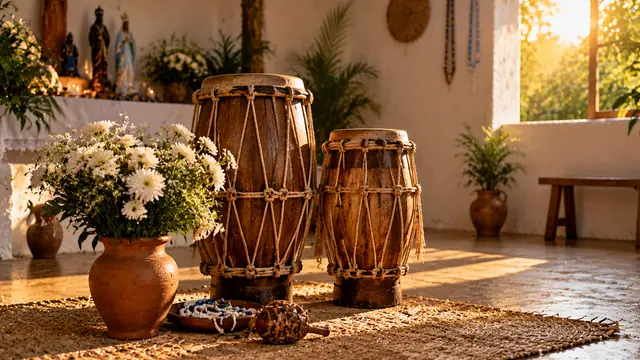
| A caboclo gira with chants and atabaque drums | Memories of a terreiro, of a celebration, a bond with your family of faith |
If the forest was the center of the dream, read dreaming about a forest and dreaming about a tree.
See also: Dreaming about Ogum and Dreaming about the Buddha.
When a dream about a caboclo calls for attention
Most of the time, this dream is peaceful. If the caboclo appears blessing you and you have symptoms that worry you, see a doctor: faith does not replace treatment, and treatment does not erase faith. If the dream becomes a recurring nightmare, with fear of sleeping or frights several times a week, talk to a health professional. See how to have fewer nightmares.
Source: Morgenthaler and colleagues, Journal of Clinical Sleep Medicine, 2018.
The caboclo in dream books
O Livro dos Sonhos, a Brazilian dream book by L. P. Baçan, has no entry for caboclo or for the entities of umbanda. The closest is forest: in life, worries; in love, desire. It is an association from folk tradition, far removed from the religious meaning the figure has for people who attend a terreiro.
Man and His Symbols explains why these lists fail: for the book, dreams are individual phenomena, and their symbols cannot be catalogued. The caboclo of someone who has been a medium for twenty years does not weigh the same as the caboclo of someone who has only heard of him.
Sources: L. P. Baçan, O Livro dos Sonhos, 2014; Jung (ed.), Man and His Symbols.
The folk reading of dreaming about a caboclo
Among practitioners and sympathizers, dreaming about a smiling caboclo is usually read as a sign of protection and of open roads; a caboclo blessing you, as care for your health; a stern caboclo, as an invitation to rethink your attitudes. The green of the leaves appears as a sign of healing, and several caboclos together, as gathered strength. People who want to go deeper usually talk to their own religious leadership. These are readings from the tradition, not predictions. See what dream meanings look like according to science and culture.
Sources
- Schredl M, Hofmann F. Continuity between waking activities and dream activities. Consciousness and Cognition, 2003. https://doi.org/10.1016/S1053-8100(02)00072-7
- Dement W, Wolpert EA. The relation of eye movements, body motility, and external stimuli to dream content. Journal of Experimental Psychology, 1958. https://doi.org/10.1037/h0048908
- Freud S. The Interpretation of Dreams (Die Traumdeutung), 1900. Project Gutenberg. https://www.gutenberg.org/ebooks/66048
- Jung CG (ed.). Man and His Symbols, 1964. Portuguese edition consulted: O homem e seus símbolos, Nova Fronteira/HarperCollins Brasil. https://www.skoob.com.br/book/8435
- Chevalier J, Gheerbrant A. A Dictionary of Symbols (Dictionnaire des symboles). Portuguese edition consulted: Dicionário de símbolos, José Olympio/Record. https://www.record.com.br/products/dicionario-de-simbolos
- Morgenthaler TI et al. Position Paper for the Treatment of Nightmare Disorder in Adults: An American Academy of Sleep Medicine Position Paper. Journal of Clinical Sleep Medicine, 2018. https://doi.org/10.5664/jcsm.7178
- Baçan LP. O Livro dos Sonhos (Brazilian dream book). Self-published, 2014.
Frequently asked questions
Is dreaming about a caboclo good or bad?
Neither, on its own. In umbanda, many people read the dream as protection and advice. For research, it usually reflects recent memories and worries. It is not a prediction.
Is a caboclo an orixá?
No. Caboclos are entities of umbanda, and orixás are deities. Many houses link caboclos to the line of Oxóssi, the hunter orixá, which is why the figures blend together in dreams.
What does it mean to dream about a caboclo blessing you?
The scene usually accompanies phases of fatigue, illness or worry, and the wish for relief. In folk reading, it is a sign of care. If you have symptoms, seek medical advice.
Why did I dream about a caboclo if I do not follow umbanda?
Festivals, the folk healers of childhood, trips to the countryside and images from social media feed dreams. You do not need to be religious to dream about a spirit entity.
What is the spiritual meaning of dreaming about a caboclo?
For many followers, it is a sign of protection, of healing and of advice worth listening to. It is a reading of faith, without proof, and it varies from house to house.