Dreaming about a mãe de santo or pai de santo: the direct answer
Dream interpretation is not prediction and not diagnosis. This article separates what sleep research observes from what popular interpretation associates with the theme, always saying which is which.
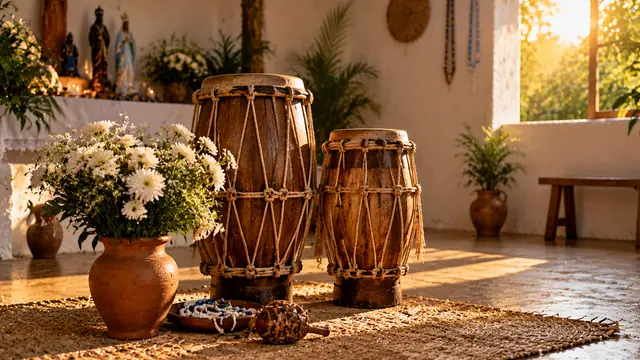
Dreaming about a mãe de santo (priestess of Candomblé or Umbanda) or a pai de santo (priest of those same traditions) is not a sign of a spiritual debt, of a curse someone "made" against you or that something bad is about to happen. The dream tends to show up in phases when you are looking for guidance: a hard decision, a loss, a question of faith, the wish to hear from someone older and more experienced. For people who attend a terreiro (the house of worship of these Afro-Brazilian religions), it is also a memory of the house.
In Candomblé, the ialorixá (mãe de santo) and the babalorixá (pai de santo) are the religious leaders of a house: they initiate its members, look after the rites and counsel the community. In Umbanda, the role also exists, sometimes under other names, such as dirigente (leader) or zelador (caretaker). Titles and customs vary from house to house, and this article treats the subject as a belief of these traditions, with the scientific reading alongside.
Read also: Dreaming about macumba or Umbanda and Dreaming that you are incorporating a spirit.
Why this figure appears in the dream
The continuity hypothesis, tested by Michael Schredl and Friedrich Hofmann in 2003, says that dreams reuse what occupied waking life. A recent consultation, an initiated aunt who talks about her house, the festival of Iemanjá (the sea goddess, one of the orixás, the deities of Candomblé and Umbanda) on the news, a TV series or a Brazilian soap opera with terreiro scenes: any of these images can come back at night with a face and a voice.
There is also the figure itself. A mãe de santo or pai de santo brings together three roles that dreams like to use: authority, care and advice. That is why they appear on nights of doubt, just as a grandmother or a priest appears for other people. There is no specific scientific study on dreams about Afro-Brazilian religious leaders; the general rule of continuity applies.
Scenes with a mãe de santo or pai de santo
| Scene | What usually goes with it |
|---|---|
| A mãe de santo casting cowrie shells for you | Seeking guidance, a pending decision, the wish to hear from an outsider |
| A pai de santo giving advice or scolding you | A guilty conscience, advice you already received and have not followed yet |
| Receiving a blessing, a passe (laying on of hands) or a leaf bath | Tiredness, a need for care, a wish to start over |
| Being called to join the house | Belonging, doubt about your own faith, a commitment you are thinking of taking on |
| A mãe de santo who has already died | Missing someone, grief, the memory of the person who looked after the family or the community |
| Arguing with the leader or running away from the terreiro | Conflict with some authority, fear, prejudice learned in childhood |
If the dream featured a spirit giving advice, read dreaming about a preto-velho (the spirit of a wise elder of African descent, revered in Umbanda); if everyone was dressed in white, dreaming about Oxalá (the orixá associated with creation and peace); if someone in red and black stood at the gate, dreaming about Exu (the messenger orixá who guards paths and crossroads). And if the mãe de santo in the dream was your grandmother or your mother, see dreaming about your late mother.
See also: Dreaming about your boyfriend cheating and Dreaming about a child.
Cowrie shells in a dream: tradition, science and caution
In Candomblé, the jogo de búzios (cowrie-shell divination) is a religious practice led by the head of the house. The shells fall open or closed, and within the tradition the reading is used to learn which orixá rules the person, what offering to make or which path to follow. For believers, it is a dialogue with the sacred. For science, there is no evidence that the shells, or a dream about them, predict events.
The feeling that "the dream warned me" has a well-known explanation: in a classic study, Baruch Fischhoff showed that knowing the outcome changes the way we judge what came before. Once something happens, the old dream looks like a clear warning. More on this in I dreamed it and it happened: why it feels like a premonition.
A word of caution: serious leaders, of any religion, do not use fear to charge people. If someone tells you that the dream demands an expensive and urgent ritual, take your time. If the dream keeps coming back as a nightmare and robs you of sleep, see a health professional; read how to have fewer nightmares. If you are in intense distress, in the US you can call or text 988 (Suicide & Crisis Lifeline).
Sources: Fischhoff, Hindsight is not equal to foresight, 1975 (reprinted 2003); Morgenthaler and colleagues, Journal of Clinical Sleep Medicine, 2018.
Freud, Jung and faith on the mãe de santo
In Freud's psychoanalysis. When discussing the ancient dream interpreters, Freud singles out Artemidorus of Daldis, who took the dreamer's life into account: the same element had one meaning for a rich man and another for a poor one, one for a married man and another for a single one. A good consultation also begins by asking who the person is. Freud went further: the meaning would lie in the dreamer's own memories.
In Jung's psychology. Jung described images that repeat across very different cultures, such as the mother who embraces and the wise old man who gives counsel. In a Jungian key, the mãe de santo or pai de santo in the dream may give a face to that wisdom you are seeking, the part of you that knows what needs to be done. It is a psychological reading, which lives alongside the religious one without replacing it.
In symbols and faith. In A Dictionary of Symbols, Chevalier and Gheerbrant link the shell to water and fertility. The cowrie, for that matter, once circulated as currency in parts of Africa. In the mythology of the orixás collected by Reginaldo Prandi in Mitologia dos orixás, Orunmilá is the orixá linked to divination, and Exu is the messenger who carries words back and forth between people and the sacred: this is the universe the shells belong to. In Brazil, ialorixás such as Mãe Menininha do Gantois, in Salvador, became known far beyond the terreiros.
Bringing both readings together. Science explains how the memory of a consultation or a conversation becomes a scene. Faith, for those who have it, asks what guidance you are looking for.
Sources: Freud, Die Traumdeutung, 1900; Jung (ed.), Man and His Symbols; Chevalier and Gheerbrant, A Dictionary of Symbols; Prandi, Mitologia dos orixás.
The mãe de santo and pai de santo in dream books
O Livro dos Sonhos, a Brazilian dream book by L. P. Baçan, has no entry for mãe de santo, pai de santo, ialorixá or cowrie shells. The closest is priest, a generic figure from European tradition, which the book links to difficulties in life and danger in love. The entry for mother is kinder: change in life and closeness in love. Neither of them describes the religions of African origin.
Jung was wary of these catalogues: in Man and His Symbols, the same image changes meaning depending on the dreamer's life.
Sources: L. P. Baçan, O Livro dos Sonhos, 2014; Jung (ed.), Man and His Symbols.
What folk belief says about this dream
Among practitioners, dreaming about the mãe de santo of your own house is often read as a call to visit her or to take care of a forgotten commitment. Shells falling open would speak of paths revealing themselves; the blessing, of protection; the scolding, of a reminder to keep your word; a leader who has died, of ancestors watching over the family. Each terreiro has its own foundations. These are readings from the tradition, not predictions. See what dream meanings look like according to science and culture.
Sources
- Schredl M, Hofmann F. Continuity between waking activities and dream activities. Consciousness and Cognition, 2003. https://doi.org/10.1016/S1053-8100(02)00072-7
- Fischhoff B. Hindsight ≠ foresight: the effect of outcome knowledge on judgment under uncertainty. Journal of Experimental Psychology: Human Perception and Performance, 1975. Reprinted in Quality and Safety in Health Care, 2003; 12: 304-311. https://doi.org/10.1136/qhc.12.4.304
- Morgenthaler TI et al. Position Paper for the Treatment of Nightmare Disorder in Adults: An American Academy of Sleep Medicine Position Paper. Journal of Clinical Sleep Medicine, 2018. https://doi.org/10.5664/jcsm.7178
- Freud S. The Interpretation of Dreams (Die Traumdeutung), 1900. Project Gutenberg. https://www.gutenberg.org/ebooks/66048
- Jung CG (ed.). Man and His Symbols, 1964. Portuguese edition consulted: O homem e seus símbolos, Nova Fronteira/HarperCollins Brasil. https://www.skoob.com.br/book/8435
- Chevalier J, Gheerbrant A. A Dictionary of Symbols (Dictionnaire des symboles). Portuguese edition consulted: Dicionário de símbolos, José Olympio/Record. https://www.record.com.br/products/dicionario-de-simbolos
- Prandi R. Mitologia dos orixás (Mythology of the Orishas). São Paulo: Companhia das Letras, 2001. https://www.companhiadasletras.com.br/livro/9788535900644/mitologia-dos-orixas
- Baçan LP. O Livro dos Sonhos (Brazilian dream book). Self-published, 2014.
Frequently asked questions
Does dreaming about a mãe de santo mean I need to be initiated?
For research, the dream reflects the memories, doubts and searches of the moment. Within the tradition itself, a decision like that (known as fazer o santo, being initiated) is not made because of a dream: it is discussed with the leader of the house, over time.
What does it mean to dream about cowrie-shell divination?
It usually goes with a search for guidance or a pending decision. In the tradition, the shells are a religious practice of consultation; for science, neither the shells nor the dream predict the future.
I dreamed about a pai de santo and I do not belong to the religion. Why?
Soap operas, the news, a conversation with a relative or simple curiosity are enough. You do not need to follow a religion to dream about the figures of a tradition that is part of Brazilian culture.
What does it mean to dream about a mãe de santo who has died?
Often it is longing and grief, especially if she was important to you or to your family. Among practitioners, it is read as protection from the ancestors. If the loss weighs too much, talking to someone helps.
What is the spiritual meaning of dreaming about a mãe de santo or pai de santo?
For many believers, it is a sign of support and a call to care for their faith and commitments. It is a faith reading, without proof, and it varies from house to house.