Dreaming about Exu: what it usually points to and what it does not
Dream interpretation is not prediction and not diagnosis. This article separates what sleep research observes from what popular interpretation associates with the theme, always saying which is which.
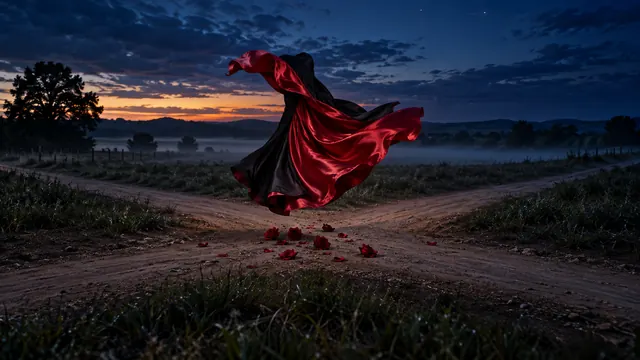
Dreaming about Exu is not a sign of a curse, of a spell cast against you or that something bad is about to happen. In candomblé, an Afro-Brazilian religion rooted in the Yoruba traditions of West Africa, Exu (Eshu in Yoruba) is the messenger orixá. Orixás, or orishas, are the deities of candomblé, and Exu is the one who carries messages back and forth between people and the sacred and who guards roads and crossroads. In umbanda, a Brazilian religion that blends African, Indigenous, Catholic and Spiritist elements, the name also refers to spirit entities that many followers see as guardians. The dream tends to show up in times of choice or of a change of direction.
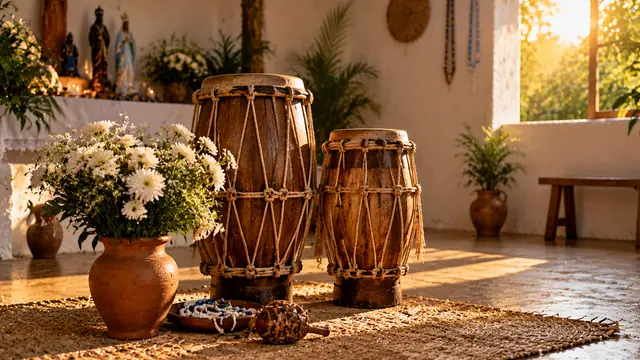
The dream also does not mean that you are "possessed", that you owe something to someone or that Exu is the devil. That last idea does not come from the Yoruba tradition or from the Afro-Brazilian religions: it is the product of a historical prejudice, explained further down. If the scene had a terreiro (an Afro-Brazilian house of worship), a gira (an umbanda ceremony with chants and dancing) or atabaque drums, it is also worth reading about dreaming about macumba or umbanda.
Read also: Dreaming about Pomba Gira and Dreaming about Zé Pilintra.
Why Exu shows up in the dream
The continuity hypothesis, tested by Michael Schredl and Friedrich Hofmann in 2003, says that what fills waking life tends to come back at night. Exu is present in many corners of Brazilian culture: the sacred chants known as pontos, terreiro celebrations, samba lyrics, the stories of a relative who attends umbanda.
He also arrives by the road of fear: people who grew up hearing that Exu is "something evil" tend to dream about him on anxious nights. Tore Nielsen and colleagues found that being chased is among the most commonly reported typical dreams. When the figure runs after you, the scene says more about the fear of the moment than about the entity. See also dreaming that you are being chased.
Sources: Schredl and Hofmann, Continuity between waking activities and dream activities, Consciousness and Cognition, 2003; Nielsen and colleagues, Dreaming, 2003.
Common scenes in dreams about Exu
| Scene | What usually goes with it |
|---|---|
| Exu standing at a crossroads | A decision between two paths, a change of phase, doubt about which way to go |
| Exu laughing or playing a joke | A sense that something got out of control, or a wish for lightness in the face of a serious problem |
| Talking to Exu or receiving a message | A need to be heard, a pending conversation in waking life |
| Exu chasing you | Fear, anxiety, images of prejudice stored since childhood |
| Exu at a gira, near Pomba Gira | Memories of a terreiro, of a celebration or of a video seen recently |
| Exu opening a door or a gate | Expectation of an opportunity, a phase of beginnings |
Pomba Gira, who often appears beside him, is a female entity of umbanda linked to the same line as the Exus. If the door or the gate was the center of the scene, also read dreaming about a door.
See also: Dreaming about Oxum and Dreaming about your ex coming back.
When the fear in this dream calls for help
If the dream repeats in a threatening tone, if you wake up in panic several times a week or start to be afraid of going to sleep, talk to a health professional: frequent nightmares can be treated, and seeking help does not lessen anyone's faith. Insults suffered because of your religion also deserve support. If you are in intense distress, in the US you can call or text 988 (Suicide & Crisis Lifeline). See how to have fewer nightmares.
Source: Morgenthaler and colleagues, Journal of Clinical Sleep Medicine, 2018.
Exu between psychoanalysis, Jung and faith
In Freud's psychoanalysis. Freud recalls that the peoples of antiquity took dreams as revelations from gods and demons. His method swaps the question "who visited me?" for another one: what does each detail remind me of? The crossroads, the clothes and the words spoken can lead to very concrete matters from the day.
In Jung's psychology. In Man and His Symbols, Joseph Henderson describes the Trickster, the clever and playful character of myths, and scholars of comparative religion often bring Exu close to this figure because of his humor and cunning. In the Jungian key, whoever shuffles the rules in a dream can represent the part of you that questions what has become too rigid, a psychological reading that does not replace the religious one.
In symbols and faith. According to the orixá myths collected by Reginaldo Prandi in Mitologia dos orixás, Exu is the messenger, the one who carries the offerings and guards the roads. In terreiros, he is usually the first to be greeted. The identification with the devil came from another story: missionaries and authorities in colonial times read, through Christian eyes, a deity who does not fit the pair of good and evil, and the prejudice grew with the persecution of religions of African origin. In A Dictionary of Symbols, Chevalier and Gheerbrant treat the crossroads as a place of encounter and of choice in many cultures.
Bringing both readings together. Science shows where the scene comes from; faith, for those who have it, asks what to do with it. Separating the religious figure from the image of the devil is the first step for the two to talk to each other.
Sources: Freud, Die Traumdeutung, 1900; Jung (ed.), Man and His Symbols; Chevalier and Gheerbrant, A Dictionary of Symbols; Prandi, Mitologia dos orixás.
Exu in dream books
O Livro dos Sonhos, a Brazilian dream book by L. P. Baçan, has no entry for Exu. The book does have an entry for the devil, but using it here would repeat the very confusion this article tries to undo. The entry closest to Exu's role in the tradition is road: in life, happiness; in love, joys. That is folk tradition, not prediction.
Freud called this way of reading "decoding": each image turns into another word, as in a code, with no guarantee that the key is right.
Sources: Freud, Die Traumdeutung, 1900; L. P. Baçan, O Livro dos Sonhos, 2014.
What folk tradition says about dreaming of Exu
Among practitioners and sympathizers, a calm or smiling Exu is usually read as a sign of open roads and protection; an Exu who demands something, as a reminder to honor your word and your commitments; the crossroads, as the time to choose. In umbanda, red and black are colors linked to him. Each house has its own reading, and people seeking religious guidance usually turn to their own spiritual leadership. These are readings from the tradition, not predictions. See what dream meanings look like according to science and culture.
Sources
- Schredl M, Hofmann F. Continuity between waking activities and dream activities. Consciousness and Cognition, 2003. https://doi.org/10.1016/S1053-8100(02)00072-7
- Nielsen TA et al. The typical dreams of Canadian university students. Dreaming, 2003. https://doi.org/10.1023/b:drem.0000003144.40929.0b
- Morgenthaler TI et al. Position Paper for the Treatment of Nightmare Disorder in Adults: An American Academy of Sleep Medicine Position Paper. Journal of Clinical Sleep Medicine, 2018. https://doi.org/10.5664/jcsm.7178
- Freud S. The Interpretation of Dreams (Die Traumdeutung), 1900. Project Gutenberg. https://www.gutenberg.org/ebooks/66048
- Jung CG (ed.). Man and His Symbols, 1964. Portuguese edition consulted: O homem e seus símbolos, Nova Fronteira/HarperCollins Brasil. https://www.skoob.com.br/book/8435
- Chevalier J, Gheerbrant A. A Dictionary of Symbols (Dictionnaire des symboles). Portuguese edition consulted: Dicionário de símbolos, José Olympio/Record. https://www.record.com.br/products/dicionario-de-simbolos
- Prandi R. Mitologia dos orixás (Mythology of the Orishas). São Paulo: Companhia das Letras, 2001. https://www.companhiadasletras.com.br/livro/9788535900644/mitologia-dos-orixas
- Baçan LP. O Livro dos Sonhos (Brazilian dream book). Self-published, 2014.
Frequently asked questions
Is dreaming about Exu a bad thing?
No. In the tradition, Exu is the messenger and the guardian of roads. For research, the dream usually reflects recent memories, choices and fears. It is neither punishment nor prediction.
Is Exu the devil?
No. The association with the Christian devil is the product of historical prejudice, from people who looked at religions of African origin through the lens of another faith. In candomblé and umbanda, Exu does not represent evil.
What does it mean to dream about Exu at a crossroads?
The crossroads is his place in the tradition and, in a dream, it usually goes with decisions between two paths. In folk reading, it is a sign that the time to choose has come. It is interpretation, not a warning.
I dreamed about Exu and I do not follow umbanda or candomblé. Why?
Songs, TV dramas, social media and childhood fears feed dreams. You do not need to be religious to dream about an orixá or a spirit entity.
What is the spiritual meaning of dreaming about Exu?
For many followers, it is a sign of protection and of an open road. It is a reading of faith, without proof, and it varies from house to house.