The short answer
Dream interpretation is not prediction and not diagnosis. This article separates what sleep research observes from what popular interpretation associates with the theme.
Dreaming about snails or slugs is not a sign that your life is stalling, that you are sick or that someone wishes you harm. The scene usually shows up when something seems to move far too slowly, or the opposite: during hectic stretches when your body is asking for calm. Slugs, with no shell, tend to come with discomfort and disgust; a snail tucked into its shell, with a wish to protect yourself.
Read also: Dreaming about turtles and Dreams about being late or failing a test.
What sleep research has observed
Research on continuity between waking life and dreams, reviewed by Michael Schredl in 2003, shows that dreams pick up what we have seen and felt. A vegetable garden full of slugs, snails on a wall after the rain or a complaint about a process that never moves forward can all become scenes at night.
The feeling of slowness also has well-known relatives. In a 2003 survey of college students by Tore Nielsen and colleagues, being late was among the typical dream themes. When the dreamer moves like a snail and never gets anywhere, the scene usually reflects rushing and pressure, not a warning about the future.
Sources: Schredl and Hofmann, Continuity between waking activities and dream activities, Consciousness and Cognition, 2003; Nielsen et al., The Typical Dreams of Canadian University Students, Dreaming, 2003.
Common variations of dreaming about snails or slugs
| Scene | What it usually comes with |
|---|---|
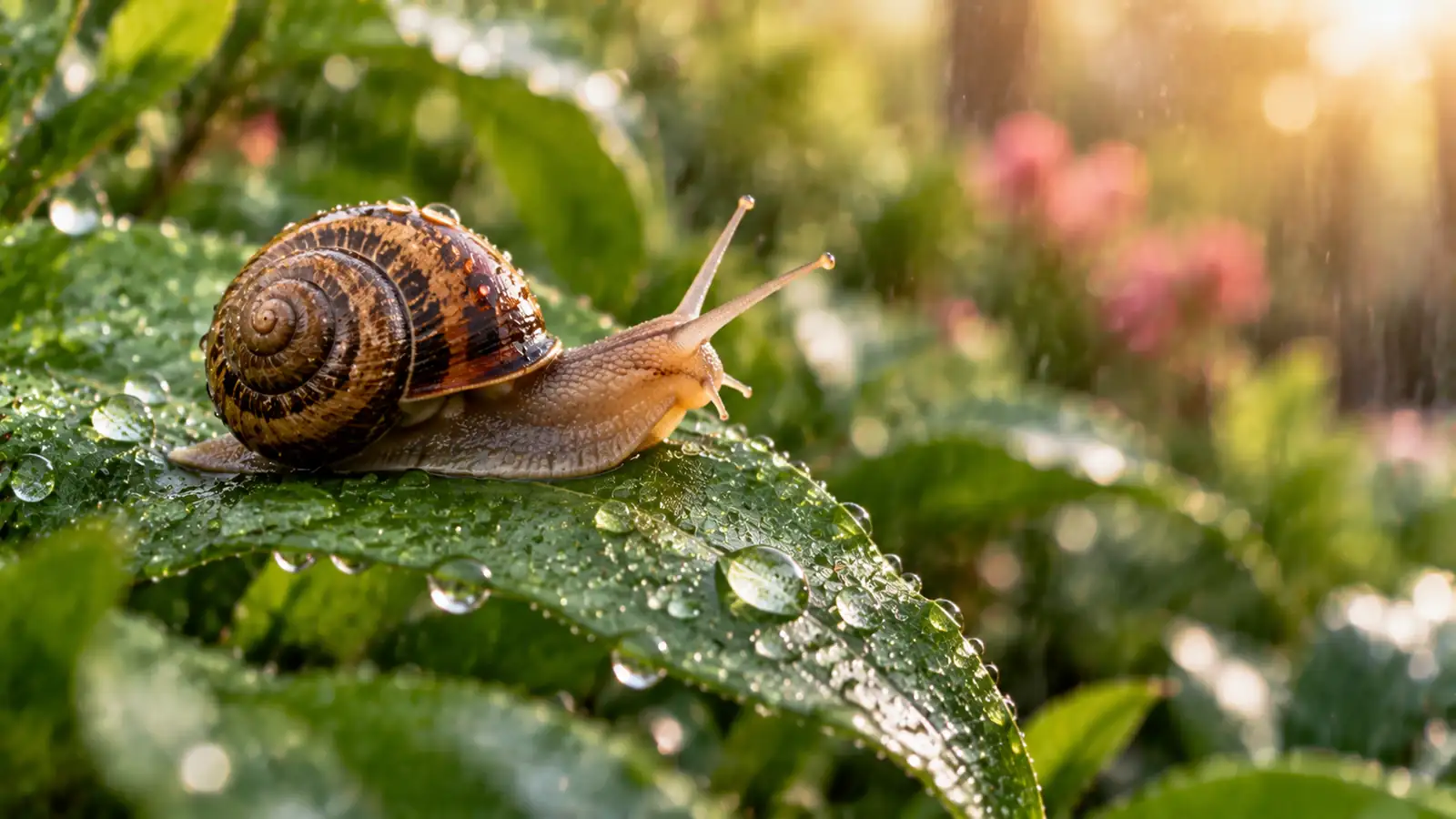
| A snail slowly climbing a leaf or wall | Patience, a sense that things are taking too long |
| A slug on your body or in your food | Disgust, discomfort with something that invaded your space |
| A snail hiding inside its shell | Wish to withdraw, need for protection |
| Lots of slugs in the house or garden | Small problems that seem to pile up |
| Moving as slowly as a snail yourself | Fear of being late, feeling stuck in place |
If the scene took place in a garden or vegetable patch, you may also want to read dreaming about crops or a vegetable garden.
When the dream deserves professional attention
Snail dreams are rarely a cause for concern. If scenes of disgust, invasion or being unable to move come back several times a week and leave you tired or afraid to sleep, see a health professional: frequent nightmares are treatable. Read how to reduce nightmares.
Source: Morgenthaler et al., Journal of Clinical Sleep Medicine, 2018.
What dream dictionaries record
Popular dream dictionaries tend to link the snail to patience and delay, and the slug to small annoyances, always with a ready translation for each image.
Freud described this way of reading dreams as a decoding method, in which every dreamed object has a fixed meaning, the same for everyone, like a key to a cipher. He considered it inadequate: what matters is what that image stirs up in the person who dreamed it. To a farmer, a slug is a pest; to a child, it's a pet in a glass jar.
Source: Freud, Die Traumdeutung, 1900.
Dreaming about snails or slugs according to Freud, Jung and faith
In Freud's psychoanalysis. Freud did not read a dream all at once. He broke it into parts and asked what came to mind about each one, the method of free association, whose development is studied in a dissertation by Juliana David Jorge (PUC Minas, 2007). In a snail dream, the shell, the shiny trail and the slowness can lead to very different memories, often tied to impressions from the day before.
In Jung's psychology. For Jung, the general function of dreams is to restore our psychological balance. Read this way, dreaming of such a slow creature during a hectic phase may work as compensation. Man and His Symbols also describes psychic growth as an ascending spiral that rises while returning to the same point, and shows a spiral mandala a woman painted after a dream.
In symbols and faith. In A Dictionary of Symbols, Chevalier and Gheerbrant write that the helical shape of a snail's shell, on land or at sea, is a universal glyph of time, of the permanence of being through change. Among the Lulua and Luba peoples of the Congo, the spiraled snail shell goes into medicines with a double use, beneficial and harmful. In the Bible, Psalm 58:8 uses the image of a slug that melts away.
Bringing both views together. Science explains the snail through memory and haste; traditions see in it time that passes without undoing who we are. Noticing whether the dream felt calm or distressing already says a lot.
Sources: Freud, Die Traumdeutung, 1900; Jorge, PUC Minas, 2007; Jung (ed.), Man and His Symbols; Chevalier and Gheerbrant, A Dictionary of Symbols.
What folk tradition links to this dream
In popular readings, the snail often stands for patience, persistence and protecting one's home, since it carries its house on its back. The slug shows up more as a sign of annoyances, clingy people or something that drags on. These are cultural interpretations, good for reflection, not predictions. See what science and culture say about dreams.
Sources
- Schredl M, Hofmann F. Continuity between waking activities and dream activities. Consciousness and Cognition, 2003. https://doi.org/10.1016/S1053-8100(02)00072-7
- Morgenthaler TI et al. Position Paper for the Treatment of Nightmare Disorder in Adults: An American Academy of Sleep Medicine Position Paper. Journal of Clinical Sleep Medicine, 2018. https://doi.org/10.5664/jcsm.7178
- Nielsen TA et al. The Typical Dreams of Canadian University Students. Dreaming, 2003. https://doi.org/10.1023/b:drem.0000003144.40929.0b
- Freud S. The Interpretation of Dreams (Die Traumdeutung), 1900. Project Gutenberg. https://www.gutenberg.org/ebooks/66048
- Jorge JD. A construção da associação livre na obra de Freud (The construction of free association in Freud's work). Master's thesis in Psychology, Pontifical Catholic University of Minas Gerais, Brazil, 2007.
- Jung CG (ed.). Man and His Symbols, 1964. Portuguese edition consulted: O homem e seus símbolos, Nova Fronteira/HarperCollins Brasil. https://www.skoob.com.br/book/8435
- Chevalier J, Gheerbrant A. A Dictionary of Symbols (Dictionnaire des symboles). Portuguese edition consulted: Dicionário de símbolos, José Olympio/Record. https://www.record.com.br/products/dicionario-de-simbolos
Frequently asked questions
Does dreaming about a snail mean my life is stalling?
No. Some folk readings link snails to delay, but that is tradition, not prediction. Research suggests the dream usually reflects the slowness or rush you are living through right now.
What does it mean to dream about a slug on your body?
The scene usually comes with disgust and a sense of invasion, as if something unpleasant were too close. It does not point to illness. If it repeats and disrupts your sleep, talk to a health professional.
What's the difference between dreaming of a snail and a slug?
The snail, with its shell, is usually tied to protection and patience; the slug, without one, to discomfort and disgust. What matters most is the emotion the scene brought.
What is the spiritual meaning of dreaming about snails?
According to A Dictionary of Symbols, the snail's spiral shell represents time and the permanence of being through change. The Bible mentions the slug, or snail, in Psalm 58. These are readings for reflection, not predictions.