What this dream usually points to (and what it doesn't)
Dream interpretation is not prediction and not diagnosis. This article separates what sleep research observes from what popular interpretation associates with the theme.
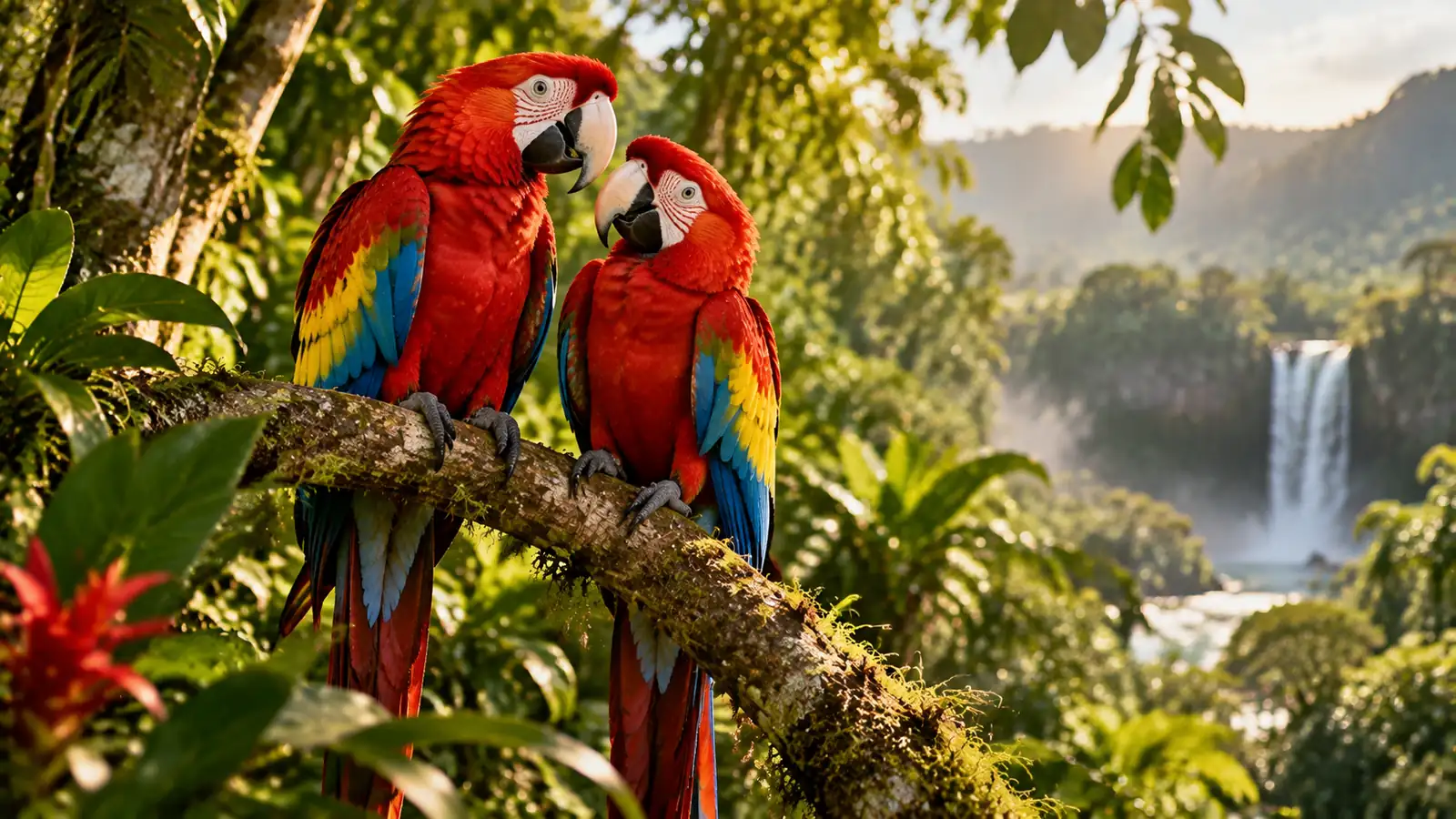
Dreaming about a macaw does not announce news, a visitor or gossip. From what research observes, the bird tends to show up tied to recent images (a trip, a documentary, a bird in the neighborhood) and to the emotions of the moment: wonder and lightness when it flies free, a tight feeling when it is caged, agitation when it won't stop squawking.
Read also: Dreaming about parrots and Dreaming about birds.
What sleep science observes about dreaming about macaws
Research on the continuity between waking and dreaming, reviewed by Michael Schredl in 2003, shows that dreams tend to reflect what we live through while awake: places, images and emotions. Someone who visited a tropical park, saw macaws at a zoo or scrolled through travel photos has plenty of material for this scene.
Sound can get in too. In 1958, William Dement and Edward Wolpert showed that outside stimuli, such as sounds, can be woven into a dream. Where macaws and parrots fly over squawking at dawn, or when an alarm goes off loudly, the real noise may grow red feathers in the night's story.
Sources: Schredl and Hofmann, Continuity between waking activities and dream activities, Consciousness and Cognition, 2003; Dement and Wolpert, Journal of Experimental Psychology, 1958.
The most common versions of this dream
| Scene | What it usually comes with |
|---|---|
| A colorful macaw flying free | Admiration, lightness, a wish for freedom |
| A macaw squawking loudly, nonstop | Agitation, something asking for attention, sometimes a real sound in the room |
| A macaw locked in a cage | A sense of being limited, a voice or talent held back |
| A macaw landing on your shoulder or hand | Closeness, delight, a feeling of being chosen |
| An injured, sick or dead macaw | Sadness, worry about something fragile |
In Indigenous myths, the macaw often appears paired with another forest animal; see also dreaming about a jaguar.
If the dream keeps coming back: when to seek help
A macaw dream is almost never a reason for concern. If it turns into a recurring nightmare (birds attacking, frightening screeches) and you wake up with a racing heart several times a week, talk to a health professional: frequent nightmares are treatable. See how to have fewer nightmares.
Source: Morgenthaler et al., Journal of Clinical Sleep Medicine, 2018.
Science and belief: Freud, Jung and faith traditions
In Freud's psychoanalysis. The first chapter of The Interpretation of Dreams gathers accounts of noises that slip into dreams and change shape, like an alarm clock that turns into church bells. A real, shrill cry can become a macaw. Freud also noted that dreams use leftovers from the previous day, even trivial details, such as a feather print on a shirt or a video glimpsed in passing.
In Jung's psychology. In Man and His Symbols, birds appear as symbols of spiritual aspiration and transcendence. The book also mentions certain South American peoples who say they are red macaws, even though they know they have no feathers or beaks. Jung calls this psychic identity, or "mystical participation": a bond between person and animal that the modern world set aside, but that dreams sometimes rekindle.
In symbols and faith. In A Dictionary of Symbols, Chevalier and Gheerbrant explain that among the Maya the macaw's long red feathers made it a symbol of fire and solar energy, and that at Copán (Honduras) macaw statues marked astronomical positions. The Bororo of Brazil believe souls, in their cycle, take on the form of a macaw. In myths about the origin of fire, it stands opposite the jaguar. In the Bible, Matthew 6:26 invites us to "behold the fowls of the air."
Bringing both views together. Science explains where the color and the noise come from. Traditions recall that for many peoples the macaw is sun, fire and soul. Both can sit side by side, along with a simple question: what in your day is asking for a voice, or for room to fly?
Sources: Freud, Die Traumdeutung, 1900; Jung (ed.), Man and His Symbols; Chevalier and Gheerbrant, A Dictionary of Symbols.
Dreaming about macaws in dream books
Popular dream books tend to give each bird a fixed meaning, like a list of words and definitions. Man and His Symbols, the book Jung edited, is wary of that approach: in its view, dreams are entirely individual events, and their symbols cannot be cataloged.
In practice, the same macaw can be the memory of a happy trip for one person and the neighbor's noisy bird for another. If you are curious about birds that talk, not just the colorful ones that fly, see also dreaming about parrots.
Source: Jung (ed.), Man and His Symbols.
Popular beliefs about this dream
In folk readings, the macaw often stands for joy, communication, beauty and freedom. A macaw in flight is read as a sign of good times; a caged one, as a lack of freedom; a squawking one, as a nudge to pay attention to what people around you are saying. These are cultural readings, good for reflection, not predictions. See what dreams mean according to science and culture.
Sources
- Schredl M, Hofmann F. Continuity between waking activities and dream activities. Consciousness and Cognition, 2003. https://doi.org/10.1016/S1053-8100(02)00072-7
- Morgenthaler TI et al. Position Paper for the Treatment of Nightmare Disorder in Adults: An American Academy of Sleep Medicine Position Paper. Journal of Clinical Sleep Medicine, 2018. https://doi.org/10.5664/jcsm.7178
- Dement W, Wolpert EA. The relation of eye movements, body motility, and external stimuli to dream content. Journal of Experimental Psychology, 1958. https://doi.org/10.1037/h0048908
- Freud S. The Interpretation of Dreams (Die Traumdeutung), 1900. Project Gutenberg. https://www.gutenberg.org/ebooks/66048
- Jung CG (ed.). Man and His Symbols, 1964. Portuguese edition consulted: O homem e seus símbolos, Nova Fronteira/HarperCollins Brasil. https://www.skoob.com.br/book/8435
- Chevalier J, Gheerbrant A. A Dictionary of Symbols (Dictionnaire des symboles). Portuguese edition consulted: Dicionário de símbolos, José Olympio/Record. https://www.record.com.br/products/dicionario-de-simbolos
Frequently asked questions
Is dreaming about a macaw a good sign?
The scene usually comes with wonder and lightness, and folk readings link the bird to joy and freedom. But that is tradition, not prediction. Research suggests the dream reflects the images and emotions of the moment.
What does it mean to dream about a caged macaw?
It often comes with a sense of being limited or of something held back, like an idea or a wish kept to yourself. It does not predict loss or trouble.
Why did I dream about a squawking macaw?
Real sounds can enter dreams, as Dement and Wolpert showed in 1958. An alarm, a bird outside or another sharp noise can become the macaw's cry.
What is the spiritual meaning of dreaming about a macaw?
It depends on the tradition. According to A Dictionary of Symbols, the Maya saw the macaw as a symbol of sun and fire, and the Bororo link it to the cycle of souls. These are readings for reflection, not predictions.