The short answer
Dream interpretation is not prediction and not diagnosis. This article separates what sleep research observes from what popular interpretation associates with the theme.
Dreaming about dancing does not announce a wedding, a party or a new romance. Most of the time the scene follows what you are going through: a wish to celebrate, to get closer to someone, to feel lighter, or the fear of being watched and getting it wrong. The mood of the dream (pleasure, shyness, fatigue) tells you far more than the dancing itself.
Read also: Dreaming about a party and Dreaming about a wedding.
Why dancing shows up in your dreams
Research on the continuity between waking life and dreams, reviewed by Michael Schredl in 2003, shows that dreams tend to follow what fills our days: activities, people and worries. A recent wedding, a dance class, a song stuck in your head or a video watched before bed is natural raw material for a ballroom at night. Emotions count as much as events: a happy stretch can turn into a party, and a time of feeling exposed can turn into a dance floor where everyone stares.
If you are learning a routine, there is an interesting finding. In a 2010 study, Erin Wamsley and colleagues saw that people who dreamed about a newly learned task (a virtual maze) did better when they tried it again after a nap. Dreaming about dance steps may partly be the brain going over what you practiced.
Sources: Schredl and Hofmann, Continuity between waking activities and dream activities, Consciousness and Cognition, 2003; Wamsley and colleagues, Current Biology, 2010.
Scenes that show up most in this dream
| Scene | What it usually comes with |
|---|---|
| Slow dancing cheek to cheek | A wish for closeness, tenderness, being in tune with someone |
| Not knowing the steps while everyone else dances | Fear of failing in public, feeling out of step with the group |
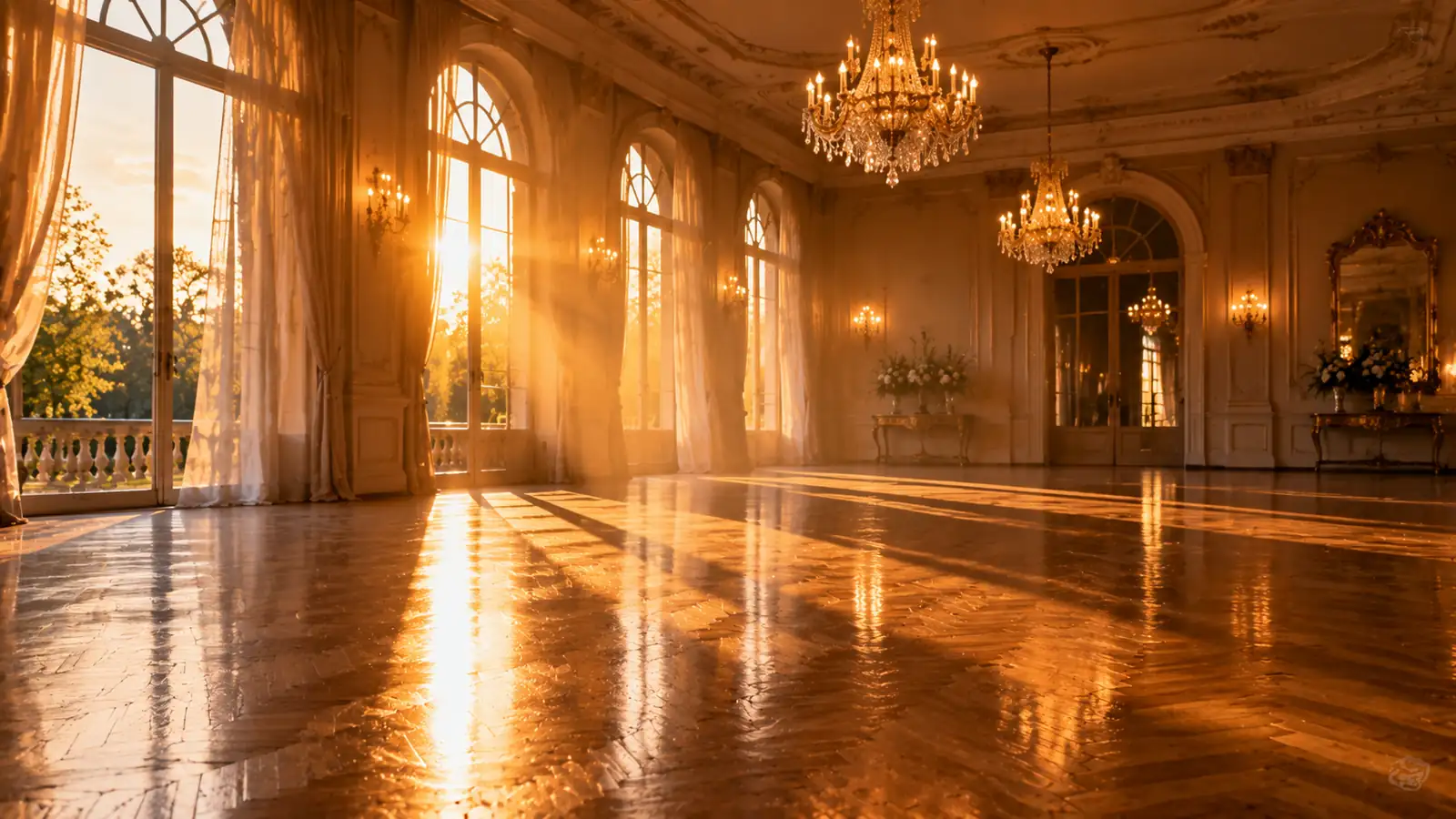
| A formal ball, elegant clothes and a glittering hall | Anticipation of an event, wanting to be seen, a sense of celebration |
| Dancing alone, freely, with nobody watching | Relief, freedom, a wish to express yourself without judgment |
| Being pulled onto the floor against your will | Social pressure, trouble saying no, discomfort with others' expectations |
If the dance was part of a bigger celebration, you may also like dreaming about a party.
If the dream keeps coming back: when to seek help
Dreaming about dancing is rarely a reason for concern. If the scene often turns into a nightmare (falling on stage, being booed, being unable to stop dancing) and you wake up distressed or start dreading sleep, talk to a health professional: recurring nightmares can be treated. See how to have fewer nightmares.
Source: Morgenthaler et al., Journal of Clinical Sleep Medicine, 2018.
Freud, Jung and faith on this dream
In Freud's psychoanalysis. For Freud, a dream is the disguised fulfillment of a wish. Dancing with someone you barely greet in waking life, or spinning across a hall that never existed, may be the dream's way of making room for a desire you keep to yourself. His method was to split the dream into parts (the partner, the music, the hall, the onlookers) and see what each one brings to mind.
In Jung's psychology. Man and His Symbols reminds us that dance is as old as ritual. In the Tuc d'Audubert cave, researcher Herbert Kühn found heel prints around figures of animals: Ice Age dancers seem to have moved like bison, in a dance for the fertility of the hunt. Read through a Jungian lens, dancing in a dream can be seen as contact with an instinctive, collective layer that the body expresses before words do.
In symbols and faith. In A Dictionary of Symbols, Chevalier and Gheerbrant call dance a language beyond words: where words are no longer enough, people dance. They mention the whirling dervishes, whose order was founded by the poet Rumi, and the cosmic dance of Shiva Nataraja in India, which joins creation and destruction. The Bible dances too: Miriam takes up her tambourine (Exodus 15:20), David dances before the Lord (2 Samuel 6:14) and Ecclesiastes 3 says there is a time to dance.
Bringing both views together. Science explains where the hall and the music come from: memory and the emotions of the day. Traditions ask something else: what wants to be celebrated, or released? Noticing whether you danced with joy or felt stiff is a good starting point for both.
Sources: Freud, Die Traumdeutung, 1900; Jung (ed.), Man and His Symbols; Chevalier and Gheerbrant, A Dictionary of Symbols.
What dream books say
The Brazilian dream book O Livro dos Sonhos, by L. P. Baçan, treats the two images separately. Dancing is linked to changes in life and satisfaction in love; a ball, to a good situation in life and happiness in love. Both readings are upbeat, treating movement as a sign of something new arriving.
Man and His Symbols, the book Jung put together, pushes back on lists like this: dreams are completely individual phenomena, and their symbols cannot be cataloged. A dream dictionary works better as a question than as a verdict.
Sources: Jung (ed.), Man and His Symbols; L. P. Baçan, O Livro dos Sonhos, 2014.
Popular beliefs about this dream
In popular interpretation, dreaming that you dance is often read as a sign of joy and harmony; dancing with a partner, as a good moment in your relationships; stumbling or dancing badly, as insecurity about something new. A lavish ball is often tied to recognition. These are cultural readings, good for reflection, not predictions. See dream meanings through science and culture.
Sources
- Schredl M, Hofmann F. Continuity between waking activities and dream activities. Consciousness and Cognition, 2003. https://doi.org/10.1016/S1053-8100(02)00072-7
- Morgenthaler TI et al. Position Paper for the Treatment of Nightmare Disorder in Adults: An American Academy of Sleep Medicine Position Paper. Journal of Clinical Sleep Medicine, 2018. https://doi.org/10.5664/jcsm.7178
- Wamsley EJ et al. Dreaming of a Learning Task Is Associated with Enhanced Sleep-Dependent Memory Consolidation. Current Biology, 2010. https://doi.org/10.1016/j.cub.2010.03.027
- Freud S. The Interpretation of Dreams (Die Traumdeutung), 1900. Project Gutenberg. https://www.gutenberg.org/ebooks/66048
- Jung CG (ed.). Man and His Symbols, 1964. Portuguese edition consulted: O homem e seus símbolos, Nova Fronteira/HarperCollins Brasil. https://www.skoob.com.br/book/8435
- Chevalier J, Gheerbrant A. A Dictionary of Symbols (Dictionnaire des symboles). Portuguese edition consulted: Dicionário de símbolos, José Olympio/Record. https://www.record.com.br/products/dicionario-de-simbolos
- Baçan LP. O Livro dos Sonhos (Brazilian dream book). Self-published, 2014.
Frequently asked questions
Is dreaming about dancing a good sign?
In folklore it is often linked to joy and harmony, but that is tradition, not prediction. Research suggests the dream follows what you live and feel, and the mood of the scene (pleasure or embarrassment) says more than the dancing itself.
What does it mean to dream about dancing with someone?
It often reflects a wish for closeness or harmony with that person, or with what they stand for. It does not mean romance is on the way. Sometimes the partner is just someone you saw recently, an echo of the day.
Why did I dream I couldn't dance while everyone watched?
It is a variation of exposure dreams, common when you feel evaluated. The scene blends the fear of making a mistake with the feeling of being out of step with the group.
What is the spiritual meaning of dreaming about dancing?
Many traditions see dance as prayer and celebration. In the Bible, David dances before the Lord (2 Samuel 6:14); for the dervishes, whirling is devotion. These are readings to reflect on, not predictions.


