Seeing a shadow figure in a dream: what is usually behind it
Dream interpretation is not prediction and not diagnosis. This article separates what sleep research observes from what popular interpretation associates with the theme, always saying which is which.
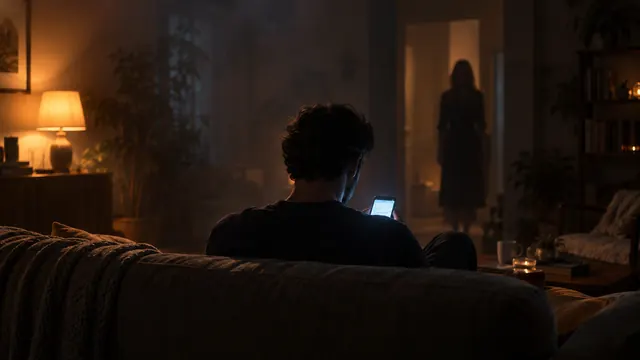
Dreaming about a shadow figure, or seeing a dark shape pass through the bedroom as you fall asleep or wake up, does not prove a spiritual presence, nor does it announce death or danger. Most of the time, the scene happens in a border zone: the brain has already started dreaming, or has not stopped yet, while the eyes are open or nearly so. That is why the figure seems so real.
It helps to tell the figures apart. A shadow usually stands still, watching; a ghost has a face, a voice or a story; the shadow figure is movement, something that crosses the corner of your eye and vanishes when you look straight at it. If it came with a locked body and a feeling of pressure on the chest or of shortness of breath, the most likely explanation is an episode of sleep paralysis.
Read also: Dreaming about sleep paralysis and Night terrors: what they are.
What happens in the brain when the shadow figure appears
In the passage between wakefulness and sleep, many healthy people have what are called hypnagogic hallucinations, which come on while falling asleep, and hypnopompic hallucinations, which come on while waking up: images, voices, footsteps or the feeling that someone is in the room. They are more common after poorly slept nights, with irregular schedules and in stressful phases.
Many of these experiences are tied to REM sleep, the phase of the most vivid dreams, in which the body stays still while the brain dreams. The 2017 review by John Peever and Patrick Fuller sums up what is known about the brain circuits that control REM sleep, about how these mechanisms influence sensorimotor function and about how failures in them lie behind disorders such as narcolepsy and REM sleep behavior disorder. Beyond what the review summarizes, the most accepted explanation is that pieces of that state mix with wakefulness, and a person can see a dream figure with open eyes.
Vision helps explain it too. The edge of the visual field picks up movement well and detail poorly, and in the dark the brain fills the gaps with what it expects to see: a coat on the door becomes someone, a car's headlights on the curtain become a figure crossing the wall.
Source: Peever and Fuller, The biology of REM sleep, Current Biology, 2017.
When the shadow figure calls for a doctor's visit
A shadow figure now and then, as you fall asleep or wake up, is part of the normal workings of sleep. See a doctor, ideally someone who treats sleep problems, if the episodes become frequent; if they come with strong daytime sleepiness, naps you cannot resist or sudden weakness in your legs when you laugh or feel strong emotion; if you thrash or shout in your sleep; or if they started after a new medication, alcohol or other substances.
Seeing shadow figures during the day, fully awake, also deserves a medical evaluation. Little dots or specks floating in your vision are common, but if they suddenly appear in large numbers, with flashes of light or a shadow like a curtain covering part of your vision, see an eye doctor the same day or seek urgent medical care. Frequent nightmares have treatment: see how to have fewer nightmares. If the fear becomes too heavy to carry, reach out for help: in the US, you can call or text 988 (Suicide & Crisis Lifeline).
Source: Morgenthaler and colleagues, Journal of Clinical Sleep Medicine, 2018.
A shadow figure passing, standing still or in the room: the most common scenes
| Scene | What usually goes with it |
|---|---|
| A dark figure passing the bedroom door | Falling asleep or waking up, accumulated tiredness, a silent house |
| A figure standing at the foot of the bed | A sense of presence typical of waking up in the middle of REM sleep, sometimes with a locked body |
| A figure in the corner of your eye that vanishes when you look | Peripheral vision filling in the dark, alertness on tense nights |
| A figure that looks like someone you know | Longing, unfinished business with that person, recent grief |
| A figure running after you | A classic chase theme, the anxiety of the moment |
| A white or pale figure | A calmer strangeness, sometimes felt as a presence that soothes |
If the figure resembled someone who has died, read dreaming about someone who has died and grief dreams. If it was chasing you, see dreaming that you are being chased.
See also: Dreaming that you can't scream and Do animals dream? What science already knows.
Shadow figures, science and belief: Freud, Jung and faith
In Freud's psychoanalysis. In the first chapter of The Interpretation of Dreams, Freud gathers Alfred Maury's observations on hypnagogic hallucinations: sharp, shifting images that appear while falling asleep and may last a little after you open your eyes. Maury said he had been pestered by grotesque figures with twisted features as he drifted off, and afterward remembered dreaming about them. Freud also cites George Trumbull Ladd, for whom the dreams that come right after falling asleep in a dark room use the specks of light of the retina itself as an outline.
In Jung's psychology. In Man and His Symbols, Jung points out that the psyche is not a single block: parts of it can act on their own, and traditional peoples described this as "loss of soul." In a Jungian key, the figure that escapes your gaze may stand for something of yours that has not yet been acknowledged, such as a fear, a grief or a tiredness you do not admit.
In symbols and faith. In Spiritism (the Kardecist doctrine, widespread in Brazil), The Spirits' Book by Allan Kardec teaches that during sleep the ties between spirit and body loosen and that the spirit can relate to others; many Spiritists read shadow figures in this key, and their centers usually recommend prayer and support. In the Bible, the confusion appears too: in Matthew 14, the disciples see Jesus walking on the sea before dawn and cry out, "It is a spirit"; in Luke 24, they suppose they have seen a spirit. In these accounts, the fright comes before the recognition.
Bringing both readings together. Science explains the mechanism; faith, for those who have it, offers comfort in the seconds of fear, as prayer does. One does not need to silence the other, as long as belief does not keep you from seeking help when the episodes keep coming back.
Sources: Freud, Die Traumdeutung, 1900; Jung (ed.), Man and His Symbols; Kardec, The Spirits' Book.
The shadow figure in dream books
O Livro dos Sonhos, a Brazilian dream book by L. P. Baçan, has no entry for a shadow figure. The closest is the one for an apparition, which tradition reads like this: in life, resentment; in love, disagreements. It is a reading that speaks of strained relationships, not of hauntings.
Freud called this kind of translation the decoding method: each image turns into another through a fixed key, written by someone who does not know the dreamer. A figure that appears after three poorly slept nights and another that appears in the week of a funeral call for different questions.
Sources: L. P. Baçan, O Livro dos Sonhos, 2014; Freud, Die Traumdeutung, 1900.
What folk belief says about seeing a shadow figure
In Brazilian folk belief, a dark figure is usually read as heavy energy, an encosto (a spirit believed to cling to a person) or envy, and many families respond with prayer, holy water, smudging with herbs or herbal baths, according to the faith of each household. A white figure would be a guardian angel or a visit from someone who has passed; a figure passing quickly, news on the way; the figure of someone living, a sign that the person is thinking of you. When a shadow figure coincides with sad news, the feeling of a warning is strong, but memory tends to adjust itself after the fact, as explained in I dreamed it and it happened. These are readings from tradition, not predictions. See what dream meanings look like according to science and culture.
Sources
- Peever J, Fuller PM. The Biology of REM Sleep. Current Biology, 2017; 27: R1237-R1248. https://doi.org/10.1016/j.cub.2017.10.026
- Morgenthaler TI et al. Position Paper for the Treatment of Nightmare Disorder in Adults: An American Academy of Sleep Medicine Position Paper. Journal of Clinical Sleep Medicine, 2018. https://doi.org/10.5664/jcsm.7178
- Freud S. The Interpretation of Dreams (Die Traumdeutung), 1900. Project Gutenberg. https://www.gutenberg.org/ebooks/66048
- Jung CG (ed.). Man and His Symbols, 1964. Portuguese edition consulted: O homem e seus símbolos, Nova Fronteira/HarperCollins Brasil. https://www.skoob.com.br/book/8435
- Kardec A. O livro dos espíritos (1857), questions 400 to 418: O sono e os sonhos. Kardecpedia. https://kardecpedia.com/roteiro-de-estudos/2/o-livro-dos-espiritos/718/livro-segundo-mundo-espirita-ou-mundo-dos-espiritos/capitulo-viii-emancipacao-da-alma/o-sono-e-os-sonhos/400
- Baçan LP. O Livro dos Sonhos (Brazilian dream book). Self-published, 2014.
Frequently asked questions
Is it normal to see a shadow figure when falling asleep or waking up?
Yes. Images, sounds and a sense of presence in the passage between sleep and wakefulness are common in healthy people, especially after poorly slept nights. If they become frequent, see a doctor.
Is seeing a dark figure in the bedroom something spiritual?
Many traditions read it that way, and each person lives their faith in their own way. Science explains most cases by REM sleep mixing with wakefulness and by how vision works in the dark.
What is the difference between seeing a shadow figure and having sleep paralysis?
In sleep paralysis, the person wakes up unable to move, and the figure or presence usually comes with it. The figure can also appear without paralysis, while falling asleep, as a hypnagogic hallucination.
When is seeing shadow figures a reason to see a doctor?
When the episodes are frequent, come with strong daytime sleepiness, sudden weakness when laughing or feeling emotion, or appear when you are fully awake. Specks in your vision with flashes of light call for an eye doctor the same day.
What is the spiritual meaning of dreaming about a shadow figure?
In Spiritism, sleep loosens the ties between spirit and body, and some read the figure as spiritual contact; in folk belief, a white figure is protection and a dark one, heavy energy. These are readings of faith, with no scientific proof.