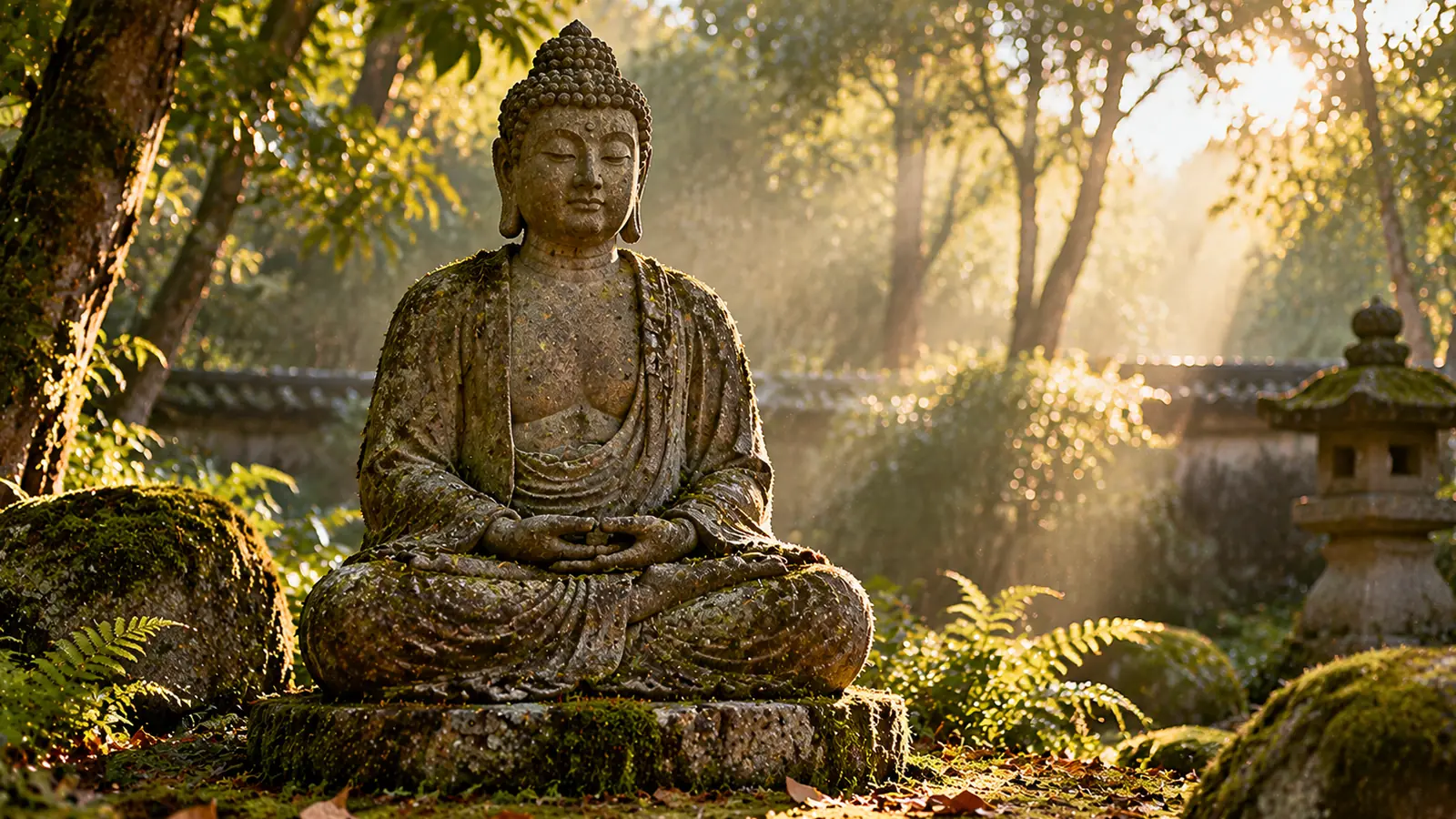
Dreaming about the Buddha: the short answer
Dream interpretation is not prediction and not diagnosis. This article separates what sleep research observes from what popular interpretation associates with the theme, always saying which is which.
Dreaming about the Buddha is not a guaranteed sign of luck, nor a mandatory call to change religion. The image tends to appear in phases with too much noise, inside or outside: anxiety, too many tasks, a wish to stop. It also shows up after a yoga class or after being given a statue as a gift.
It helps to separate two figures. The historical Buddha is Siddhartha Gautama, who lived in northern India around the 5th century BCE; "Buddha" means "the awakened one". The laughing Buddha with a big belly, common in home decor shops, is another figure: Budai, a monk from the Chinese tradition associated with abundance and contentment. Many people dream of the second one thinking it is the first.
Read also: Dreaming about a lotus flower and Dreaming about God.
Why the Buddha shows up in the dream
The continuity hypothesis, tested by Michael Schredl and Friedrich Hofmann in 2003, holds that dreams follow what occupies waking life. The Buddha arrives by many paths: the statue at a Japanese restaurant, a documentary about Tibet, a visit to a temple such as Zu Lai, in Cotia, in the state of São Paulo, or to the home of a Japanese Brazilian relative with a Buddhist altar, a presence that reached Brazil with Japanese immigration.
The emotions of the day count too. Someone tired of constant demands may dream of the figure that, for most people, sums up the idea of serenity.
How the Buddha usually appears in the dream
| Scene | What usually goes with it |
|---|---|
| The Buddha seated in meditation, hands in the lap | A wish for calm, fatigue from too many stimuli, a desire to put your head in order |
| The Buddha lying on his side | In Buddhist art, it recalls the Buddha's final passing; in the dream, rest or the end of a cycle |
| The smiling Buddha with a big belly | A wish for lightness and abundance, the memory of a home ornament or a gift |
| A broken or fallen Buddha statue | Fear of losing a hard-won peace, disappointment with a practice or with someone |
| A Buddhist monk or a temple | A search for guidance, a wish to step away from the rush |
| Meditating beside the Buddha | A phase of withdrawal and reflection |
If the dream also featured a religious image from another tradition, read dreaming about a statue of a saint. If the scene was high up, among clouds and rocks, see dreaming about a mountain.
See also: Dreaming about your husband cheating and Dreaming about macumba or umbanda.
When the dream about the Buddha deserves attention
This dream is rarely a cause for concern. It deserves attention when it comes with very restless nights, insomnia or anguish that does not go away, as if the search for calm in the dream were a call for help. In those cases, a health professional can help. People who practice intense meditation and start sleeping badly or feeling discomfort should also talk to their instructor and to a professional. See how to have fewer nightmares.
Source: Morgenthaler and colleagues, Journal of Clinical Sleep Medicine, 2018.
The Buddha in dream books
O Livro dos Sonhos, a Brazilian dream book by L. P. Baçan, has no entry for the Buddha. The two closest entries point in opposite directions: image, in life, benefits and, in love, reconciliation; idol, in life, setbacks and, in love, falseness. The book does not say which of the two applies, and that shows the limit of the method.
Freud called this way of reading the decoding method: each image is swapped for a fixed meaning, as with a key, without asking the dreamer anything. The Buddha of someone who meditates every day and the Buddha of someone who saw the statue in a shop window do not speak of the same thing.
Sources: Freud, Die Traumdeutung, 1900; L. P. Baçan, O Livro dos Sonhos, 2014.
Freud, Jung and Buddhism on this dream
In Freud's psychoanalysis. Freud did not write about the Buddha in The Interpretation of Dreams, but the book has a curious example: a researcher slept with the back of his head uncovered and dreamed he was taking part in a religious ceremony outdoors. Freud's method would be to ask what the statue brings to mind: who gave it, where it was, what you were feeling. Years later, in Beyond the Pleasure Principle (1920), he borrowed the word nirvana to name the mind's tendency to reduce tension.
In Jung's psychology. Jung took a close interest in Eastern thought: he wrote the foreword to a book by D. T. Suzuki on Zen and studied the mandalas of Tibetan Buddhism. In Man and His Symbols, the mandala appears as an image of the wholeness of the person, what Jung called the Self. A Buddha seated at the center of a circle, in a dream, can be read as an image of a center, of someone finding their own axis.
In symbols and faith. Buddhist tradition tells that Queen Maya dreamed of a white elephant before the birth of Siddhartha, and Tibetan Buddhism has a practice called dream yoga, of awareness during sleep. In Buddhism, the Buddha is seen as a teacher who showed a path, not as a god who punishes or rewards; the image serves as a reminder of qualities such as compassion and attention. In A Dictionary of Symbols, Chevalier and Gheerbrant link the Buddha to the wheel of the teaching and to the lotus flower, which is born in the mud and opens clean.
Bringing both readings together. Science explains how a meditation class or a statue reaches the dream. The traditions ask what in your life is asking for silence.
Sources: Freud, Die Traumdeutung, 1900; Jung (ed.), Man and His Symbols; Chevalier and Gheerbrant, A Dictionary of Symbols.
Popular readings about the Buddha in dreams
In Brazilian popular reading, which mixes home decor, feng shui and belief, the laughing Buddha is a sign of abundance and of joy at home, and receiving a statue as a gift would mean protection. As for colors, a golden Buddha recalls prosperity; a white one, peace; a stone one, steadiness. A broken statue would be a call to look after your own calm. None of this comes from Buddhism, which does not promise luck: these are beliefs of popular tradition, good for reflection, not predictions. See what dream meanings look like according to science and culture.
Sources
- Schredl M, Hofmann F. Continuity between waking activities and dream activities. Consciousness and Cognition, 2003. https://doi.org/10.1016/S1053-8100(02)00072-7
- Morgenthaler TI et al. Position Paper for the Treatment of Nightmare Disorder in Adults: An American Academy of Sleep Medicine Position Paper. Journal of Clinical Sleep Medicine, 2018. https://doi.org/10.5664/jcsm.7178
- Freud S. The Interpretation of Dreams (Die Traumdeutung), 1900. Project Gutenberg. https://www.gutenberg.org/ebooks/66048
- Baçan LP. O Livro dos Sonhos (Brazilian dream book). Self-published, 2014.
- Jung CG (ed.). Man and His Symbols, 1964. Portuguese edition consulted: O homem e seus símbolos, Nova Fronteira/HarperCollins Brasil. https://www.skoob.com.br/book/8435
- Chevalier J, Gheerbrant A. A Dictionary of Symbols (Dictionnaire des symboles). Portuguese edition consulted: Dicionário de símbolos, José Olympio/Record. https://www.record.com.br/products/dicionario-de-simbolos
Frequently asked questions
Is dreaming about the Buddha good luck?
The dream does not predict luck. In popular belief, the laughing Buddha is linked to abundance, but that is a home decor tradition, not a Buddhist teaching. For science, the image usually comes with a wish for calm.
What is the difference between the Buddha and the chubby Buddha?
The historical Buddha is Siddhartha Gautama, a teacher who lived in ancient India. The laughing Buddha with a big belly is Budai, a monk from the Chinese tradition linked to contentment. They are different figures.
What does it mean to dream about a broken Buddha statue?
It usually goes with the fear of losing a hard-won peace or with disappointment in someone. It is not a punishment or a bad omen.
Is dreaming about the Buddha a call to become a Buddhist?
Not necessarily. The dream may reflect curiosity, a wish for calm or recent contact with the subject.
What is the spiritual meaning of dreaming about the Buddha?
For those who follow Buddhism, the dream can be read as a reminder of the path of attention and compassion. For other people, as a call to withdraw and reflect. These are readings of faith and reflection, without proof, and not predictions.