You are not disorganized, your brain is efficient
The passport was in "a safe place." So safe that nobody knows where it is, two weeks before the trip. This happens to almost everyone, and the reason has less to do with mess and more to do with how memory records the day.
Read also: How to organize a small closet and actually gain space and Automatic backup: how to never lose your phone photos and files.
The doorway effect
A series of experiments at the University of Notre Dame showed that walking through a doorway makes people forget more of what they were doing than covering the same distance inside a single room. The researchers' explanation is that the brain organizes experience into "episodes," and moving from one room to another marks the end of one. What stayed in the previous episode becomes harder to reach.
Putting a document away while doing something else, walking around the house or rushing out is the perfect recipe: the action happens, but it gets locked inside an episode the brain has already closed.
Why "a safe place" is the worst place
When we pick a special hiding spot for something important, we create exactly the kind of memory that never repeats: a location used once. A fixed spot, where everything of that type always goes, does not depend on remembering an episode. It depends on a habit. And habits do not need to be remembered.
How to apply it at home
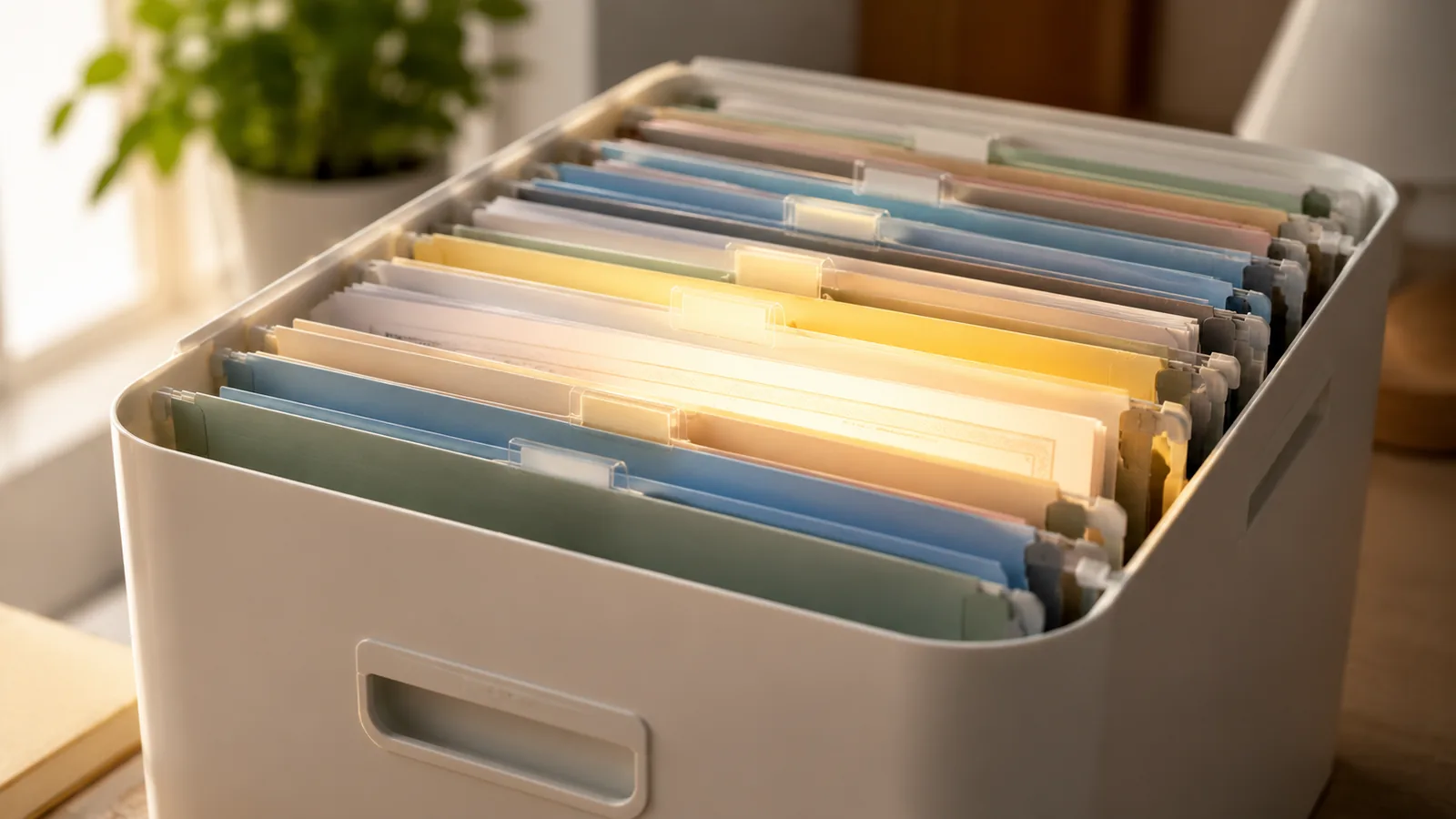
- One place for documents. A file box, an accordion folder or a fireproof safe. Every document goes there, no exceptions.
- Put it away in the same episode. Came home with a document in hand? It goes to its place before you change rooms or tasks.
- Say it out loud when you store something outside the routine. It sounds silly, but it creates a stronger memory of the moment.
- Keep digital copies. Scan or photograph the hardest-to-replace documents and store them in the cloud, protected by a strong password and two-factor authentication. A photo does not replace the original, but it gives you the numbers you need to request a replacement.
What deserves extra care
Prioritize documents that take time, fees or a trip to an office to replace: birth certificates, Social Security cards, passports, marriage and divorce records, car titles, the deed to your home, wills and insurance policies. Ready.gov, the federal emergency preparedness site, recommends gathering these in one place along with copies you can grab quickly in an emergency, like a flood, fire or evacuation. Keep your Social Security card at home instead of in your wallet.
Source: Ready.gov, Financial Preparedness.
Sources
- Radvansky GA, Krawietz SA, Tamplin AK. Walking through doorways causes forgetting: further explorations. Quarterly Journal of Experimental Psychology, 2011. https://doi.org/10.1080/17470218.2011.571267
- Ready.gov. Financial Preparedness. https://www.ready.gov/financial-preparedness
Frequently asked questions
Why do I forget what I was doing when I walk into another room?
Research on the doorway effect suggests a change of room acts as an episode break in memory, making what you were thinking before less accessible.
Does a photo of a document count as the document?
No. It is useful as a record of the information, but official agencies require the original or an official digital version.
What is the best place to keep important documents?
A single fixed spot, dry and known to the people in the house who may need it. A fireproof and waterproof box adds protection.
Should I carry my Social Security card?
Generally no. Keep it at home in your document box and carry it only when you need it.