What dreaming about roses usually points to
Dream interpretation is not prediction and not diagnosis. This article separates what sleep research observes from what popular interpretation associates with the theme, always saying which is which.
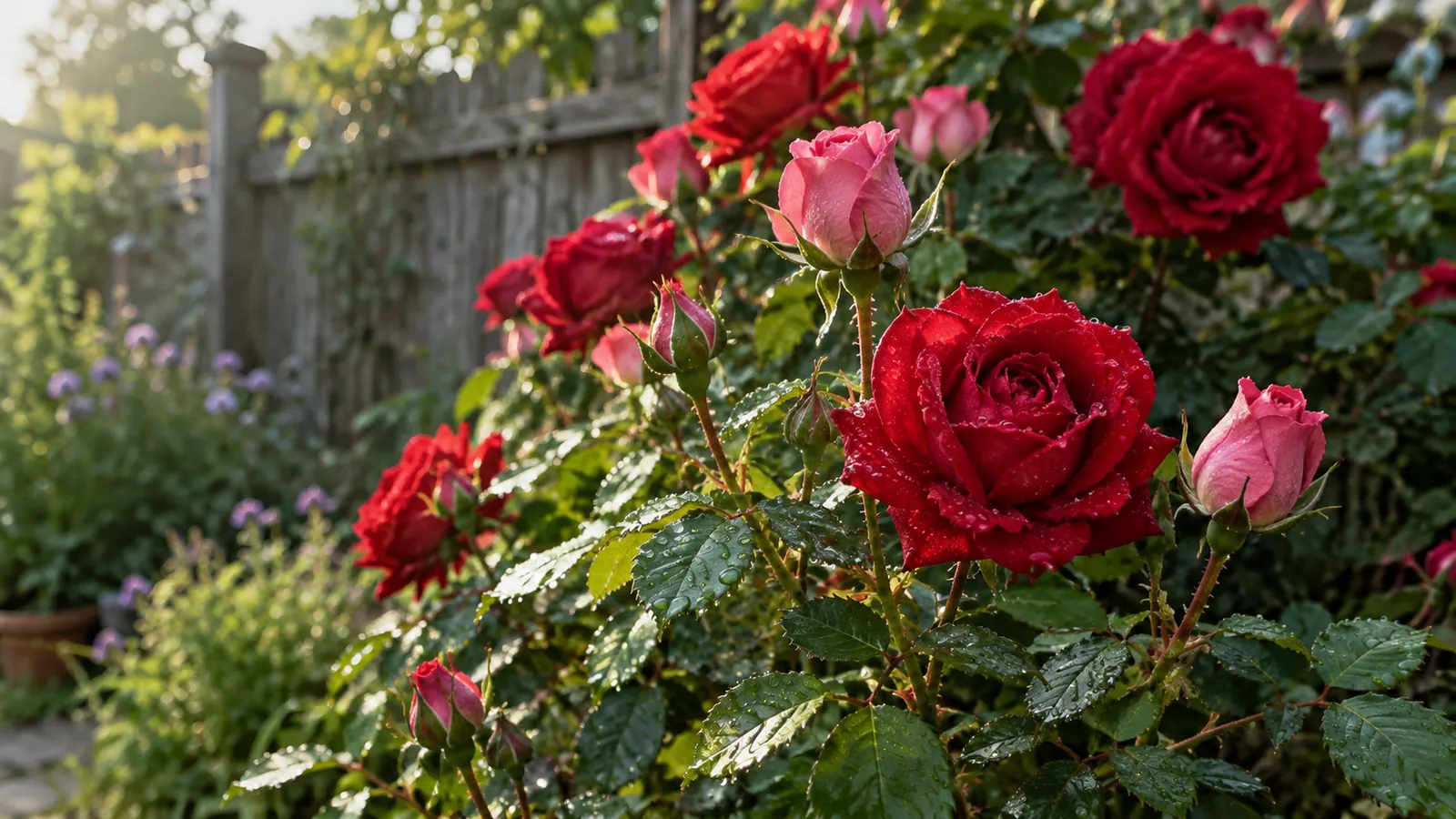
Dreaming about roses is not a warning of a marriage proposal, of mourning or of betrayal. In dreams, the rose is almost always tied to affection: someone you care about, care you received, a longing for tenderness that the day did not meet. When the rose is wilted or covered in thorns, the dream usually brings the hard side of the same theme: hurt, distance or the fear of getting hurt.
The color and condition of the flower change the mood of the scene, but not its basic meaning. A red, white or yellow rose is still a rose: an image of relationships, of gifts and of fragility.
Read also: Dreaming about flowers and Dreaming about an orchid.
Where the rose in the dream comes from
Michael Schredl and Friedrich Hofmann showed in 2003 that what a person does and thinks during the day tends to carry on in dreams. Roses are everywhere: at the corner florist, in the vase at a wake, on the poster of a TV soap opera, in the emoji of a message that arrived late at night. Someone who worked at a wedding, pruned the rosebush or recently received flowers has the scene set up before going to sleep.
Smell counts too. William Dement and Edward Wolpert observed in 1958 that stimuli applied during sleep, such as sounds and water on the skin, could make their way into the plot. A floral perfume on the pillow, a bouquet in the bedroom or a rose-scented fabric softener can have the same effect, and the dream builds an entire garden out of a single scent.
Sources: Schredl and Hofmann, Continuity between waking activities and dream activities, Consciousness and Cognition, 2003; Dement and Wolpert, Journal of Experimental Psychology, 1958.
Freud, Jung and faith on the rose
In Freud's psychoanalysis. In The Interpretation of Dreams, Freud analyzed at length the dream of a patient who walked down a staircase holding a flowering branch, and saw in the flowers the mix of desire, innocence and guilt that the dream tries to hide and show at the same time. In a Freudian reading, the rose usually speaks of desire and of the fear of exposing oneself to it.
In Jung's psychology. Jung saw in many-petaled flowers an image of the center of the person, similar to mandalas. In Man and His Symbols, the reminder is that a symbol only makes sense within the dreamer's own life: the rose of someone who has just lost a loved one and the rose of someone who is starting to date do not say the same thing.
In symbols and faith. In A Dictionary of Symbols, Chevalier and Gheerbrant record the rose as a symbol of love, of regeneration and of the cup that gathers life, linked both to Venus and to Christian devotion. In the Bible, Song of Songs 2:1 mentions the "rose of Sharon", and Isaiah 35:1 promises that the desert "shall blossom as the rose". For people of faith, the rose in a dream can be read as comfort and as a promise that something dry will bloom again.
Bringing both readings together. Science explains how gifts, scents and soap operas get into the dream; tradition explains why the rose became the flower of affection and also of pain. Noticing whether the rose was open, wilted or full of thorns helps you decide which reading fits.
Sources: Freud, Die Traumdeutung, 1900; Jung (ed.), Man and His Symbols; Chevalier and Gheerbrant, A Dictionary of Symbols.
The most common versions of this dream
| Scene | What usually goes with it |
|---|---|
| Receiving a bouquet of red roses | Affection received, a wish to be remembered, a good phase in a relationship |
| A wilted or dry rose, or one dropping its petals | Longing, a relationship that has cooled, weariness with something that was once beautiful |
| A rose thorn pricking your finger | Fear of getting hurt when you get close to someone, a small hurt that still stings |
| A rosebush full of flowers in the yard or garden | Care that bears fruit, family, memories of home |
| White or yellow roses | Peace, friendship, affection without demands; in some regions, the memory of someone who has passed away |
If the dream was about the whole garden and not just the rosebush, see dreaming about a garden.
See also: Dreaming about a fountain and Dreaming about leaves.
When to seek help
Roses hardly ever turn into nightmares. If the scene keeps coming back with distress, like thorns that never stop growing or flowers at the wake of someone who is still alive, and you wake up badly several times a week, talk to a health professional: frequent nightmares have treatment. See how to have fewer nightmares.
Source: Morgenthaler and colleagues, Journal of Clinical Sleep Medicine, 2018.
What dream books say
In O Livro dos Sonhos, a Brazilian dream book, L. P. Baçan sums up the rose with the book's usual short formula: in life, joys; in love, sincere affection, with the caveat that a wilted rose would indicate sadness. It is the compact version of a tradition the whole culture repeats.
Jung would point out that symbols do not fit into lists: the same rose changes meaning according to the dreamer's story. Freud was harsher and called this method "decoding", a mechanical swap of image for meaning. Both agree on one point: the book can offer ideas, but the key to the dream lies in the life of the person who dreamed it.
Sources: L. P. Baçan, O Livro dos Sonhos, 2014; Jung (ed.), Man and His Symbols.
What folk tradition associates with roses
Brazilian folk reading gives each color its own meaning. A red rose would be passion or reconciliation; a white one, peace and forgiveness; a yellow one, friendship, or jealousy in some regions; a pink one, new tenderness. A rose with many thorns would be a warning of a difficult person nearby. Many roses in a single dream, an abundance of affection; a single rose, someone special.
All of this is tradition, not prediction. It serves as a starting point for thinking about your own life, never as a guarantee of what will happen. See what dream meanings look like according to science and culture.
Sources
- Schredl M, Hofmann F. Continuity between waking activities and dream activities. Consciousness and Cognition, 2003. https://doi.org/10.1016/S1053-8100(02)00072-7
- Dement W, Wolpert EA. The relation of eye movements, body motility, and external stimuli to dream content. Journal of Experimental Psychology, 1958. https://doi.org/10.1037/h0048908
- Freud S. The Interpretation of Dreams (Die Traumdeutung), 1900. Project Gutenberg. https://www.gutenberg.org/ebooks/66048
- Jung CG (ed.). Man and His Symbols, 1964. Portuguese edition consulted: O homem e seus símbolos, Nova Fronteira/HarperCollins Brasil. https://www.skoob.com.br/book/8435
- Chevalier J, Gheerbrant A. A Dictionary of Symbols (Dictionnaire des symboles). Portuguese edition consulted: Dicionário de símbolos, José Olympio/Record. https://www.record.com.br/products/dicionario-de-simbolos
- Morgenthaler TI et al. Position Paper for the Treatment of Nightmare Disorder in Adults: An American Academy of Sleep Medicine Position Paper. Journal of Clinical Sleep Medicine, 2018. https://doi.org/10.5664/jcsm.7178
- Baçan LP. O Livro dos Sonhos (Brazilian dream book). Self-published, 2014.
Frequently asked questions
Does dreaming about red roses mean love is coming?
That is the most common folk reading. Research finds no prediction: the red rose usually reflects the affection the person already lives or longs for.
Is dreaming about a wilted rose a sign of death?
No. It usually goes with longing, tiredness or a relationship that has cooled. There is no evidence that it is a warning.
Does a rose thorn in a dream mean betrayal?
There is no basis for that. Thorns show up in the dreams of people who are afraid of getting hurt or who are holding on to a small hurt.
What does the Bible say about roses?
The rose appears in Song of Songs 2:1 and in Isaiah 35:1, as an image of beauty and renewal. The Bible does not interpret dreams about roses.
I received flowers and dreamed about roses. Is that normal?
Yes. Recent experiences, especially those involving scent and emotion, often come back in dreams.