What this dream usually points to (and what it doesn't)
Dream interpretation is not prediction and not diagnosis. This article separates what sleep research observes from what popular interpretation associates with the theme.
Dreaming about a cave does not announce danger or discovery. Closed, dark spaces fit dreams well, because dreams often work with sensations of containment, mystery and the search for an exit.
Read also: Dream meanings: what science and culture actually say | Dreaming about a house: why that scene repeats.
Why caves appear in dreams
The dream combines places seen and sensations lived, such as being in a tight space or in the dark. It is enough to have gone through something similar, even in films or photos.
The threat simulation hypothesis suggests dreaming rehearses risky situations in safety, and closed spaces with no clear exit are part of that kind of scene.
Source: Revonsuo, The reinterpretation of dreams, Behavioral and Brain Sciences, 2000.
Common variations of dreaming about a cave
- Entering the cave: curiosity mixed with apprehension.
- Being trapped inside: a feeling of tightness, common in pressured phases.
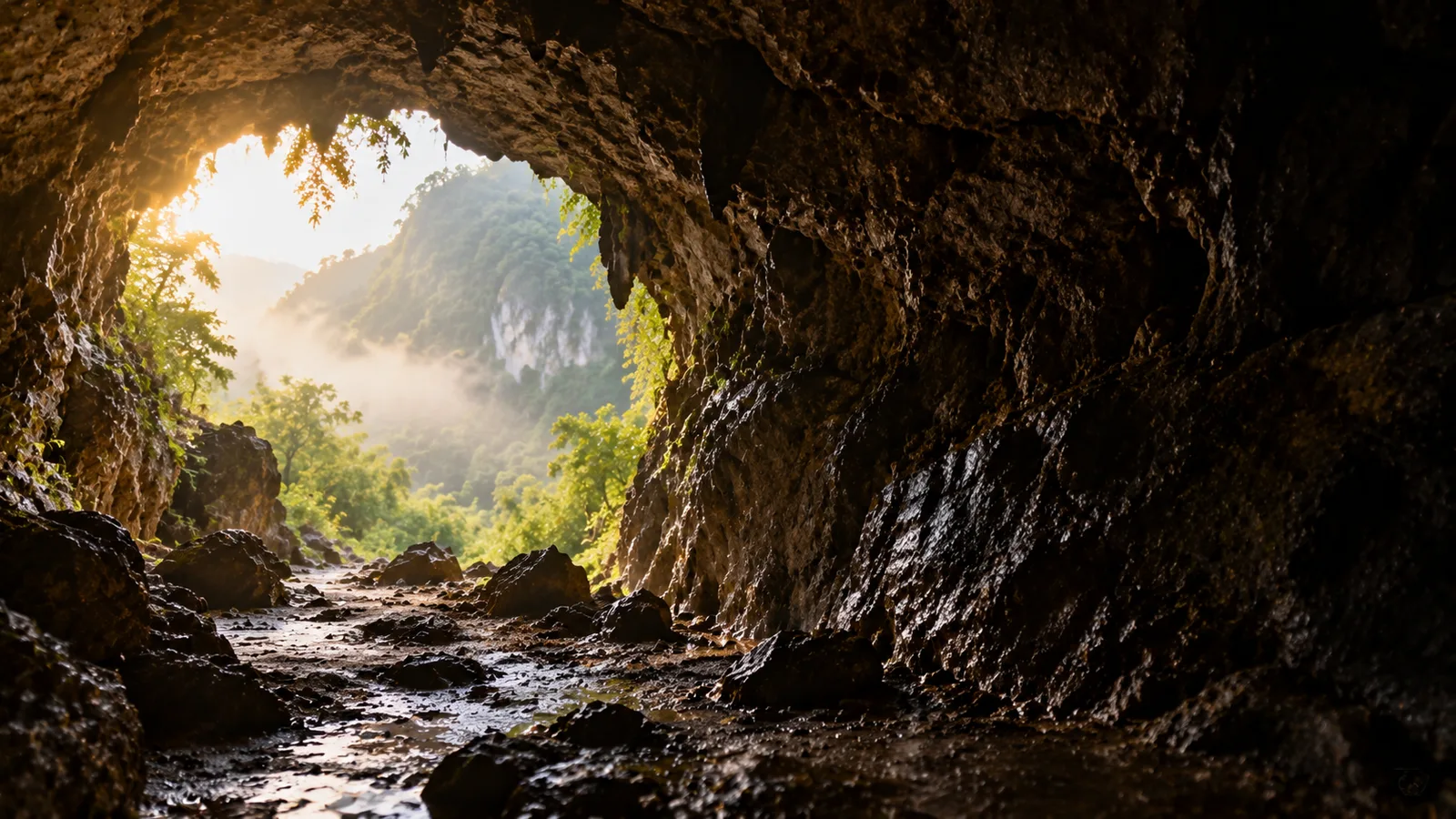
- Seeing light at the exit: relief and a sense of hope.
- Dark, endless cave: tied to uncertainty, in folk reading.
- Finding something inside: a scene of discovery, pleasant.
See also: Dreaming about a mountain and Dreaming about a candle flame or fireplace.
When the fear disrupts waking life
Dreaming about a cave now and then is common. It deserves attention if fear of closed spaces limits activities such as elevators, transport or exams. That condition has treatment, generally therapy and gradual exposure with a professional.
If the dream repeats and wakes you frightened several times a week, talk to a health professional.
Source: Morgenthaler and colleagues, Journal of Clinical Sleep Medicine, 2018.
What dream books say
Livro do Sonho, a popular Brazilian dream dictionary, reads coming out of a cave as the end of a turbulent period, and going into one as caution with ambitious projects, with the advice to pay more attention to love. In several traditions, the cave is a place of retreat and inner discovery. The Brazilian dream book O Livro dos Sonhos, by L. P. Baçan, takes another path and links caves to losing money in life and to adventures in love.
Freud described dream books as a kind of dictionary that translates each image into another with a fixed meaning. Artemidorus of Daldis, author of the oldest complete Greek dream book that has survived, advised looking at the dreamer's life before interpreting. If you see the dream as a message, both paths suggest the same thing: ask what this image brings to mind in your life right now. See dream meanings according to science and culture.
Source: Livro do Sonho, Brazilian dream dictionary; Freud, Die Traumdeutung, 1900; L. P. Baçan, O Livro dos Sonhos, 2014.
Dreaming about a cave according to Freud, Jung and faith
In Freud's psychoanalysis. A whole cave is hard to decode in one go, and Freud did not even try. His method of free association broke the dream into pieces and asked what came to mind about each one: the narrow entrance, the darkness, the echo, the light far ahead. A master's thesis by Juliana David Jorge (PUC Minas, Brazil, 2007) traces how this method took shape across his work.
In Jung's psychology. Man and His Symbols devotes several pages to the painted caves of the Ice Age, such as Lascaux in France. To reach the large chambers with painted animals, visitors still pass through narrow, dark and damp passages, and the book notes that people living near such paintings refused to go close to them, out of a kind of religious awe. From a Jungian angle, going down into a cave in a dream can be read as a dive into the oldest layers of the psyche, where things live that have not yet found words.
In symbols and faith. In A Dictionary of Symbols, Chevalier and Gheerbrant call the cave an archetype of the mother's womb, present in the origin and initiation myths of many peoples. At Eleusis, in Greece, initiates were chained inside a grotto and had to escape toward the light; Plato made the cave, with its shadows on the wall, the image of a world of appearances. In the Bible, 1 Kings 19:9 shows the prophet Elijah sheltering in a cave, where the word of God comes to him.
Bringing both views together. Shelter and passage at once, the cave suits both readings. Science explains why a closed space feels frightening; traditions ask what is learned inside. Before looking for meaning, notice which way you were moving in the dream: going in or coming out.
Sources: Freud, Die Traumdeutung, 1900; Jorge, PUC Minas, 2007; Jung (ed.), Man and His Symbols; Chevalier and Gheerbrant, A Dictionary of Symbols; L. P. Baçan, O Livro dos Sonhos, 2014.
Popular beliefs about this dream
In folk reading, the cave stands for introspection, diving into oneself, and the light at the exit for clarity. In many traditions it is a place of retreat and mystery. None of this predicts events, and readings vary.
Read also: the feeling of being trapped in dreams; Dreaming about a city.
Sources
- Schredl M, Hofmann F. Continuity between waking activities and dream activities. Consciousness and Cognition, 2003. https://doi.org/10.1016/S1053-8100(02)00072-7
- Revonsuo A. The reinterpretation of dreams. Behavioral and Brain Sciences, 2000. https://doi.org/10.1017/S0140525X00004015
- Morgenthaler TI et al. Position Paper for the Treatment of Nightmare Disorder in Adults. Journal of Clinical Sleep Medicine, 2018. https://doi.org/10.5664/jcsm.7178
- Freud S. The Interpretation of Dreams (Die Traumdeutung), 1900. Project Gutenberg. https://www.gutenberg.org/ebooks/66048
- Livro do Sonho. Sonhar com caverna. https://www.livrodosonho.com/significado-dos-sonhos-sonhar-com-caverna-1202.htm
- Jorge JD. A construção da associação livre na obra de Freud (The construction of free association in Freud's work). Master's thesis in Psychology, Pontifical Catholic University of Minas Gerais, Brazil, 2007.
- Jung CG (ed.). Man and His Symbols, 1964. Portuguese edition consulted: O homem e seus símbolos, Nova Fronteira/HarperCollins Brasil. https://www.skoob.com.br/book/8435
- Chevalier J, Gheerbrant A. A Dictionary of Symbols (Dictionnaire des symboles). Portuguese edition consulted: Dicionário de símbolos, José Olympio/Record. https://www.record.com.br/products/dicionario-de-simbolos
- Baçan LP. O Livro dos Sonhos (Brazilian dream book). Self-published, 2014.
Frequently asked questions
Is dreaming about a cave a bad omen?
No. It is a setting of containment and mystery, with no predictive value.
Does dreaming I am stuck in a cave indicate claustrophobia?
Not necessarily. But people who fear closed spaces tend to dream more of that kind of scene.
Does dreaming I leave the cave mean victory?
That is a folk reading of relief. Research sees the dream as a reflection of emotions and what you lived.
What does the Bible say about caves?
In 1 Kings 19:9, the prophet Elijah, worn out and pursued, shelters in a cave and there receives the word of God. For people of faith, the image can speak of retreat and listening. But dreaming of a cave is not a warning or a promise: science links it to everyday feelings of pressure and uncertainty.