Dreaming about Carnival: the straight answer
Dream interpretation is not prediction and not diagnosis. This article separates what sleep research observes from what popular interpretation associates with the theme, always saying which is which.
Brazilian Carnival is the great national festival held in the days before Lent, usually in February or early March: blocos (street parties that follow a band or drum group through the city) fill the streets, and samba schools parade with floats, costumes and hundreds of drummers. Dreaming about Carnival does not announce betrayal, a fight or a fleeting romance. The scene usually shows up when life calls for a break, a party or freedom, or, on the contrary, when the person feels left out while everyone else seems to be having fun. A street party, a parade, a costume and confetti change the tone, but the core is usually the same: the wish, or the fear, of letting go.
It is not a prediction either. Close to February, with marchinhas (traditional Carnival songs) playing and costumes for sale on every corner, the dream may simply be the calendar slipping into your sleep. For parties in general, see dreaming about a party.
Read also: Dreaming about a ball or dancing and Dreaming about music.
Why Carnival invades your sleep
The continuity hypothesis, tested by Michael Schredl and Friedrich Hofmann in 2003, says that dreams follow what fills waking life. Someone who parades with a samba school, plays in a drum section, sews costumes or just watches the parades on TV has Carnival on their mind for weeks beforehand.
The sound of the street gets in too. In 1958, William Dement and Edward Wolpert showed in the lab that stimuli during sleep, such as a sound played in the room, can be incorporated into the plot. The drumming of a street band passing in the small hours can turn into a parade in the dream. And when the party turns into distress, like getting lost in the crowd or being pushed around, the scene comes close to common nightmare themes, such as being chased, described by Michael Schredl and Anja Göritz in 2018.
Sources: Schredl and Hofmann, Continuity between waking activities and dream activities, Consciousness and Cognition, 2003; Dement and Wolpert, Journal of Experimental Psychology, 1958; Schredl and Göritz, Nightmare Themes, Journal of Clinical Sleep Medicine, 2018.
Street party, parade and costume: the most common scenes
| Scene | What usually goes with it |
|---|---|
| Dancing through Carnival in a street party | A wish for lightness, to be among friends, to break the routine |
| Parading with a samba school | A wish to be seen and recognized, teamwork, pride in belonging |
| Wearing a costume or a mask | A wish to try out another way of being, or to hide something for a while |
| Losing someone in the crowd | Fear of being alone, of losing control, weariness with too many people |
| Watching the party from afar, without joining in | A sense of exclusion, shyness, a phase of withdrawal |
| Carnival ending and the street empty | The end of a cycle, tiredness after the euphoria, going back to obligations |
If the costume was a clown's, read dreaming about a circus or a clown. If the scene revolved around drinking, see dreaming about drinks or a drunk person.
See also: Dreaming about getting fired and Dreaming about a loose tooth.
When the revelry turns into a nightmare
Most of the time, dreaming about Carnival is light. It deserves attention when the dream repeats as a nightmare, with confusion, shoving or fear of not making it home, and you wake up frightened several times a week. Frequent nightmares can be treated; see how to have fewer nightmares.
If the dream brings back something difficult you lived through at a party, such as violence or harassment, talk to a health professional. In the US, you can call or text 988 (Suicide & Crisis Lifeline). If the scene points to a real concern about drinking, the way forward is also a health professional.
Source: Morgenthaler and colleagues, Journal of Clinical Sleep Medicine, 2018.
Masks, Freud, Jung and faith at Carnival
In Freud's psychoanalysis. In The Interpretation of Dreams, Freud describes composite figures: a person in the dream who has the name of one acquaintance and the face of another, like Dr. M. in his own dream, who carried features of his older brother. In a dreamed Carnival, full of half-hidden faces, this blending becomes almost literal. For Freud, the whole dream is a wish in disguise so it can slip past the censor.
In Jung's psychology. The word persona, which Jung used for the social face, comes from Latin and referred to the actor's mask in the theater. At Carnival, the everyday mask is swapped for another one, of your own choosing. In Man and His Symbols, Joseph Henderson describes the trickster, the prankster of myths, as the most primitive stage of the hero, driven by impulses and pranks.
In symbols and faith. The name Carnival is often linked to the Latin “carne levare”, to remove meat, because the festival comes right before Lent; on Ash Wednesday, the Catholic liturgy recalls that we are dust. Many evangelical churches hold retreats during those days. In Afro-Brazilian traditions, the afoxés, such as the Filhos de Gandhy in Salvador, take to the streets with chants and the ijexá rhythm linked to candomblé, a religion of African roots practiced in Brazil. In A Dictionary of Symbols, Chevalier and Gheerbrant note that the festive mask does not only hide: for a while, it releases what the person usually holds back.
Bringing both readings together. Research explains how the calendar, sound and memory bring Carnival into sleep; traditions ask what you want to let loose and what you would rather keep hidden.
Sources: Freud, Die Traumdeutung, 1900; Jung (ed.), Man and His Symbols; Chevalier and Gheerbrant, A Dictionary of Symbols.
Carnival in dream books
In O Livro dos Sonhos, a Brazilian dream book, L. P. Baçan looks at the festival with suspicion: Carnival would mean, in life, frivolities; in love, quick passions. The mask goes in the same direction, with difficulties in life and betrayal in love.
Freud saw in these books a fixed key with no guarantee. He noted that, as far back as antiquity, Artemidorus of Daldis took into account the life and situation of the dreamer before interpreting. The Carnival of a samba dancer and that of someone who runs from the noise do not get the same reading.
Sources: Freud, Die Traumdeutung, 1900; L. P. Baçan, O Livro dos Sonhos, 2014.
Carnival in folk reading
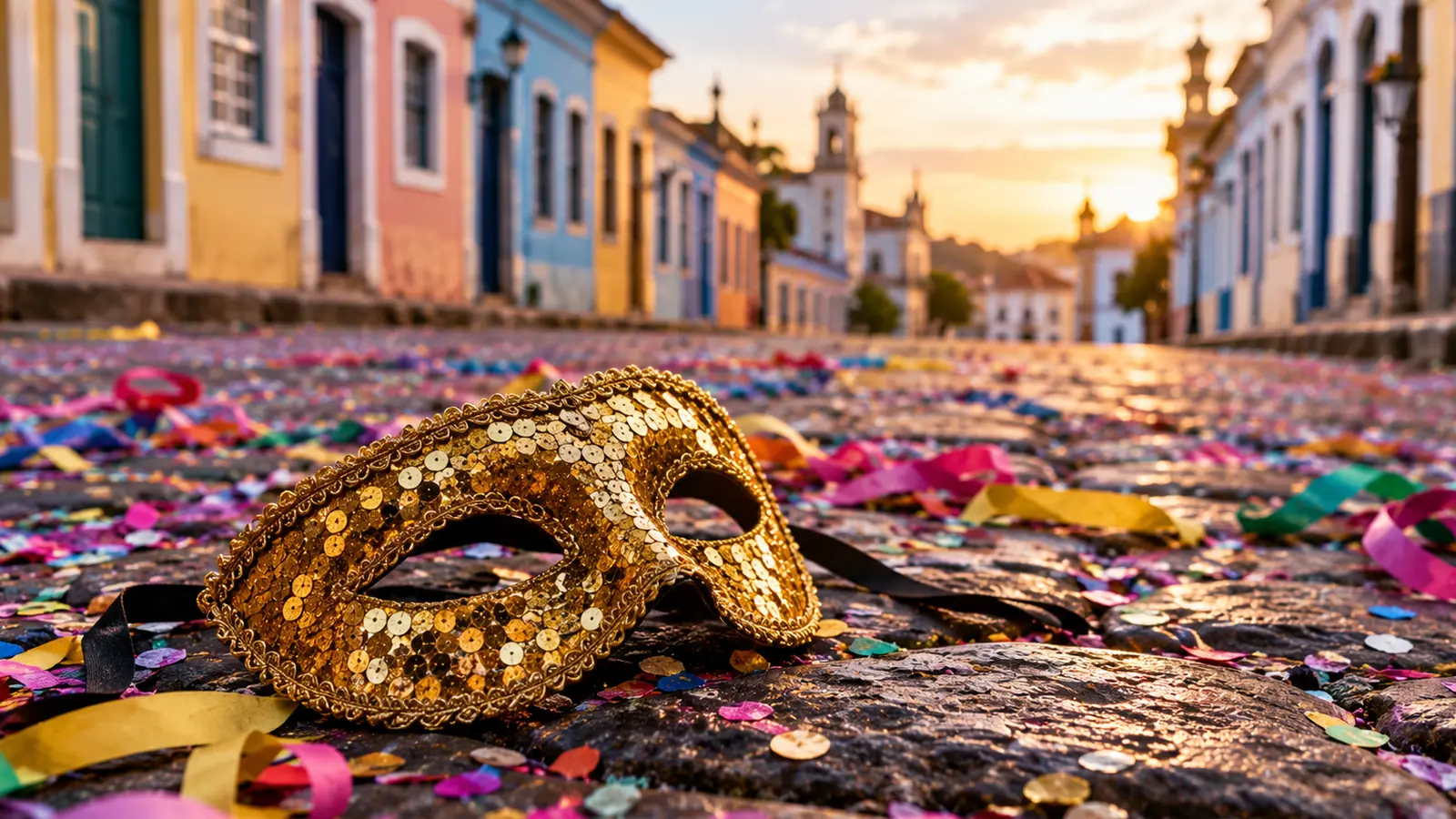
In Brazilian folk reading, a lively street party in a dream is usually seen as joy on its way; a colorful costume, creativity; a mask, someone hiding their intentions; confetti and streamers, a family celebration. Ash Wednesday would be the end of a phase. The gold of the sequins would speak of shine; the black of the mask, of secrets. These are beliefs of tradition, not predictions. See what dream meanings look like according to science and culture.
Sources
- Schredl M, Hofmann F. Continuity between waking activities and dream activities. Consciousness and Cognition, 2003. https://doi.org/10.1016/S1053-8100(02)00072-7
- Dement W, Wolpert EA. The relation of eye movements, body motility, and external stimuli to dream content. Journal of Experimental Psychology, 1958. https://doi.org/10.1037/h0048908
- Schredl M, Göritz AS. Nightmare Themes: An Online Study of Most Recent Nightmares and Childhood Nightmares. Journal of Clinical Sleep Medicine, 2018. https://doi.org/10.5664/jcsm.7002
- Morgenthaler TI et al. Position Paper for the Treatment of Nightmare Disorder in Adults: An American Academy of Sleep Medicine Position Paper. Journal of Clinical Sleep Medicine, 2018. https://doi.org/10.5664/jcsm.7178
- Freud S. The Interpretation of Dreams (Die Traumdeutung), 1900. Project Gutenberg. https://www.gutenberg.org/ebooks/66048
- Jung CG (ed.). Man and His Symbols, 1964. Portuguese edition consulted: O homem e seus símbolos, Nova Fronteira/HarperCollins Brasil. https://www.skoob.com.br/book/8435
- Chevalier J, Gheerbrant A. A Dictionary of Symbols (Dictionnaire des symboles). Portuguese edition consulted: Dicionário de símbolos, José Olympio/Record. https://www.record.com.br/products/dicionario-de-simbolos
- Baçan LP. O Livro dos Sonhos (Brazilian dream book). Self-published, 2014.
Frequently asked questions
Is dreaming about Carnival a sign of betrayal?
No. In O Livro dos Sonhos, Baçan links the mask to betrayal in love, but that is tradition, not a warning. The dream usually speaks of a wish to let go or of feeling left out of the party.
What does it mean to dream that you are in costume?
It usually goes with a wish to try out another way of being, or to hide something for a while.
What does it mean to dream that you get lost in the street party?
The scene usually comes with fear of being alone or of losing control, and it comes close to dreams of being chased. It does not predict anything bad.
Why do I dream about Carnival out of season?
Because the dream reuses memories and wishes. A Carnival song on the radio or missing a past celebration is enough.
What is the spiritual meaning of dreaming about Carnival?
In the Christian reading, Carnival comes before Lent, and the dream can be read as an invitation to balance celebration and reflection. In Afro-Brazilian traditions, the street is also a place of faith, as in the afoxés. These are faith readings, with no proof.