What the camel usually says in the dream
Dream interpretation is not prediction and not diagnosis. This article separates what sleep research observes from what popular interpretation associates with the theme, always saying which is which.
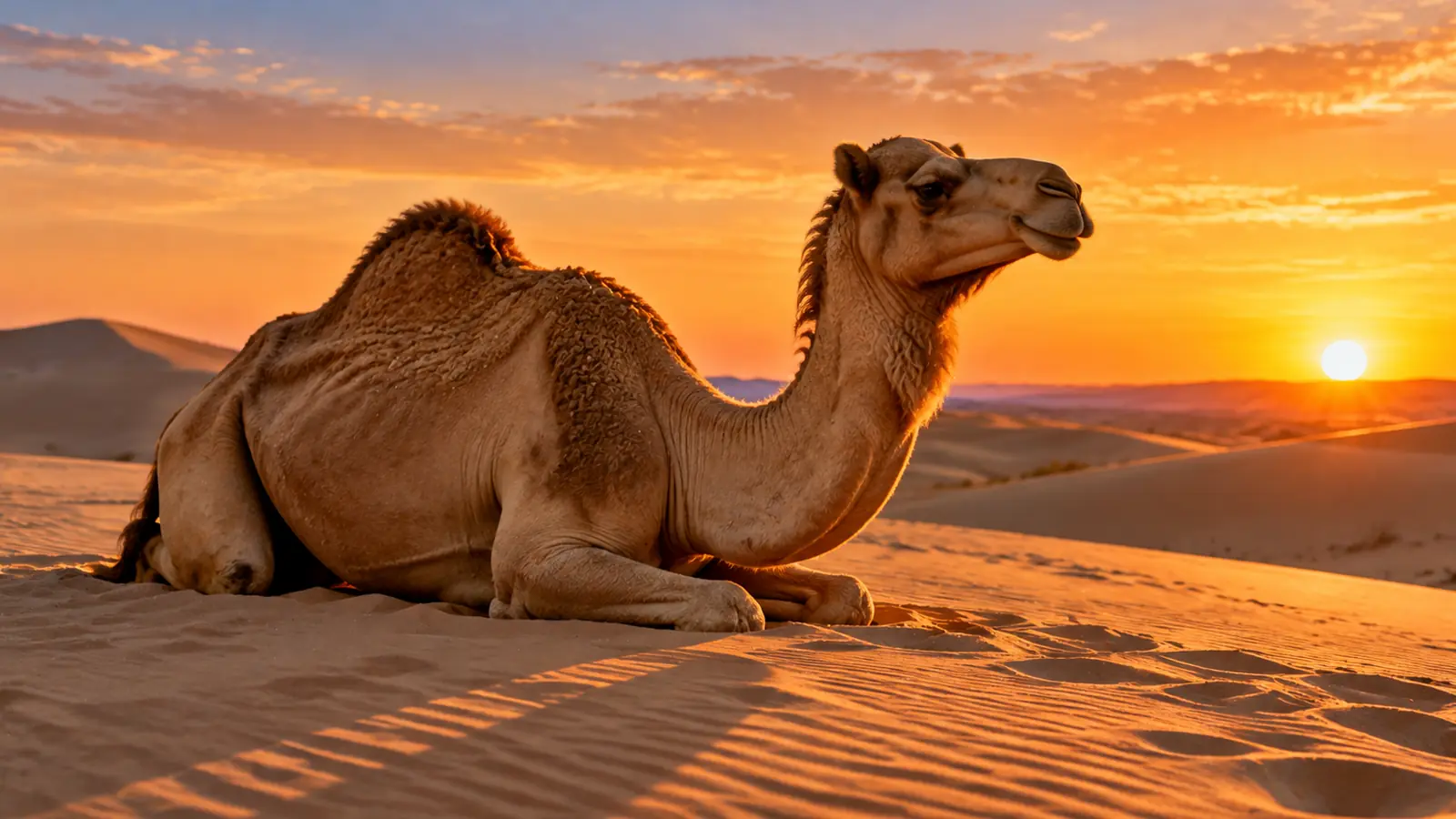
Dreaming about a camel does not announce a sure trip, an inheritance or guaranteed good news. The image tends to appear in phases of prolonged effort: demanding work, a routine that takes stamina, a period in which you carry more than you would like. The camel is the animal that endures thirst and weight for a long time, and the dream tends to borrow that reputation.
Nor is it a sign that you will be left with nothing. When the camel drinks water or reaches an oasis, the scene usually comes with relief. The setting is almost always the desert of the dream, and it is worth reading the two together.
Read also: Dreaming about a desert and Dreaming about a horse.
How the camel makes its way into the dream
The continuity hypothesis, tested by Michael Schredl and Friedrich Hofmann in 2003, says that dreams make use of what passed through waking life. The camel has several routes to the night: a documentary about the Sahara, photos from someone who went to Morocco or Egypt, the dromedary rides on the dunes of Genipabu, in the Brazilian state of Rio Grande do Norte, a nativity scene with the three wise men, an adventure movie.
Language helps too. In Brazil, "camelar" (literally, "to camel") is slang for working hard or walking a lot, and someone who feels that way may dream about the animal without ever having seen one. The body comes into it as well: heat in the bedroom and a dry mouth during the night go well with scenes of desert and thirst.
Psychoanalysis, symbols and faith on the camel
In Freud's psychoanalysis. Freud did not analyze dreams about camels in The Interpretation of Dreams. His method, however, still applies: separate the manifest content (the animal on the dune) from the latent content (what it brings to mind for the dreamer) and let the person associate freely. A camel can pull up the memory of a trip, of a childhood nativity scene or of a phrase like the Brazilian "estou camelando" ("I am slaving away").
In Jung's psychology. In Man and His Symbols, dream animals appear as images of instinctive nature, the part of us that knows how to endure before it thinks. The camel, which stores reserves and crosses emptiness, can be read as the part of us that holds on. The Jungian question would be: what are you carrying, and how much longer can you keep going like this?
In symbols and faith. A Dictionary of Symbols, by Chevalier and Gheerbrant, links animals to instinctive forces and to crossings. In the Bible, the camel appears many times: Abraham's servant finds Rebekah when she gives water to the camels (Genesis 24); John the Baptist wears clothing of camel's hair (Matthew 3); and Jesus says it is easier for a camel to go through the eye of a needle than for a rich man to enter the Kingdom of God (Matthew 19).
Bringing both readings together. Research shows where the camel comes from: from what you saw, heard and felt in your body. Traditions ask about loads, patience and crossings. Writing the scene down when you wake up helps you see which question makes more sense.
Sources: Freud, Die Traumdeutung, 1900; Jung (ed.), Man and His Symbols; Chevalier and Gheerbrant, A Dictionary of Symbols.
Camel scenes and what usually goes with them
| Scene | What usually goes with it |
|---|---|
| A camel crossing the desert | A long phase of effort, a sense of moving forward despite fatigue |
| Riding a camel | A new challenge that rocks you, fear of losing your balance, the memory of an outing or a trip |
| An overloaded camel | Too many tasks or responsibilities, a wish to share the weight |
| A camel drinking water or at an oasis | Relief, a well-earned pause, recovery after a dry period |
| A camel spitting or angry | Irritation with someone, a harsh conversation, fear of being disrespected |
| A camel lying down that will not get up | Accumulated fatigue, a sense of having no stamina left for a project |
If the animal in the dream was a different size, compare with dreaming about a llama and dreaming about an elephant. When the dream is about the road, see dreaming about a trip.
See also: Dreaming about a squirrel and Dreaming about a snake in bed.
When the camel asks for a pause
Most of the time, dreaming about a camel is just a dream. If the scene repeats with thirst, heat and a feeling of being lost, it is worth looking at your sleep and your body: a very hot bedroom, too little water during the day or extreme tiredness can show up this way. If the dream becomes a frequent nightmare, with frightened awakenings, talk to a health professional, because repeated nightmares have treatment. See also how to have fewer nightmares.
Source: Morgenthaler and colleagues, Journal of Clinical Sleep Medicine, 2018.
The camel in dream books
In O Livro dos Sonhos, a Brazilian dream book, L. P. Baçan gives the camel one of the most optimistic readings on the list: in life, good news; in love, fulfillment. The book seems to hold on to the idea of arrival, of the animal that completes the crossing.
Freud, who knew this genre of book well, criticized the decoding method: swapping each image for a fixed meaning, as in a key, without considering the person. The camel of someone just back from Egypt and that of someone who feels overloaded at work do not tell the same story.
Sources: Freud, Die Traumdeutung, 1900; L. P. Baçan, O Livro dos Sonhos, 2014.
The camel in folk belief
In Brazilian folk reading, the camel is linked to endurance and patience. A loaded camel is seen as a phase of work that will bear fruit; a camel drinking water, as rest that is on its way; two camels together, as a solid partnership. A white camel appears as a sign of calm, and a dark camel, as a call for prudence. Dreaming that you ride and reach your destination is read as a goal achieved. These are traditional readings, food for thought, not predictions. See what dream meanings look like according to science and culture.
Sources
- Schredl M, Hofmann F. Continuity between waking activities and dream activities. Consciousness and Cognition, 2003. https://doi.org/10.1016/S1053-8100(02)00072-7
- Freud S. The Interpretation of Dreams (Die Traumdeutung), 1900. Project Gutenberg. https://www.gutenberg.org/ebooks/66048
- Jung CG (ed.). Man and His Symbols, 1964. Portuguese edition consulted: O homem e seus símbolos, Nova Fronteira/HarperCollins Brasil. https://www.skoob.com.br/book/8435
- Chevalier J, Gheerbrant A. A Dictionary of Symbols (Dictionnaire des symboles). Portuguese edition consulted: Dicionário de símbolos, José Olympio/Record. https://www.record.com.br/products/dicionario-de-simbolos
- Morgenthaler TI et al. Position Paper for the Treatment of Nightmare Disorder in Adults: An American Academy of Sleep Medicine Position Paper. Journal of Clinical Sleep Medicine, 2018. https://doi.org/10.5664/jcsm.7178
- Baçan LP. O Livro dos Sonhos (Brazilian dream book). Self-published, 2014.
Frequently asked questions
Is dreaming about a camel a sign of travel?
Not necessarily. The camel may come from a real or planned trip, but the dream does not predict any journey. It usually speaks more of effort and of an inner crossing.
What does it mean to dream about a loaded camel?
It usually goes with phases full of responsibilities. It is worth noticing whether the load in the dream recalls something you feel in your routine.
Is dreaming about a camel spitting a bad sign?
It predicts nothing bad. It usually reflects irritation or a recent harsh conversation. In folk tradition it is seen as a warning to avoid arguments.
What is the difference between dreaming about a camel and a dromedary?
For the dream, almost none. In practice, the dromedary has one hump and the camel has two; many people call both of them camels.
What is the spiritual meaning of dreaming about a camel?
In faith-based readings, the camel recalls patience, humility and crossing, images present in Bible passages. It is a belief-based interpretation, without proof.