How much sleep adults need
A consensus statement from the American Academy of Sleep Medicine and the Sleep Research Society recommends that adults sleep 7 hours or more per night on a regular basis.
Source: AASM and SRS, recommended amount of sleep for adults, 2015.
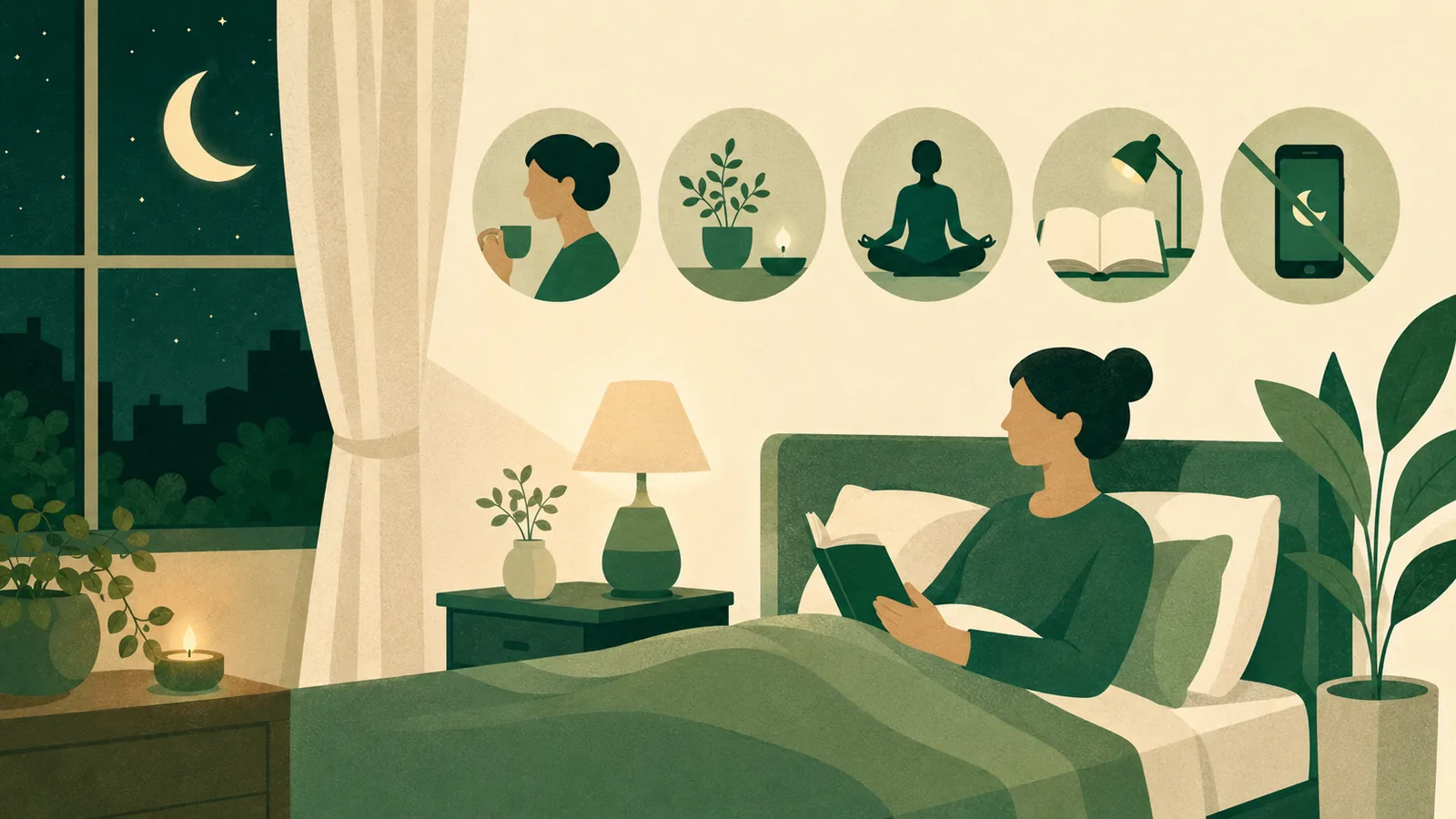
Habits that help
- Go to bed and wake up at similar times, weekends included.
- Have a relaxing routine before bed.
- Keep the bedroom dark, quiet and comfortable.
- Avoid caffeine, alcohol and nicotine close to bedtime.
- Avoid long naps during the day.
- Exercise regularly, but not right before bed.
Source: NHS, insomnia.
If you can't fall asleep
Lying in bed watching the clock makes it worse. If you are still awake after about 20 minutes, get up, do something calm in dim light and go back when you feel sleepy. Keep the phone away from the bed. See also why you wake up several times at night.
Phones in bed
Scrolling in bed keeps the brain busy and pushes bedtime later without you noticing. Leaving the phone away from the bed and swapping the screen for a paper book in the last part of the evening is one of the simplest changes to test.
What a study showed about reading on a screen before bed
Harvard researchers compared, in the lab, adults who read for four hours before bed on a light-emitting e-reader with the same adults reading a printed book, over five nights in each condition.
With the screen, participants took longer to fall asleep, released less melatonin, the hormone that signals night to the body, had their body clock pushed later and were less alert the next morning. The study used long, controlled screen time, but it helps explain why trading the phone for a paper book in the last hour of the night often makes a difference.
Source: Chang et al., Evening use of light-emitting eReaders, PNAS, 2015.
Afternoon coffee counts
Many people drink coffee mid-afternoon and assume it does not touch their night. A study in the Journal of Clinical Sleep Medicine tested a high dose of caffeine taken at bedtime, 3 hours before or 6 hours before. Even 6 hours before, caffeine cut total sleep by more than an hour, measured with a device at home.
The curious detail is that participants did not always notice the loss. That is why the authors recommended avoiding caffeine in the 6 hours before bed. Remember it is also in black tea, cola, energy drinks and chocolate.
When to get help
According to the NHS, see a doctor if sleep problems last for months and affect your day. Loud snoring with pauses in breathing or strong daytime sleepiness also need assessment. Do not take sleeping pills without medical advice.
What experts and health authorities say
The Virtual Health Library of Brazil's Ministry of Health publishes guidance from the Brazilian Academy of Neurology (in Portuguese) that matches the NHS advice: regular times for going to bed and getting up, the same routine at weekends, avoiding caffeine, alcohol and food close to bedtime and, if sleep does not come within 15 to 30 minutes, getting up and reading in another room.
In a report by Jornal da USP (in Portuguese) on a study published in the journal Sleep Science, researcher Renatha El Rafihi Ferreira, of the University of São Paulo, calls cognitive behavioral therapy for insomnia the "gold standard" treatment. In the same report, neurologist Rosa Hasan, a sleep medicine specialist, notes that stopping sleeping pills after long use should be guided by a doctor.
Sources: Brazil's Ministry of Health VHL, sleep disorders; Jornal da USP, sleeping pills.
Read also: Methanol in drinks.
Sources
- Watson NF et al. Recommended Amount of Sleep for a Healthy Adult. Sleep, 2015. https://pubmed.ncbi.nlm.nih.gov/25979105/
- NHS. Insomnia. https://www.nhs.uk/conditions/insomnia/
- Chang et al., Evening use of light-emitting eReaders, PNAS, 2015. https://doi.org/10.1073/pnas.1418490112
- Drake et al., Caffeine effects on sleep taken 0, 3, or 6 hours before going to bed, Journal of Clinical Sleep Medicine, 2013. https://doi.org/10.5664/jcsm.3170
- Brazil's Ministry of Health, Virtual Health Library. Distúrbios do sono (source: Brazilian Academy of Neurology). BVS MS, 2012 (in Portuguese). https://bvsms.saude.gov.br/disturbios-do-sono/
- Caires L. Brasileiros estão tomando muito remédio para dormir, quando há alternativas eficazes. Jornal da USP, 2026 (in Portuguese). https://jornal.usp.br/ciencias/brasileiros-estao-tomando-muito-remedio-para-dormir-quando-ha-alternativas-eficazes/
Frequently asked questions
How many hours of sleep do adults need?
The AASM and SRS recommend 7 hours or more per night, on a regular basis.
Does herbal tea help?
Caffeine-free teas can be part of a relaxing routine. Avoid black tea and other caffeinated drinks at night.
Can I catch up on sleep at the weekend?
Extra sleep helps with tiredness, but very different schedules make regular sleep harder.