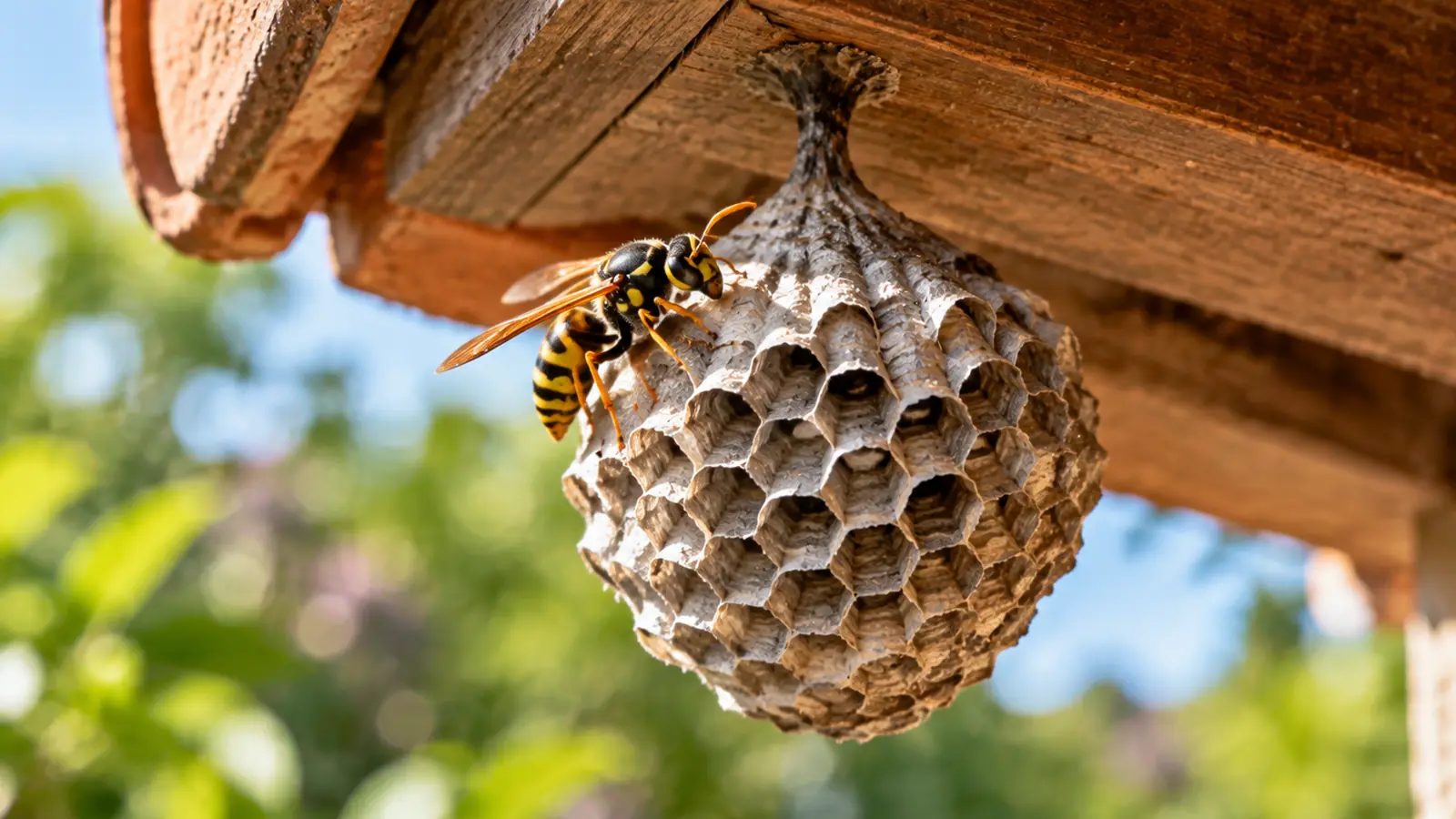
Dreaming about wasps or hornets: what the scene usually shows
Dream interpretation is not prediction and not diagnosis. This article separates what sleep research observes from what popular interpretation associates with the theme, always saying which is which.
Dreaming about wasps or hornets is not a warning about an enemy, envy or gossip. The scene usually shows up in phases of tension: a workplace where every word stings, an argument you keep avoiding, the impression that touching a certain subject will set off a reaction. The sting in the dream tends to come with a quick pain, a fright or anger.
In Brazil, vespa and marimbondo are popular names for the same group of insects; in many regions, marimbondo is the wasp that builds its nest under the eaves, much like what English speakers call a hornet. Unlike the bee, tied to honey and the hive, the wasp almost always appears in dreams as a threat or as defense.
Read also: Dreaming about bees and Dreaming about insects.
Why the wasp flies into the dream
According to the continuity hypothesis, tested by Michael Schredl and Friedrich Hofmann in 2003, dreams reuse what occupies waking life. The wasp gets in easily: the nest knocked down in the backyard, the sting from childhood, the wasp that circled your snack in the park. The expression "stirring up a hornet's nest" helps too.
Antti Revonsuo proposed in 2000 that dreaming about threats would be the brain's rehearsal for reacting to danger, an idea still under debate. In a 2018 online study, Michael Schredl and Anja Göritz found that being chased is among the most frequently reported nightmare themes; the swarm flying after you is one version of that scene.
Sources: Schredl and Hofmann, Continuity between waking activities and dream activities, Consciousness and Cognition, 2003; Revonsuo, The reinterpretation of dreams, Behavioral and Brain Sciences, 2000; Schredl and Göritz, Nightmare Themes, Journal of Clinical Sleep Medicine, 2018.
The sting in psychoanalysis, symbols and faith
In Freud's psychoanalysis. In the first chapter of The Interpretation of Dreams, Freud gathers accounts of bodily stimuli that enter the dream: a light pinch on the neck, given on purpose during sleep, turned into a mustard plaster. An itch or a numb arm can take the shape of a sting. When the body does not explain it, Freud asks about feelings: who has been "stinging" you?
In Jung's psychology. In Man and His Symbols, animals in dreams speak of our instinctive nature, and the meaning shifts depending on who is dreaming. The wasp, which attacks when it senses its nest is threatened, may show the irritation you swallow during the day and that, at night, grows a stinger.
In symbols and faith. In the Bible, God promises to send hornets ahead of the people to drive away their enemies (Exodus 23:28; Joshua 24:12), an image of protection, not punishment. In A Dictionary of Symbols, Chevalier and Gheerbrant show how the bee, which lives in a society, became an image of order and work in many cultures; the wasp, its close relative, is usually left with the stinger's side.
Bringing both readings together. Research shows how a nest under the eave, an old sting or an itch in the middle of the night can turn into a swarm. Traditions ask what you are protecting and what has been asking for distance. Writing down the scene when you wake up helps you see which question makes more sense.
Sources: Freud, Die Traumdeutung, 1900; Jung (ed.), Man and His Symbols; Chevalier and Gheerbrant, A Dictionary of Symbols.
Stings, nests and swarms: the most common versions
| Scene | What usually goes with it |
|---|---|
| Being stung by a wasp or hornet | A criticism or a word that hurt; sometimes real pain or an itch during sleep |
| A hornet nest on the roof or the wall | A delicate subject inside the home that nobody wants to touch; the memory of a real nest |
| A swarm flying after you | A feeling of being pressured from all sides; a classic chase scene |
| Knocking down or burning the nest | A wish to solve, once and for all, a problem that has bothered you for a long time |
| A wasp trapped at the window, bumping against the glass | Restlessness with no way out, an idea that goes round and round and gets nowhere |
| Killing a wasp | Relief, a sense of having defended yourself, the end of a small annoyance |
If the nest was under the eave, see dreaming about a roof. If running away was the center of the dream, read dreaming that you are being chased.
See also: Dreaming about ticks and Dreaming about grasshoppers.
When dreaming about wasps deserves care
The dream itself does no harm. It deserves attention when the swarm's attack keeps repeating and you often wake up frightened. Frequent nightmares have treatment, and a health professional is the way forward. See how to have fewer nightmares. Outside the dream, swelling that spreads or shortness of breath after a real sting calls for emergency care.
Source: Morgenthaler and colleagues, Journal of Clinical Sleep Medicine, 2018.
Wasps, hornets and dream books
O Livro dos Sonhos, a Brazilian dream book by L. P. Baçan, has no entry for the wasp or the hornet. The closest is the one for the bee, the wasp's relative: in life, money; in love, surprises. Using that entry for the wasp is already an adaptation, and it works as a curiosity of tradition, not as an answer.
Jung reminded us that a symbol does not fit in a list. The wasp of someone who was badly stung as a child and the wasp of someone who has only seen one in the backyard do not weigh the same.
Sources: L. P. Baçan, O Livro dos Sonhos, 2014; Jung (ed.), Man and His Symbols.
The hornet in Brazilian folk reading
In folk tradition, being stung by a hornet in a dream is a sign of envy or gossip nearby; seeing a hornet nest, of a family quarrel that is better left alone; shooing the swarm away, of victory over those who want to get in your way. A yellow wasp is read as jealousy; many wasps together, as pressure and demands. These are traditional readings, not predictions. See what dream meanings look like according to science and culture.
Sources
- Schredl M, Hofmann F. Continuity between waking activities and dream activities. Consciousness and Cognition, 2003. https://doi.org/10.1016/S1053-8100(02)00072-7
- Revonsuo A. The reinterpretation of dreams. Behavioral and Brain Sciences, 2000. https://doi.org/10.1017/S0140525X00004015
- Schredl M, Göritz AS. Nightmare Themes: An Online Study of Most Recent Nightmares and Childhood Nightmares. Journal of Clinical Sleep Medicine, 2018. https://doi.org/10.5664/jcsm.7002
- Freud S. The Interpretation of Dreams (Die Traumdeutung), 1900. Project Gutenberg. https://www.gutenberg.org/ebooks/66048
- Jung CG (ed.). Man and His Symbols, 1964. Portuguese edition consulted: O homem e seus símbolos, Nova Fronteira/HarperCollins Brasil. https://www.skoob.com.br/book/8435
- Chevalier J, Gheerbrant A. A Dictionary of Symbols (Dictionnaire des symboles). Portuguese edition consulted: Dicionário de símbolos, José Olympio/Record. https://www.record.com.br/products/dicionario-de-simbolos
- Morgenthaler TI et al. Position Paper for the Treatment of Nightmare Disorder in Adults: An American Academy of Sleep Medicine Position Paper. Journal of Clinical Sleep Medicine, 2018. https://doi.org/10.5664/jcsm.7178
- Baçan LP. O Livro dos Sonhos (Brazilian dream book). Self-published, 2014.
Frequently asked questions
Is dreaming about hornets a sign of envy?
There is no basis for that. The link with envy and gossip comes from folk tradition. For research, the wasp usually reflects tension, a criticism that hurt or a real nest seen during the day.
What is the difference between dreaming about a wasp and a bee?
The bee usually comes tied to honey, the hive and teamwork; the wasp appears more as a threat or as defense. Both speak of what you lived and felt, not of the future.
What does it mean to dream that a wasp stung you?
It often goes with a word that hurt or a recent conflict. It can also come from a real itch or pain during sleep.
Does dreaming about a hornet nest inside the house mean a family fight?
It does not predict a fight. It may show a delicate subject nobody wants to touch. A calm conversation usually helps more than interpreting the dream.
What is the spiritual meaning of dreaming about wasps or hornets?
In a faith reading, some people recall that, in the Bible, hornets go ahead of the people to drive away their enemies, and see the dream as a sign of protection. Others read it as a call to stay watchful. These are readings of faith, without proof.