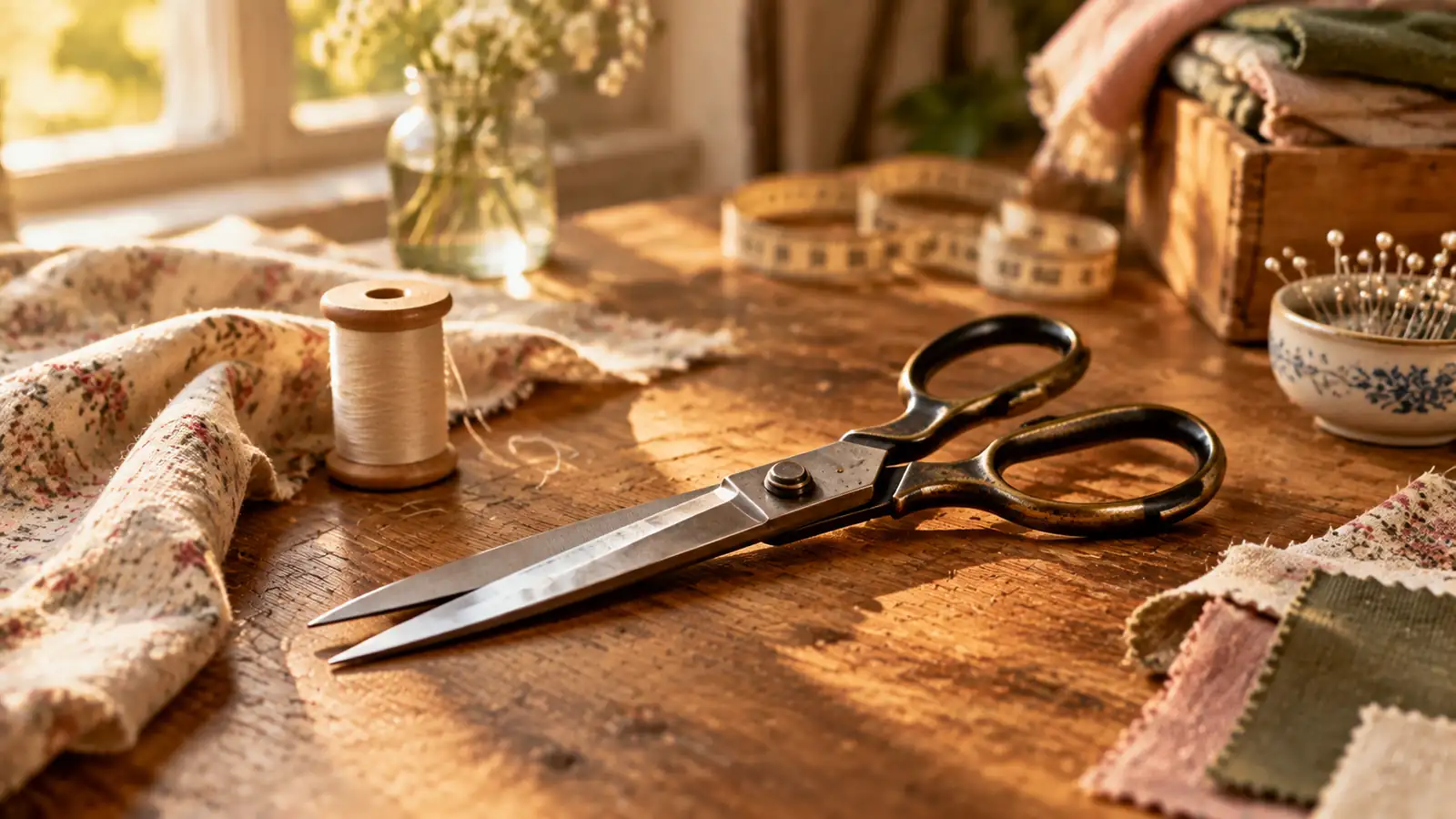
Dreaming about sewing or scissors: the short answer
Dream interpretation is not prediction and not diagnosis. This article separates what sleep research observes from what popular interpretation associates with the theme.
Dreaming about sewing or scissors does not predict a fight, a windfall or a breakup. The scene tends to show up when something needs mending, adjusting or deciding: sewing fits a wish to patch things up, and cutting fits choices and endings. For people who sew, do crafts or just got a haircut, it may simply be the day coming back at night.
Read also: Dreaming about clothes and Dreaming about a suit or tie.
What sleep science observes about dreaming about sewing or scissors
Research on the continuity between waking and dreaming, reviewed by Michael Schredl in 2003, shows that dreams tend to reflect daily activities, worries and emotions. Someone who sews for a living, altered a garment or watched someone at a sewing machine has a good chance of seeing the scene again in sleep.
Recently learned tasks can come back too. In 2010, Erin Wamsley and colleagues found that people who dreamed about a task they had just learned (finding their way through a virtual maze) performed better on it afterward. For someone learning to sew, dreaming about a needle may be part of how practice settles in.
Sources: Schredl and Hofmann, Continuity between waking activities and dream activities, Consciousness and Cognition, 2003; Wamsley and colleagues, Current Biology, 2010.
The most common versions of this dream
| Scene | What it usually comes with |
|---|---|
| Sewing a garment by hand or on a machine | A wish to fix, adjust or make something calmly |
| Pricking a finger or tangling the thread | Irritation, details slipping out of control |
| Being unable to thread the needle | Frustration, a sense that something small is blocking everything |
| Cutting fabric with scissors | A decision, a wish to separate or end something |
| Lost or dull scissors, or scissors cutting the wrong thing | Fear of making a mistake, regret, a sense of losing control |
If the blade took on a threatening edge, see also dreaming about knives.
If the dream keeps coming back: when to seek help
Most of the time, dreams about sewing or scissors are harmless. If scenes with blades and injuries keep repeating, make you afraid to fall asleep or weigh on your day, talk to a health professional: frequent nightmares are treatable. See how to have fewer nightmares.
Source: Morgenthaler et al., Journal of Clinical Sleep Medicine, 2018.
Science and belief: Freud, Jung and faith traditions
In Freud's psychoanalysis. Freud described condensation, in which a dream merges several ideas into one image, and displacement, which shifts the spotlight to something that seemed minor. A dress stitched from scraps of different colors is almost a picture of that work: pieces of the day and of other times sewn into a single garment. His method would be to take each scrap and ask where it came from.
In Jung's psychology. Jungian psychology often reads clothing through the persona, the social mask. In that light, altering a garment in a dream can be read as adjusting the way you present yourself. Man and His Symbols also quotes Max Ernst, who recalled the poet Lautréamont's line about a sewing machine and an umbrella meeting on an operating table: strange objects side by side, as so often happens in dreams.
In symbols and faith. In A Dictionary of Symbols, Chevalier and Gheerbrant note that in the Far East marriage is symbolized by two red silk threads that a celestial spirit twists into one, and that the Fates spin time and destiny. Scissors appear among the Masonic tools, active only through the will of the person using them. In the Bible, Matthew 9:16 speaks of a patch of new cloth on an old garment, and Acts 9:39 recalls the tunics Dorcas used to sew.
Bringing both views together. Science shows how the day and new skills get into a dream. Traditions ask what is being joined and what is being cut. Writing down what the needle was sewing, or what the scissors were cutting, already helps tell one from the other.
Sources: Freud, Die Traumdeutung, 1900; Jung (ed.), Man and His Symbols; Chevalier and Gheerbrant, A Dictionary of Symbols.
What dream books say
The Brazilian dream book O Livro dos Sonhos, by L. P. Baçan, treats the two tools separately. Scissors, in life, point to a handsome profit and, in love, to comfort. The needle goes the other way: in life, intrigue; in love, quarrels. The same sewing basket yields one hopeful reading and one warning.
Freud saw these books as the "decoding" method, which swaps each image for a fixed meaning, like a cipher. His example: in one such book, "letter" stood for "trouble." For Freud, the cipher misses that the same needle may recall a grandmother who sewed for one person and a shot at the doctor's for another.
Sources: Freud, Die Traumdeutung, 1900; L. P. Baçan, O Livro dos Sonhos, 2014.
Popular beliefs about this dream
In folk readings, sewing is often linked to reconciliation, patience and mending things in life; pricking a finger, to small gossip or setbacks; and scissors, to cuts, breakups or firm decisions. Open, sharp scissors, for some, speak of initiative; broken ones, of interrupted plans. These are cultural readings, not predictions. See what dreams mean according to science and culture.
Sources
- Schredl M, Hofmann F. Continuity between waking activities and dream activities. Consciousness and Cognition, 2003. https://doi.org/10.1016/S1053-8100(02)00072-7
- Morgenthaler TI et al. Position Paper for the Treatment of Nightmare Disorder in Adults: An American Academy of Sleep Medicine Position Paper. Journal of Clinical Sleep Medicine, 2018. https://doi.org/10.5664/jcsm.7178
- Wamsley EJ et al. Dreaming of a Learning Task Is Associated with Enhanced Sleep-Dependent Memory Consolidation. Current Biology, 2010. https://doi.org/10.1016/j.cub.2010.03.027
- Freud S. The Interpretation of Dreams (Die Traumdeutung), 1900. Project Gutenberg. https://www.gutenberg.org/ebooks/66048
- Jung CG (ed.). Man and His Symbols, 1964. Portuguese edition consulted: O homem e seus símbolos, Nova Fronteira/HarperCollins Brasil. https://www.skoob.com.br/book/8435
- Chevalier J, Gheerbrant A. A Dictionary of Symbols (Dictionnaire des symboles). Portuguese edition consulted: Dicionário de símbolos, José Olympio/Record. https://www.record.com.br/products/dicionario-de-simbolos
- Baçan LP. O Livro dos Sonhos (Brazilian dream book). Self-published, 2014.
Frequently asked questions
Do scissors in a dream mean a fight or a breakup?
No. Some folk readings link scissors to separation, but that is tradition, not prediction. In Baçan's dream book, scissors stand for profit and comfort. Research suggests the scene usually comes with decisions or a wish for change.
What does it mean to dream that you are sewing?
It often comes with a wish to fix, adjust or finish something patiently. For people who actually sew, it is also a common echo of their routine.
What about pricking your finger on a needle?
That scene usually comes with irritation or a sense that a detail got out of hand. It does not predict injury or conflict.
What does the Bible say about sewing?
Matthew 9:16 uses the image of new cloth patched onto an old garment, and Acts 9:39 shows the tunics Dorcas sewed for others. These are texts for reflection, not keys to predict the future.