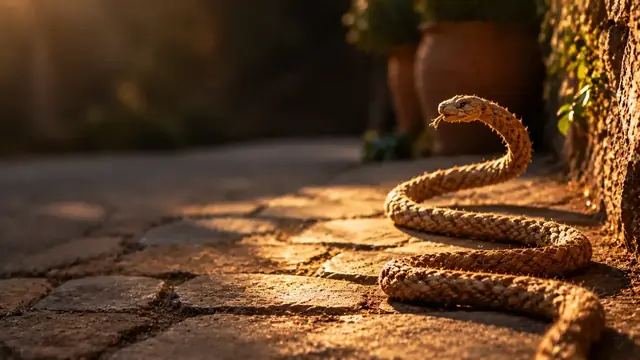
What dreaming about killing a snake usually points to
Dream interpretation is not prediction and not diagnosis. This article separates what sleep research observes from what popular interpretation associates with the theme, always saying which is which.
Dreaming about killing a snake does not mean you are going to fight with someone, hurt a person or that you have a hidden violent side. In most accounts, the dream comes with an attitude: you decided to face something that had been threatening you, you closed a situation, you said a no you had been holding back. What marks the scene is the gesture, not the death of the animal.
It is different from finding the snake already dead, which usually comes with relief that took no effort, the theme of dreaming about a dead snake. The general meaning of the animal is covered in dreaming about snakes; here the focus is on the act of killing.
Read also: Dreaming about a snake attacking and Dreaming about many snakes.
Why the dream ends with you defeating the snake
According to Antti Revonsuo's hypothesis, dreaming rehearses threats in order to train the reaction. Not every rehearsal ends in flight: sometimes the plot goes all the way to self-defense, and you wake up having won. Waking life supplies the rest, as Michael Schredl and Friedrich Hofmann showed in 2003. Anyone who grew up in the Brazilian countryside has seen a father, a grandfather or a neighbor kill a snake with a hoe in the yard, and that memory stays stored away.
Research also takes seriously the question many people ask after this dream: does killing in a dream say something about aggression while awake? In 2014, Schredl and Mathes published a study with that very question in its title, about dreams of killing someone. In other words, it is a question science examines carefully, not an accusation against the dreamer. And in your case the victim was a snake, an animal the brain treats as a threat.
Sources: Revonsuo, The reinterpretation of dreams, Behavioral and Brain Sciences, 2000; Schredl and Hofmann, Continuity between waking activities and dream activities, Consciousness and Cognition, 2003; Schredl and Mathes, Are dreams of killing someone related to waking-life aggression?, Dreaming, 2014.
How you killed the snake in the dream
| Scene | What usually goes with it |
|---|---|
| With a hoe or a stick | A practical attitude, using what was at hand to solve a problem |
| With your bare hands | Courage, a sense of having solved something alone and up close |
| Striking the snake's head | Going straight to the point, attacking the root of a problem |
| To protect a child, an animal or another person | Care, responsibility, the role of the one who defends the home |
| The snake would not die, no matter how many blows | A persistent problem, frustration, a matter that keeps coming back |
| Killing it and then feeling pity or guilt | Doubt about a hard decision you made |
If the dream involved killing a person, and not an animal, the reading is different: see dreaming about a murder.
See also: Dreaming about a yellow snake and Dreaming about a green snake.
In real life, do not kill the snake
The dream may end with the snake dead, but when you are awake the best path is a different one. Brazil has hundreds of snake species, and most of them are not venomous. The vine snake (cobra-cipó), the water snake (cobra-d'água) and the snail-eating dormideira, which feeds on slugs and snails, are examples of common, harmless snakes there. In addition, Brazil's Environmental Crimes Law (Law 9,605 of 1998) forbids killing wild animals without authorization, and snakes are included. Trying to kill or catch a snake also raises the chance of being bitten.
If you come across a snake, move away calmly, keep children and pets at a distance, watch from afar where it goes and call your local wildlife or emergency services (911 in the US); in Brazil, people call the fire department (193) or the city's environmental agency. If in doubt about whether it is a true or false coral snake, treat it as dangerous. In case of a bite, get medical care immediately: do not apply a tourniquet, do not cut the wound and do not suck it.
When this dream calls for attention
A single dream calls for nothing. It deserves attention in two cases. The first is a recurring nightmare, with the snake that never dies and waking up frightened several times a week: frequent nightmares have treatment, and a health professional can help. The second is when you really move while dreaming, throw punches or kicks, fall out of bed or hurt the person sleeping next to you. John Peever and Patrick Fuller's review of the biology of REM sleep describes REM sleep behavior disorder, and this kind of movement deserves a medical evaluation. See also how to have fewer nightmares.
Sources: Morgenthaler and colleagues, Journal of Clinical Sleep Medicine, 2018; Peever and Fuller, The biology of REM sleep, Current Biology, 2017.
Killing the snake for Freud, Jung and faith
In Freud's psychoanalysis. In The Interpretation of Dreams, Freud analyzes the dream of a patient in which a beetle dies crushed by a window. Her associations led to things from the day before, such as a moth that had fallen into a glass of water, and then to the theme of cruelty to animals and the contradictions of her own life. The animal's death was the way in, not the main subject.
In Jung's psychology. In Man and His Symbols, Joseph Henderson describes the hero myth, found among many peoples, in which the hero faces a monster, a dragon or a serpent. In the Jungian reading, the victory speaks of the maturing of the ego in the face of forces that once dominated it. Killing the snake, in that key, would mean taking the reins of something.
In symbols and faith. At the very beginning of the Bible, God announces that the offspring of the woman will strike the serpent's head: "it shall bruise thy head" (Genesis 3:15). In Luke 10:19, Jesus tells the disciples, "I give unto you power to tread on serpents and scorpions". For many Christians, the defeated snake is an image of evil overcome. These are beliefs of the tradition, without proof.
Bringing both readings together. Science speaks of rehearsal and memory; psychology and faith speak of courage and victory. It is worth asking what you have faced in recent days, or what you wish you had faced.
Sources: Freud, Die Traumdeutung, 1900; Jung (ed.), Man and His Symbols.
Killing a snake in dream books
O Livro dos Sonhos, a Brazilian dream book by L. P. Baçan, has no entry for the act of killing a snake. The entry for the serpent says: in life, danger; in love, betrayal. Those who follow folk logic tend to conclude that, if the serpent died, the danger has passed; that conclusion, however, belongs to the reader, not to the book.
Freud called this way of interpreting decoding, in which each image turns into another through a fixed code. Its flaw, for him, was forgetting the person who dreamed and what they lived through the day before.
Sources: L. P. Baçan, O Livro dos Sonhos, 2014; Freud, Die Traumdeutung, 1900.
What folk tradition says about killing a snake in a dream
In Brazilian folk reading, killing the snake in a dream is one of the most celebrated signs: victory over an enemy, the end of envy, overcoming an obstacle. Killing it with your bare hands would mean winning through your own effort; killing a big snake, overcoming an important challenge; killing several, a run of victories. The snake that will not die, on the other hand, would be a stubborn problem that calls for patience. These are traditional readings, not predictions. See what dream meanings look like according to science and culture.
Sources
- Revonsuo A. The reinterpretation of dreams. Behavioral and Brain Sciences, 2000. https://doi.org/10.1017/S0140525X00004015
- Schredl M, Hofmann F. Continuity between waking activities and dream activities. Consciousness and Cognition, 2003. https://doi.org/10.1016/S1053-8100(02)00072-7
- Schredl M, Mathes J. Are dreams of killing someone related to waking-life aggression? Dreaming, 2014; 24: 176-181. https://doi.org/10.1037/a0037213
- Morgenthaler TI et al. Position Paper for the Treatment of Nightmare Disorder in Adults: An American Academy of Sleep Medicine Position Paper. Journal of Clinical Sleep Medicine, 2018. https://doi.org/10.5664/jcsm.7178
- Peever J, Fuller PM. The Biology of REM Sleep. Current Biology, 2017; 27: R1237-R1248. https://doi.org/10.1016/j.cub.2017.10.026
- Freud S. The Interpretation of Dreams (Die Traumdeutung), 1900. Project Gutenberg. https://www.gutenberg.org/ebooks/66048
- Jung CG (ed.). Man and His Symbols, 1964. Portuguese edition consulted: O homem e seus símbolos, Nova Fronteira/HarperCollins Brasil. https://www.skoob.com.br/book/8435
- Baçan LP. O Livro dos Sonhos (Brazilian dream book). Self-published, 2014.
Frequently asked questions
Is dreaming about killing a snake good?
In folk reading, yes: it is usually seen as victory over a problem. Research sees no prediction in the dream, but the scene usually comes with relief and a sense of having acted.
Does dreaming that I killed a snake mean I am aggressive?
No. Dreaming that you killed a threatening animal is not a diagnosis of aggression. The relationship between dreams of killing and aggression while awake is a question research studies, not an accusation.
What if the snake would not die in the dream?
That version usually goes with persistent problems and frustration. If it becomes a recurring nightmare, it is worth talking to a health professional.
I found a snake at home. Can I kill it?
It is not recommended. Many snakes are harmless and, in Brazil, protected by law, and trying to kill one raises the risk of a bite. Move away and call your local wildlife or emergency services (911 in the US).
What is the spiritual meaning of dreaming about killing a snake?
For many Christians, it recalls the promise in Genesis 3:15, in which the serpent's head is bruised: evil overcome. It is a reading of faith, without scientific proof.