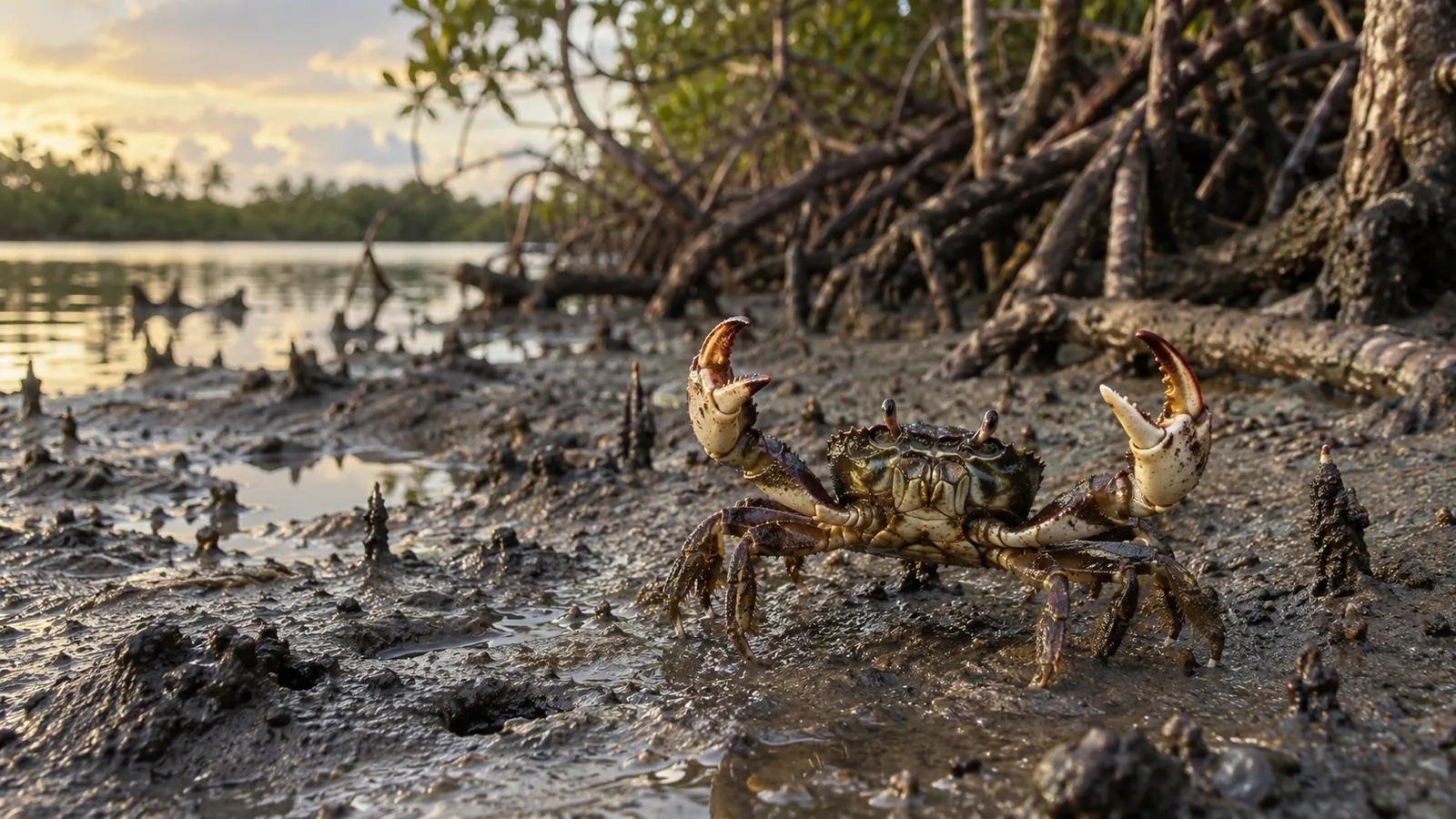
What a dream about crabs usually points to
Dream interpretation is not prediction and not diagnosis. This article separates what sleep research observes from what popular interpretation associates with the theme, always saying which is which.
Dreaming about crabs is not a warning of illness, of certain setbacks or of betrayal. The scene tends to show up in phases when something seems to be moving sideways: a plan that does not move forward, a conversation that goes in circles, a decision put off. When the crab pinches or grabs, the dream usually comes with the feeling of being held by someone or by a situation that will not let go.
The shell matters too: a crab hiding in its burrow tends to go with moments of defensiveness. It is a snapshot of the moment, not a diagnosis.
Read also: Dreaming about the beach and Dreaming about scorpions.
Why the crab comes out of its burrow in the dream
The continuity hypothesis, tested by Michael Schredl and Friedrich Hofmann in 2003, says that dreams follow what fills waking life. The crab has many paths into the night: a crab feast at a beach kiosk, a video of crab catchers in the mangrove, the horoscope of someone born under Cancer, Sebastian from The Little Mermaid, a trip to the coast.
Language helps. The name of the disease, cancer, comes from the Latin cancer, crab, and in Portuguese "walking backward like a crab" is a common expression. When they mapped the typical dreams of Canadian university students in 2003, Tore Nielsen and colleagues found that being chased sits at the top of the list; a crab running after you on the sand is a small version of that scene.
Sources: Schredl and Hofmann, Continuity between waking activities and dream activities, Consciousness and Cognition, 2003; Nielsen and colleagues, Dreaming, 2003.
Common crab scenes and what comes with them
| Scene | What usually goes with it |
|---|---|
| A crab pinching your foot or hand | A feeling of being stuck to someone or to a problem; sometimes, physical discomfort during sleep |
| A crab walking sideways or backward | A plan that does not move forward, a sense of going in circles without getting anywhere |
| Lots of crabs coming out of the mud | Many loose ends at once, a busy environment, memories of the beach or of a trip |
| Catching or gathering crabs | Effort to get something, work that calls for patience and a steady hand |
| A cooked red crab on the table | A gathering of family or friends, hunger, the memory of a trip to the coast |
If the scene took place in a mangrove or at sea, read also dreaming about mud and dreaming about the ocean and giant waves.
See also: Dreaming about an octopus and Dreaming about mosquitoes.
When it is worth telling a professional about the dream
Dreaming about crabs is rarely a cause for concern. It deserves attention when the dream turns into a recurring nightmare and you start waking up frightened several times a week. Frequent nightmares can be treated, and the first step is talking to a health professional. If the dream stirred up a fear of illness, take that question to a doctor. See also how to have fewer nightmares.
Source: Morgenthaler and colleagues, Journal of Clinical Sleep Medicine, 2018.
Psychoanalysis, symbols and faith on the crab
In Freud's psychoanalysis. In the first chapter of The Interpretation of Dreams, Freud gathers accounts of bodily stimuli that make their way into dreams, such as pain, cold and pressure. A cramp in the foot can take the form, in the scene, of a squeezing claw. The crab from a Sunday at the beach can also come back at night carrying another subject, like someone who just "won't let go."
In Jung's psychology. In an essay known in English as On the Psychology of the Unconscious, Jung analyzes the dream of a patient who was about to cross a river when a crab hidden in the water seized her foot. He also read the creature as something within her, pulling her back. Man and His Symbols follows the same line: the animal in a dream often shows the instinctive side that the person still knows little about.
In symbols and faith. In A Dictionary of Symbols, Chevalier and Gheerbrant discuss the crab alongside the sign of Cancer, which astrology links to water, the Moon and the home. In Greek myth, Hera sent a crab to attack Heracles during his fight with the Lernaean Hydra; the hero crushed it, and the goddess placed it in the sky as a constellation. The Bible does not name the crab, but Leviticus 11 classifies as unclean the water creatures without fins or scales, a group that includes crustaceans.
Bringing both readings together. Research explains how the beach, the plate and words carry the crab into the dream; traditions ask what you are protecting and what is holding you. Writing the scene down when you wake up helps you choose the question.
Sources: Freud, Die Traumdeutung, 1900; Jung (ed.), Man and His Symbols; Chevalier and Gheerbrant, A Dictionary of Symbols.
The crab in dream books
In O Livro dos Sonhos, a Brazilian dream book, L. P. Baçan sums up each theme in two lines, one for life and one for love. For the crab, the entry follows the creature's reputation: in life, delays; in love, a jealousy that clings. Catching the crab appears as a difficulty overcome.
Freud called this way of reading the decoding method: each image becomes a fixed meaning, without asking the dreamer anything. The crab of someone who works in the mangrove and the crab of someone who has been reading about medical tests are not talking about the same thing.
Sources: Freud, Die Traumdeutung, 1900; L. P. Baçan, O Livro dos Sonhos, 2014.
What folk tradition says about the crab
In Brazilian folk reading, a crab walking backward means delays in your plans; a big crab, an obstacle that calls for patience; lots of crabs, gossip nearby. Catching a crab by hand is an achievement earned with effort, and eating crab, the end of a hard phase. As for colors, the red of a cooked crab speaks of passion, and the blue of the guaiamum, a Brazilian land crab, of calm. These are traditional readings, good for reflection, not predictions. See what dream meanings look like according to science and culture.
Sources
- Schredl M, Hofmann F. Continuity between waking activities and dream activities. Consciousness and Cognition, 2003. https://doi.org/10.1016/S1053-8100(02)00072-7
- Nielsen TA et al. The typical dreams of Canadian university students. Dreaming, 2003. https://doi.org/10.1023/b:drem.0000003144.40929.0b
- Morgenthaler TI et al. Position Paper for the Treatment of Nightmare Disorder in Adults: An American Academy of Sleep Medicine Position Paper. Journal of Clinical Sleep Medicine, 2018. https://doi.org/10.5664/jcsm.7178
- Freud S. The Interpretation of Dreams (Die Traumdeutung), 1900. Project Gutenberg. https://www.gutenberg.org/ebooks/66048
- Jung CG (ed.). Man and His Symbols, 1964. Portuguese edition consulted: O homem e seus símbolos, Nova Fronteira/HarperCollins Brasil. https://www.skoob.com.br/book/8435
- Chevalier J, Gheerbrant A. A Dictionary of Symbols (Dictionnaire des symboles). Portuguese edition consulted: Dicionário de símbolos, José Olympio/Record. https://www.record.com.br/products/dicionario-de-simbolos
- Baçan LP. O Livro dos Sonhos (Brazilian dream book). Self-published, 2014.
Frequently asked questions
Is dreaming about crabs a sign of illness?
No. The word cancer comes from the Latin cancer, crab, and that link can bring the creature into the dreams of someone worried about their health. A dream is not a diagnosis; questions about symptoms belong with a doctor.
What does it mean to dream about a crab pinching you?
It usually goes with the feeling of being stuck to someone or to a problem. It can also come from a cramp during sleep. It is not a warning of betrayal.
Is dreaming about a crab walking backward a bad sign?
It predicts nothing. It usually reflects the sense that a plan is moving sideways. In folk reading it means delay, but that is tradition, not prediction.
What is the spiritual meaning of dreaming about crabs?
A Dictionary of Symbols discusses the crab alongside the sign of Cancer, linked to water, the Moon and the home. The Bible does not name it. These are symbols for reflection, not messages about the future.
Why did I dream about crabs after going to the beach?
Because dreams reuse the day. A crab feast or a crab scuttling across the sand is enough to become a scene.