What this dream usually points to (and what it does not)
Dream interpretation is not prediction and not diagnosis. This article separates what sleep research observes from what popular interpretation associates with the theme, always saying which is which.
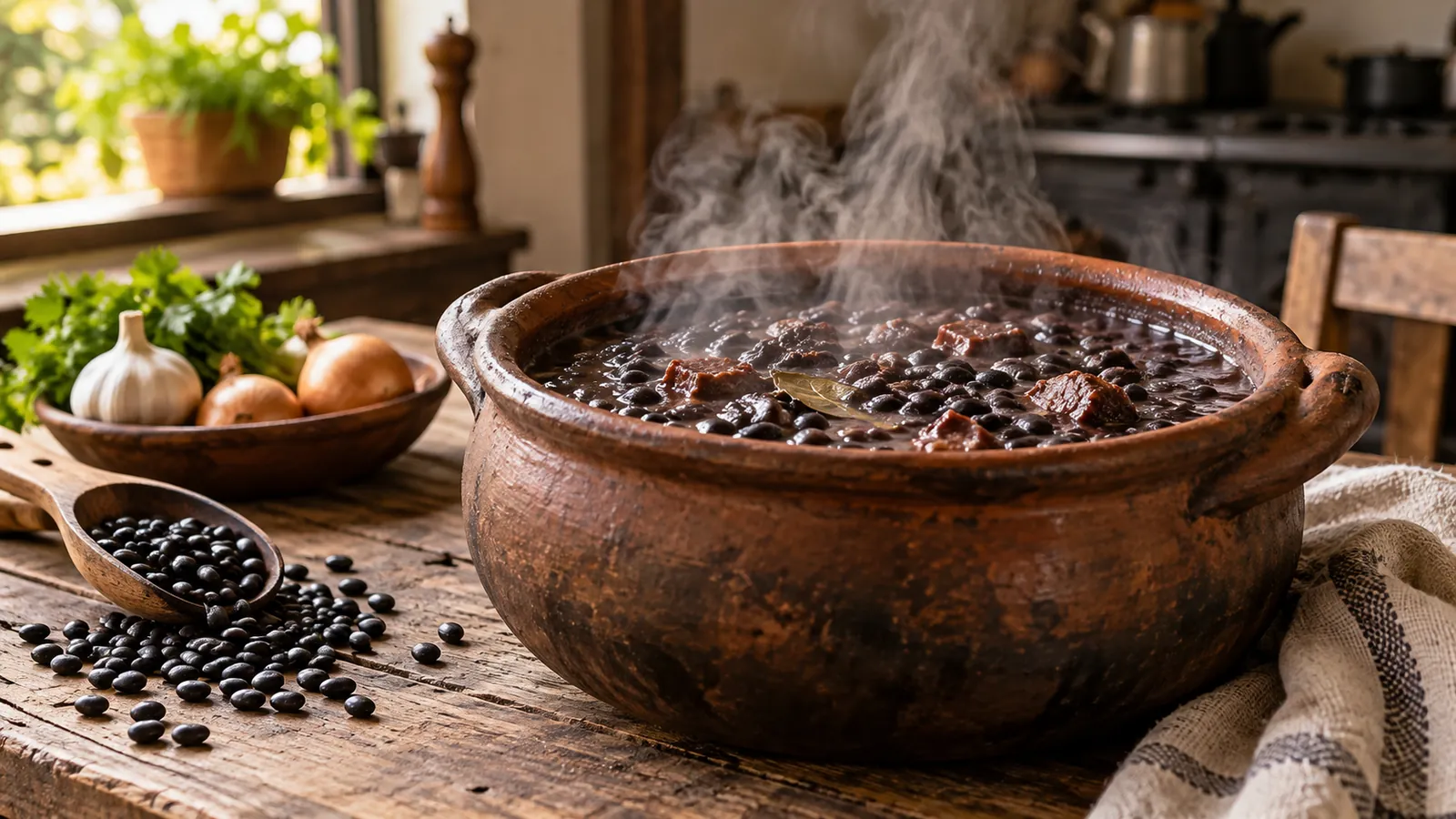
Dreaming about beans is not a warning about money, fights or illness. Beans enter the dream through routine: in Brazil they are in the pot almost every day, in the lunchbox, in the Saturday feijoada (the black bean and pork stew many families share on weekends), in the bag from the grocery store. Hot, well-seasoned beans usually come with a sense of being provided for and of a home well looked after; sorting beans, with patience or with the impression of a small, endless task; raw beans scattered, with many little things to sort out; spoiled or sour beans, with something that was kept too long.
The dream does not predict plenty or scarcity. It uses a food loaded with memory to talk about what you feel right now about making a living, work and family.
Read also: Dreaming about food and Dreaming about rice.
Why beans get into the dream
The continuity hypothesis, formulated by Michael Schredl and Friedrich Hofmann in 2003, says that the dream continues what fills waking life. In Brazil, beans fill quite a lot of it. Rice and beans are the backbone of the everyday meal: a bed of white rice with a ladle of beans in their broth on top, at lunch and often at dinner, at home, in workplace cafeterias and in lunchboxes, so much so that "arroz com feijão" (rice and beans) is also a common expression for the basics done right. Beans are left to soak the night before, cooked in the pressure cooker, seasoned, served and stored. Someone who cooked, who sorted beans with their grandmother or who works on a farm has the image at hand.
The body takes part too. Dement and Wolpert showed in 1958 that outside stimuli during sleep enter the plot of the dream. Going to bed hungry, with a heavy stomach after a feijoada or with the smell of seasoning still in the house can produce a whole dream of a bubbling pot.
Sources: Schredl and Hofmann, Continuity between waking activities and dream activities, Consciousness and Cognition, 2003; Dement and Wolpert, Journal of Experimental Psychology, 1958.
Freud, Jung and faith on beans
In Freud's psychoanalysis. Freud saw the dream as the disguised fulfillment of a wish and gave himself as the example: he ate something salty at night and dreamed of water. Someone who sleeps hungry or missing home cooking may dream of a steaming plate of beans. For Freud, food in a dream is often hunger, or the wish to be taken care of, taking shape.
In Jung's psychology. In Man and His Symbols, Jung recalls that the dream compensates for what waking life throws off balance. Someone in a phase of scarcity may dream of a full pot; someone overloaded may dream of sorting beans without end. The work of separating them one by one is, by the way, a good image of what Jung called making conscious what was mixed together.
In symbols and faith. In A Dictionary of Symbols, Chevalier and Gheerbrant record that in ancient Greece and Rome the fava bean, a relative of the common bean, was linked to the dead and to ancestors: the followers of Pythagoras avoided eating it, and during the Roman festival of the Lemuria the head of the household threw fava beans behind him to drive the spirits out of the house. At the same time, the seed that is stored and planted is a symbol of the continuity of life. The Bible lists beans among simple foods: in Ezekiel 4:9, the prophet is told to make bread from wheat, barley, beans, lentils and millet, food for hard times. In 2 Samuel 17:28, beans and lentils are among the provisions brought to David and his men.
Bringing both readings together. Science explains why the day's pot comes back at night. Symbols remind you that beans are at once food for the living and a seed that connects us to earlier generations.
Sources: Freud, Die Traumdeutung, 1900; Jung (ed.), Man and His Symbols; Chevalier and Gheerbrant, A Dictionary of Symbols.
The most common versions of this dream
| Scene | What usually goes with it |
|---|---|
| A plate of hot beans with thick broth | Nourishment, a home well looked after, missing someone's cooking |
| Sorting beans, separating them one by one | Patience, a small and lengthy task, a need to put something in order |
| Raw beans scattered, or a bag with a hole in it | Many small things to sort out, a sense of waste |
| Spoiled, sour or bug-infested beans | Something kept too long, a situation that went past its point |
| A bean plant growing, or planting beans | A project getting started, waiting, memories of school or the countryside |
If the dream showed the whole table and not just the beans, dreaming about food covers the bigger picture. If they came with rice, see also dreaming about rice.
See also: Dreaming about beer and Dreaming about a rope.
When the dream deserves professional attention
Dreaming about beans is not a cause for concern. It deserves attention if dreams about food often come with guilt, fear of eating or distress on waking: in that case, talking to a health professional about your relationship with food helps. And if any dream turns into a recurring nightmare, disturbing your rest several times a week, there is treatment. See how to have fewer nightmares.
Source: Morgenthaler and colleagues, Journal of Clinical Sleep Medicine, 2018.
In dream books
In O Livro dos Sonhos, a Brazilian dream book, L. P. Baçan follows the format popular dream books have used for generations, one line for life and another for love. For beans, the recorded line matches their reputation as simple, reliable food: in life, work and a secure livelihood; in love, a stable relationship, with spoiled beans becoming a warning of wear and tear. It is a noted belief, not a prediction.
Jung, in Man and His Symbols, makes the caveat that applies to every entry: dream symbols belong to the person and do not fit into lists. The beans of someone who grows them and the beans of someone who went hungry as a child do not say the same thing.
Sources: L. P. Baçan, O Livro dos Sonhos, 2014; Jung (ed.), Man and His Symbols.
What folk tradition associates with this dream
In Brazilian folk reading, cooked beans are a sign of being provided for and of a well-stocked home; raw beans, of work ahead; sorting beans, of patience rewarded; spilled beans, of small losses; black beans, of protection for the home; white beans, of peace; spoiled beans, of an old matter coming back; feijoada, of a party with friends; and a bean plant, of a growing project. These are cultural readings, useful for thinking about your own routine, not predictions. See what dream meanings look like according to science and culture.
Sources
- Schredl M, Hofmann F. Continuity between waking activities and dream activities. Consciousness and Cognition, 2003. https://doi.org/10.1016/S1053-8100(02)00072-7
- Dement W, Wolpert EA. The relation of eye movements, body motility, and external stimuli to dream content. Journal of Experimental Psychology, 1958. https://doi.org/10.1037/h0048908
- Morgenthaler TI et al. Position Paper for the Treatment of Nightmare Disorder in Adults: An American Academy of Sleep Medicine Position Paper. Journal of Clinical Sleep Medicine, 2018. https://doi.org/10.5664/jcsm.7178
- Freud S. The Interpretation of Dreams (Die Traumdeutung), 1900. Project Gutenberg. https://www.gutenberg.org/ebooks/66048
- Jung CG (ed.). Man and His Symbols, 1964. Portuguese edition consulted: O homem e seus símbolos, Nova Fronteira/HarperCollins Brasil. https://www.skoob.com.br/book/8435
- Chevalier J, Gheerbrant A. A Dictionary of Symbols (Dictionnaire des symboles). Portuguese edition consulted: Dicionário de símbolos, José Olympio/Record. https://www.record.com.br/products/dicionario-de-simbolos
- Baçan LP. O Livro dos Sonhos (Brazilian dream book). Self-published, 2014.
Frequently asked questions
What does it mean to dream about cooked beans?
It usually goes with a sense of being provided for, of a home well looked after or of missing someone's cooking. Folk reading speaks of plenty, but that is tradition, not prediction.
What does it mean to dream about sorting beans?
In general, patience or the feeling of a small, lengthy task. People who need to put something confusing in order often have this image.
Is dreaming about spoiled beans a bad sign?
No. It usually comes with the feeling of something kept too long or of a situation that went past its point. It does not announce illness or loss.
What does it mean to dream about a bean plant?
In general, a project getting started and waiting for results. For many people, the image comes straight from the school experiment of sprouting a bean in cotton wool.
Does dreaming about beans have a spiritual meaning?
In antiquity, the fava bean was linked to ancestors; the Bible lists beans among the simple foods of hard times. The dream may call this up, but it predicts nothing.