Dreaming about a street: the short answer
Dream interpretation is not prediction and not diagnosis. This article separates what sleep research observes from what popular interpretation associates with the theme, always saying which is which.
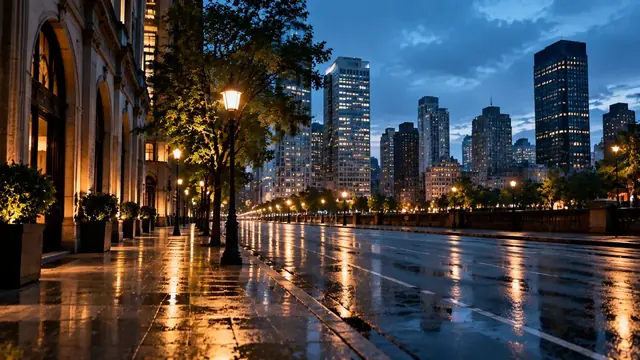
Dreaming about a street does not announce a trip, danger or a change of address. The street is the stretch between home and the world: it is how you get to work, to school, to someone's house. That is why dreams use it in phases of transition, exposure or choice. The condition of the street tends to mirror the condition of the dreamer: dark when there is insecurity, flooded when something is stuck, familiar when longing tightens.
This article is about the street itself. The city as a whole is covered in dreaming about a city; the feeling of not knowing where you are, in dreaming about being lost.
Read also: Dreaming about rain or floods and Dreaming about being chased.
Why streets show up so often in dreams
The continuity hypothesis, tested by Michael Schredl and Friedrich Hofmann in 2003, says that dreams reuse what fills waking life. Few things repeat as much as the daily commute: the same bus stop, the same corner, the same pothole in the sidewalk. That route becomes a ready-made setting, and it often blends with streets from other times in your life.
The dark street has an extra explanation. In 2000, Antti Revonsuo proposed that dreaming works as a threat simulation, a nightly rehearsal for noticing and avoiding dangers. A street with no lights and footsteps behind you is the classic stage for that rehearsal. The flooded street, on the other hand, may get a push from the body or the surroundings: in 1958, William Dement and Edward Wolpert tested outside stimuli during sleep, such as drops of water on the skin, and found that they sometimes make their way into the plot of the dream. Heavy rain beating against the window can turn into water rising in the street.
Sources: Schredl and Hofmann, Continuity between waking activities and dream activities, Consciousness and Cognition, 2003; Revonsuo, The reinterpretation of dreams, Behavioral and Brain Sciences, 2000; Dement and Wolpert, Journal of Experimental Psychology, 1958.
The streets that show up most in dreams
| Scene | What usually goes with it |
|---|---|
| A dark street, with the streetlights out | Insecurity, fear of something that has no name yet, coming home late in real life |
| A flooded street, with the water rising | A feeling of being stuck, a problem that has piled up, heavy rain during the week |
| A dirt road, with dust or mud | Memories of the countryside or of childhood, a harder path |
| The street where you lived as a child | Longing, revisiting a phase of life, news from someone from that time |
| An unknown street you have never seen | Something new, a change of job or city, curiosity mixed with apprehension |
| A dead end | A deadlock, a postponed decision, a feeling of having nowhere to go |
If the mud was at the center of the scene, read dreaming about mud; if the water was murky, dreaming about dirty water. On the street of your childhood, the old house and the neighbors often appear together: see dreaming about an old house and dreaming about your neighbor.
See also: Dreaming about a plane crash and Dreaming about the subway.
When the street in your dream calls for attention
A dark street once in a while is just a fear dream, common and passing. It deserves attention when it comes back many nights, with chases or attacks, and you wake up frightened and afraid to go to sleep. This matters even more for anyone who has been mugged or assaulted on the street: the repeated dream may be part of the way body and mind process the shock, and a health professional can help. Frequent nightmares have treatment; see how to have fewer nightmares. In intense distress, in the US, you can call or text 988 (Suicide & Crisis Lifeline), free and available 24 hours a day.
Source: Morgenthaler and colleagues, Journal of Clinical Sleep Medicine, 2018.
The street in dream books
O Livro dos Sonhos, a Brazilian dream book by L. P. Baçan, has an entry for street, and an optimistic one: in life, money; in love, success. The avenue comes in a different tone: in life, lack of prospects; in love, indecision. For the dark street, the closest entry is darkness: in life, enemies; in love, caution. This is tradition, not prediction.
Jung pointed out, in Man and His Symbols, that a symbol depends on the person who dreams it. The dirt road of someone who grew up on a small farm and that of someone who has only seen one in a movie cannot share the same key.
Sources: L. P. Baçan, O Livro dos Sonhos, 2014; Jung (ed.), Man and His Symbols.
The street in a dream according to Freud, Jung and faith
In Freud's psychoanalysis. In The Interpretation of Dreams, Freud tells how for years he dreamed of a strange place, with sandstone figures on the left, without knowing where it came from. In 1907, in Padua, he found the place on the street leading to the Arena Chapel, probably at the point where he had given up on his walk twelve years earlier. In another dream, the street he was riding along on horseback was made of impressions from Verona and Siena. The unknown street, in this reading, may be a street seen in passing and forgotten, or several streets assembled into one.
In Jung's psychology. In Jungian psychology, the path is a frequent image of the process of individuation, the growth of the personality over a lifetime. A dark street can be read as a stretch in which a person needs to face their own shadow, the sides of themselves they would rather not see; a dead end, as an attitude that no longer leads anywhere. It is a reading to think about, not a diagnosis.
In symbols and faith. In the book of Proverbs, wisdom cries out in the streets and raises her voice in the squares (Proverbs 1:20), like someone speaking in the middle of ordinary life. And Psalm 119:105 says: "Thy word is a lamp unto my feet, and a light unto my path." For people of faith, the dark street in a dream can become a request for direction, and the well-lit street, gratitude.
Bringing both readings together. Research shows that the dreamed street is made of daily routes, memories and fears. Psychology and faith ask what you are passing through right now and what lights that path.
Sources: Freud, Die Traumdeutung, 1900; Jung (ed.), Man and His Symbols.
What folk belief associates with a street in a dream
In folk reading, a well-lit, busy street is a sign of open paths; a dark street, a call for caution with people and decisions; a flooded street, a passing obstacle; a dirt road, success won through honest work. The street of your childhood would announce news from someone from the past, and an unknown street, something new on the way. A dead end is read as a time to change direction. These are beliefs from tradition, to reflect on, and not predictions. See what dream meanings look like according to science and culture.
Sources
- Schredl M, Hofmann F. Continuity between waking activities and dream activities. Consciousness and Cognition, 2003. https://doi.org/10.1016/S1053-8100(02)00072-7
- Revonsuo A. The reinterpretation of dreams. Behavioral and Brain Sciences, 2000. https://doi.org/10.1017/S0140525X00004015
- Dement W, Wolpert EA. The relation of eye movements, body motility, and external stimuli to dream content. Journal of Experimental Psychology, 1958. https://doi.org/10.1037/h0040031
- Morgenthaler TI et al. Position Paper for the Treatment of Nightmare Disorder in Adults: An American Academy of Sleep Medicine Position Paper. Journal of Clinical Sleep Medicine, 2018. https://doi.org/10.5664/jcsm.7178
- Baçan LP. O Livro dos Sonhos (Brazilian dream book). Self-published, 2014.
- Freud S. The Interpretation of Dreams (Die Traumdeutung), 1900. Project Gutenberg. https://www.gutenberg.org/ebooks/66048
- Jung CG (ed.). Man and His Symbols, 1964. Portuguese edition consulted: O homem e seus símbolos, Nova Fronteira/HarperCollins Brasil. https://www.skoob.com.br/book/8435
Frequently asked questions
What does it mean to dream about a dark street?
It usually goes with insecurity or fear of something that has not taken shape yet. For research, threat dreams are common and may work as a rehearsal of danger. It is not a warning.
Is dreaming about a flooded street a bad sign?
No. The scene usually reflects a feeling of being stuck or a problem that has piled up, and sometimes it comes from the real rain of the week. In tradition, it is read as a passing obstacle.
Why do I dream about the street where I lived as a child?
Childhood places are well stored in memory and come back in times of longing, of change or after running into someone from that time.
I dreamed about a street I have never seen. Does it exist?
It might: Freud says he recognized in Padua a place he had been seeing in dreams for years, and that he had probably passed by it on a visit in 1895, without remembering it. But most of the time, the dream builds the street out of pieces of different places.
What is the spiritual meaning of dreaming about a street?
For many people of faith, the street is an image of the path of life, and the dream becomes a request for direction, as in Psalm 119:105. It is a faith reading, with no proof behind it.