Dreaming about a mall: the direct answer
Dream interpretation is not prediction and not diagnosis. This article separates what sleep research observes from what popular interpretation associates with the theme, always saying which is which.
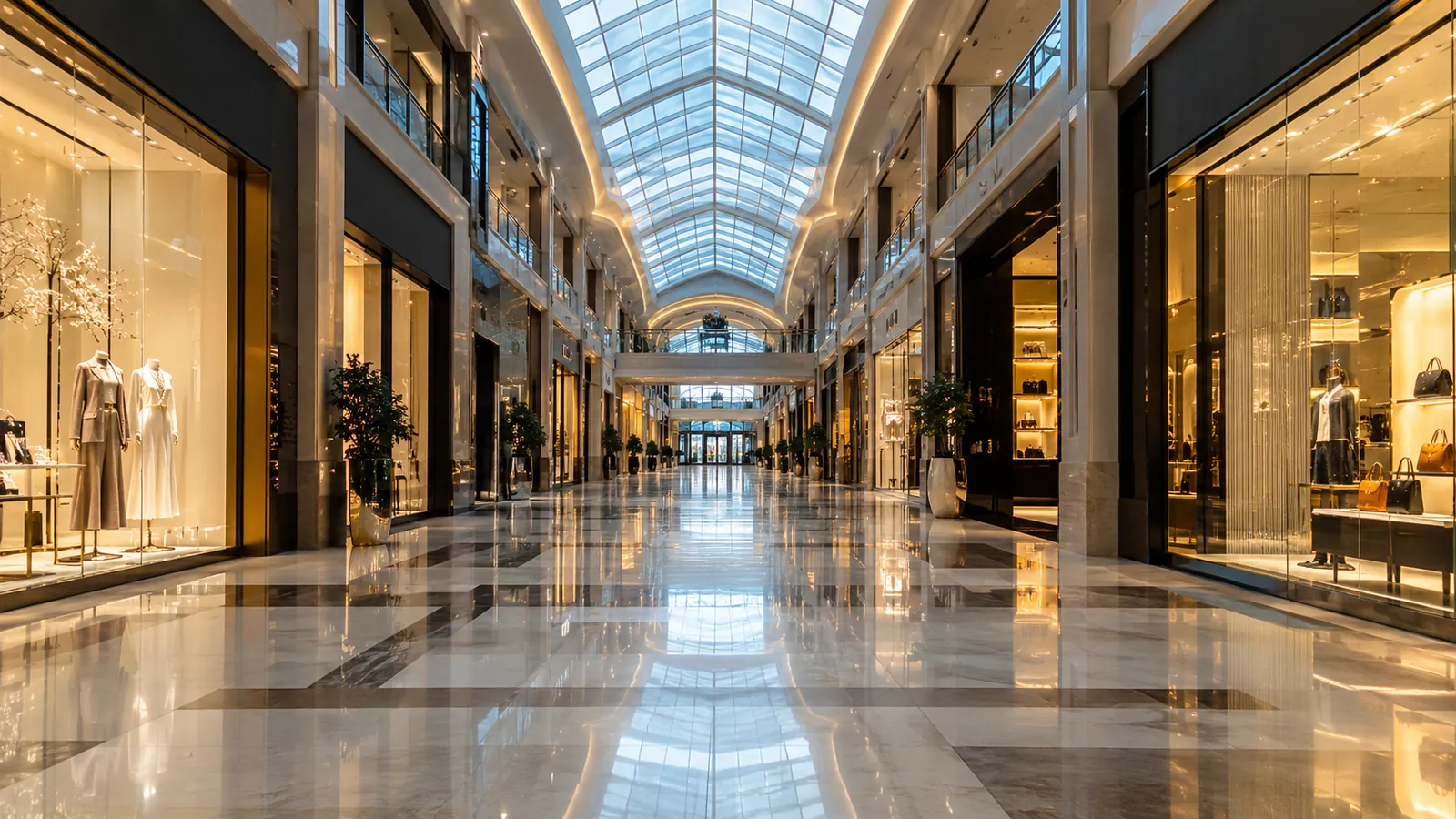
Dreaming about a shopping mall usually points to a phase of choices and comparisons: between two jobs, two paths, two wants. The mall is the place where everything is on display at the same time, and the dream uses this setting when a person feels they need to decide among many options, or when the wish to have something has grown bigger than the budget allows.
The dream does not announce money on the way or debt coming. And it is not a "shopaholic's dream": the mall is part of the routine of millions of people, who go there for the movies, for work, for the bank or to escape the heat. The scene that matters is what you were doing inside and how you felt.
Read also: Dreaming about a city and Dreaming about money.
Why the mall shows up in the dream
The continuity hypothesis, studied by Michael Schredl and Friedrich Hofmann in 2003, says that the places and activities of waking life tend to come back in dreams. For someone who works in a mall, spends weekends there or has just faced the holiday shopping season, the setting is ready in memory. Even someone who only browsed store windows on their phone carries the excess of offers into the night.
The mall also has features that dreams like to use: corridors that repeat, floors that look alike, many doors, many strangers and a parking garage that is hard to find. In the dream, this architecture becomes the perfect maze for the feeling of being lost or late, two of the most common themes in surveys of typical dreams, such as the one by Tore Nielsen and colleagues in 2003.
Sources: Schredl and Hofmann, Continuity between waking activities and dream activities, Consciousness and Cognition, 2003; Nielsen and colleagues, Dreaming, 2003.
Freud, Jung and symbols on this dream
In Freud's psychoanalysis. In The Interpretation of Dreams, Freud argued that the dream fulfills a wish in disguise. Few places are made of desire as much as a mall: everything there is on offer. Walking among store windows without buying may be desire on display and put off; filling shopping bags, the satisfaction that waking life does not allow.
In Jung's psychology. Jung saw in dreams an attempt to compensate for what the conscious mind exaggerates. In Man and His Symbols, he and his collaborators describe how modern people, surrounded by objects, lose touch with the symbols that once gave life meaning. An empty mall, or one with no exit, in this key, may be the dream showing the hollow side of abundance, and asking the person to look for what is missing somewhere else.
In symbols and faith. The mall is too new to appear in A Dictionary of Symbols, but Chevalier and Gheerbrant deal with the market and the fair as places of exchange, of meeting and also of confusion, where things get lost and found. The Bible has market scenes that carry weight: in Matthew 21, Jesus drives the sellers out of the temple, separating the place of prayer from the place of commerce. In Luke 12, the parable of the man who builds bigger barns warns against hoarding without thinking about the rest of life. The dream about a mall, in this reading, asks what you are buying with your time.
Bringing both readings together. Science shows the mall as a familiar setting and an ideal maze for the feeling of being lost. Symbols ask about desire and about what is worth it. Noting the store you were looking for and whether there was an exit helps tie the two ends together.
Sources: Freud, Die Traumdeutung, 1900; Jung (ed.), Man and His Symbols; Chevalier and Gheerbrant, A Dictionary of Symbols.
Scenes that show up most in this dream
| Scene | What usually goes with it |
|---|---|
| A packed mall, full of strangers | Too many demands, a feeling of being one among many, social fatigue |
| An empty, closed or abandoned mall | A phase of pause, a desire that has lost its appeal, a sense of emptiness after an achievement |
| Not finding the store or the exit | A stalled decision, difficulty choosing, fear of wasting time on what does not matter |
| Buying a lot, or having no money at the checkout | Wanting more than is possible, worry about bills, guilt about spending |
| Running into someone you know at the mall | A wish to talk with that person, an unfinished matter, missing someone |
If the scene took place inside a clothing store or in the fitting room, it is worth reading dreaming about clothes too.
See also: Dreaming about a farm and Dreaming about a forest.
When it is worth seeking help
A dream about a mall is rarely a nightmare. But if the scene of being lost, surrounded or with no way out keeps repeating, you often wake up anxious and it starts to disturb your sleep, it is worth talking to a health professional: recurring nightmares have treatment. See how to have fewer nightmares.
Source: Morgenthaler and colleagues, Journal of Clinical Sleep Medicine, 2018.
What dream books say
In O Livro dos Sonhos, a Brazilian dream book, L. P. Baçan has no entry for the mall, a place too recent for the tradition of these books. The closest is the entry for a store or for shopping, which follows this line: in life, opportunities and novelties; in love, spending because of someone. Folk reading carried this key over to the mall.
Freud criticized this decoding format precisely because it ignores the dreamer: the store that appears to someone in debt is different from the store that appears to someone who has just been promoted. The table helps you start, but the answer lies in each person's story.
Sources: Freud, Die Traumdeutung, 1900; L. P. Baçan, O Livro dos Sonhos, 2014.
Folk readings of dreaming about a mall
In Brazilian folk reading, dreaming about a mall is associated with novelties and with spending decisions. A crowded mall appears as a phase of many opportunities; an empty mall, as a call to spend less; buying in the dream, as a wish that will come true; not being able to buy, as a warning that it is time to wait. A mall with very colorful stores is read as joy ahead; a dark or closed mall, as a deal that will not move forward. These are readings from tradition, not predictions. See what dream meanings look like according to science and culture.
Sources
- Schredl M, Hofmann F. Continuity between waking activities and dream activities. Consciousness and Cognition, 2003. https://doi.org/10.1016/S1053-8100(02)00072-7
- Nielsen TA et al. The typical dreams of Canadian university students. Dreaming, 2003. https://doi.org/10.1023/b:drem.0000003144.40929.0b
- Freud S. The Interpretation of Dreams (Die Traumdeutung), 1900. Project Gutenberg. https://www.gutenberg.org/ebooks/66048
- Jung CG (ed.). Man and His Symbols, 1964. Portuguese edition consulted: O homem e seus símbolos, Nova Fronteira/HarperCollins Brasil. https://www.skoob.com.br/book/8435
- Chevalier J, Gheerbrant A. A Dictionary of Symbols (Dictionnaire des symboles). Portuguese edition consulted: Dicionário de símbolos, José Olympio/Record. https://www.record.com.br/products/dicionario-de-simbolos
- Morgenthaler TI et al. Position Paper for the Treatment of Nightmare Disorder in Adults: An American Academy of Sleep Medicine Position Paper. Journal of Clinical Sleep Medicine, 2018. https://doi.org/10.5664/jcsm.7178
- Baçan LP. O Livro dos Sonhos (Brazilian dream book). Self-published, 2014.
Frequently asked questions
What does it mean to dream about a crowded mall?
It usually goes with phases of excess: many demands, many people around, social fatigue. In folk reading, it is read as many opportunities at once.
Is dreaming about an empty mall bad?
No. The scene usually appears in phases of pause or when a desire has lost its appeal. In folk reading, it is read as advice to spend less.
I dreamed I could not find the exit of the mall. What now?
It is one of the most common scenes and is linked to the feeling of being lost in a decision. It is worth noting which choice is stuck in your waking life.
Is dreaming about shopping at the mall a sign of money?
There is no basis for predicting gains. The scene usually reflects desire and comparison. In folk reading, it is read as a wish that comes true, but that is tradition, not prediction.
Does dreaming about a mall have to do with consumerism?
Not necessarily. The mall is part of many people's routine. What matters is what you were doing in the scene and how you felt.