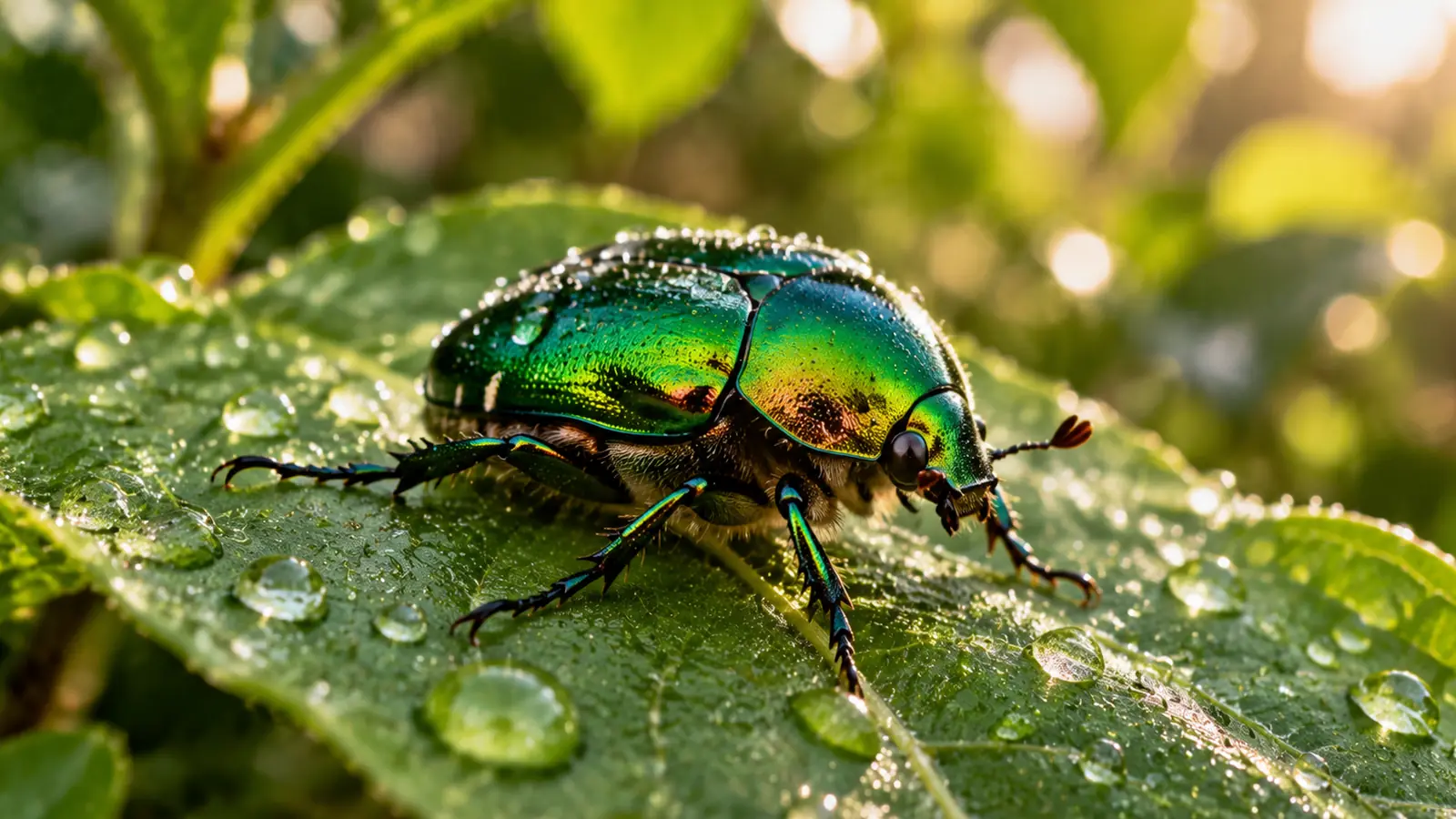
Dreaming about a beetle: the direct answer
Dream interpretation is not prediction and not diagnosis. This article separates what sleep research observes from what popular interpretation associates with the theme, always saying which is which.
Dreaming about a beetle is not a warning of enemies, of the evil eye or of bad luck. The insect tends to appear in phases of persistent annoyance, when something small disturbs your peace, or at times of protection, since the hard shell is the creature's hallmark. When the beetle falls on its back and cannot turn over, the dream tends to come with a feeling of being stuck.
Nor is it a sign of dirt in the house. For dreams with several insects mixed together, the article on dreaming about insects is the starting point; here, the focus is the beetle and what its scene usually goes along with.
Read also: Dreaming about insects and Dreaming about a ladybug.
Why the beetle shows up in the dream
The continuity hypothesis, which Michael Schredl and Friedrich Hofmann tested in 2003, shows that dreams tend to reuse what passed through the day. The beetle has many ways in: the one that hit the porch light on a hot night, the dung beetle seen in a documentary, the rhinoceros beetle from science class, the scarab of movies about Egypt.
The body takes part too. In 1958, William Dement and Edward Wolpert observed in the lab that stimuli applied during sleep, such as sprays of water on the skin, were sometimes incorporated into the plot. An itch, a strand of hair on your face or the hum of a fan can turn into a beetle walking on your arm or flying near your ear.
Sources: Schredl and Hofmann, Continuity between waking activities and dream activities, Consciousness and Cognition, 2003; Dement and Wolpert, Journal of Experimental Psychology, 1958.
Beetle scenes and what usually goes with them
| Scene | What usually goes with it |
|---|---|
| A beetle flying near you | An annoyance you cannot get out of your head, noise in the bedroom, a hot night |
| A beetle walking on your body | An itch or sensation on the skin during sleep, distress over something small |
| A black beetle | Vague fear, a worry that shows up at night; black in a dream tends to weigh more |
| A green or shiny beetle | Curiosity, unexpected beauty, the memory of nature or of a trip |
| A beetle on its back, unable to turn over | A sense of being stuck, of needing help to start again |
| Killing a beetle | A wish to settle an annoyance once and for all, relief after a small problem |
If the insect in the dream looked like something else, compare with dreaming about a cockroach and dreaming about a firefly.
See also: Dreaming about grasshoppers and Dreaming about earthworms.
When dreaming about a beetle calls for attention
Dreaming about a beetle rarely gives cause for worry. It deserves attention when the dream about insects on your body repeats, you wake up distressed or you start to be afraid of going to sleep. Frequent nightmares have treatment, and the first step is to talk to a health professional. An itch or a feeling of something crawling on your skin that continues during the day also deserves a medical evaluation, not interpretation. See how to have fewer nightmares.
Source: Morgenthaler and colleagues, Journal of Clinical Sleep Medicine, 2018.
The beetle in dream books
In O Livro dos Sonhos, a Brazilian dream book, L. P. Baçan gives the beetle a harsh reading: in life, enemies; in love, contempt. The book seems to stick with the reputation of the insect that bothers people and with the shell that lets no one get close.
Jung reminded us that a symbol always holds more than the definition we give it. The same beetle was, in ancient Egypt, an image of the sun being reborn. A list helps start the conversation, but it does not replace the question of what that beetle brings to mind for the person who dreamed it.
Sources: L. P. Baçan, O Livro dos Sonhos, 2014; Jung (ed.), Man and His Symbols.
Freud, Jung and traditions on the beetle
In Freud's psychoanalysis. In The Interpretation of Dreams, Freud analyzes a patient's dream about two beetles trapped in a box: she opened it to set them free, one flew out of the window and the other was crushed. In the analysis, leftovers from the day came up, such as a moth that had fallen into a glass of water and a book about cruelty to animals, along with memories of contradictions between appearance and character. For Freud, the tiny scene pulled a long thread of memories.
In Jung's psychology. In an essay on synchronicity, Jung tells how a patient was recounting a dream about a golden scarab when a similar beetle bumped against the window of his consulting room. He used the case to talk about meaningful coincidences. In Man and His Symbols, dream animals appear as an expression of instinctive life.
In symbols and faith. A Dictionary of Symbols, by Chevalier and Gheerbrant, devotes space to the Egyptian scarab, linked to Khepri, the sun that is born again every morning, an image of renewal. In Bahia, Besouro Mangangá ("besouro" means beetle in Portuguese) is the nickname of a famous capoeira fighter from the early 20th century, surrounded by legends of a "closed body" that weapons could not harm. These are readings from culture and belief, not from science.
Bringing both readings together. Research shows that the beetle can come from the day and from the skin; traditions ask about protection and rebirth. Both readings fit in a note written when you wake up.
Sources: Freud, Die Traumdeutung, 1900; Jung (ed.), Man and His Symbols; Chevalier and Gheerbrant, A Dictionary of Symbols.
The beetle in folk reading
In Brazilian folk reading, the beetle has a double reputation. A black beetle inside the house is seen as a warning to be careful with conversations; a green or golden beetle, as luck and renewal, in the line of the Egyptian scarab. A beetle flying around a person appears as news on its way; many beetles together, as small annoyances piling up; a beetle that leaves through the window, as a problem that resolves itself. These are traditional beliefs, for reflection, not predictions. See what dream meanings look like according to science and culture.
Sources
- Schredl M, Hofmann F. Continuity between waking activities and dream activities. Consciousness and Cognition, 2003. https://doi.org/10.1016/S1053-8100(02)00072-7
- Dement W, Wolpert EA. The relation of eye movements, body motility, and external stimuli to dream content. Journal of Experimental Psychology, 1958. https://doi.org/10.1037/h0048908
- Morgenthaler TI et al. Position Paper for the Treatment of Nightmare Disorder in Adults: An American Academy of Sleep Medicine Position Paper. Journal of Clinical Sleep Medicine, 2018. https://doi.org/10.5664/jcsm.7178
- Baçan LP. O Livro dos Sonhos (Brazilian dream book). Self-published, 2014.
- Jung CG (ed.). Man and His Symbols, 1964. Portuguese edition consulted: O homem e seus símbolos, Nova Fronteira/HarperCollins Brasil. https://www.skoob.com.br/book/8435
- Freud S. The Interpretation of Dreams (Die Traumdeutung), 1900. Project Gutenberg. https://www.gutenberg.org/ebooks/66048
- Chevalier J, Gheerbrant A. A Dictionary of Symbols (Dictionnaire des symboles). Portuguese edition consulted: Dicionário de símbolos, José Olympio/Record. https://www.record.com.br/products/dicionario-de-simbolos
Frequently asked questions
Is dreaming about a black beetle a bad sign?
It predicts nothing bad. Black tends to intensify the feeling of fear in the dream, which usually reflects a current worry. In folk tradition, it is read as a call for caution.
What does it mean to dream about a beetle on your body?
Often the scene comes from a real sensation on the skin during sleep, such as an itch or a strand of hair. It also goes with distress over something small that bothers you.
What is the difference between dreaming about a beetle and a cockroach?
Both are hard-shelled insects, but the cockroach usually comes with disgust and a sense of dirt, and the beetle, with buzzing, a shell and sometimes shine.
Why did I dream about a flying beetle?
Insects that hit the light on hot nights are common, and the hum of a fan can enter the dream. The scene usually speaks of an annoyance you cannot get out of your head.
What is the spiritual meaning of dreaming about a beetle?
In spiritual readings, the beetle is often linked to the Egyptian scarab, a symbol of rebirth and protection. It is a belief-based interpretation, without proof.